Remote Work
Virtual Assistant Interview Questions and Answers (2026): How to Actually Get Hired
Hiring a VA is about being low-risk: prove reliability with STAR examples, measurable results, and a clear remote setup.
12 min read

If you want the job, stop giving vague answers. In 2026, most VA interviews come down to one thing: can you show clear proof that you’re easy to work with in a remote role? I’d focus on specific examples, simple metrics, and clear remote-work plans.
Here’s the short version:
- Use STAR: situation, task, action, result
- Show proof, not traits: response times, task volume, error rate, client length, on-time delivery
- Explain your system for inboxes, calendars, task tracking, and updates
- Be clear about remote setup: backup internet, backup power, work hours, time zone overlap
- Show safe work habits: 2FA, password manager, file permissions, locked devices
- Match your profile claims with real examples from your past work
- Offer a paid trial task if it fits the role
What hiring managers want: clear English, follow-through, calm handling of changes, and early updates when something is blocked.
A few numbers make answers stronger. For example:
- “I cut inbox response time by 40% in 3 weeks.”
- “I managed calendars for 3 executives across 4 time zones with zero scheduling errors in 12 months.”
- “I tracked 40 weekly tasks in Trello and flagged blockers before deadlines slipped.”
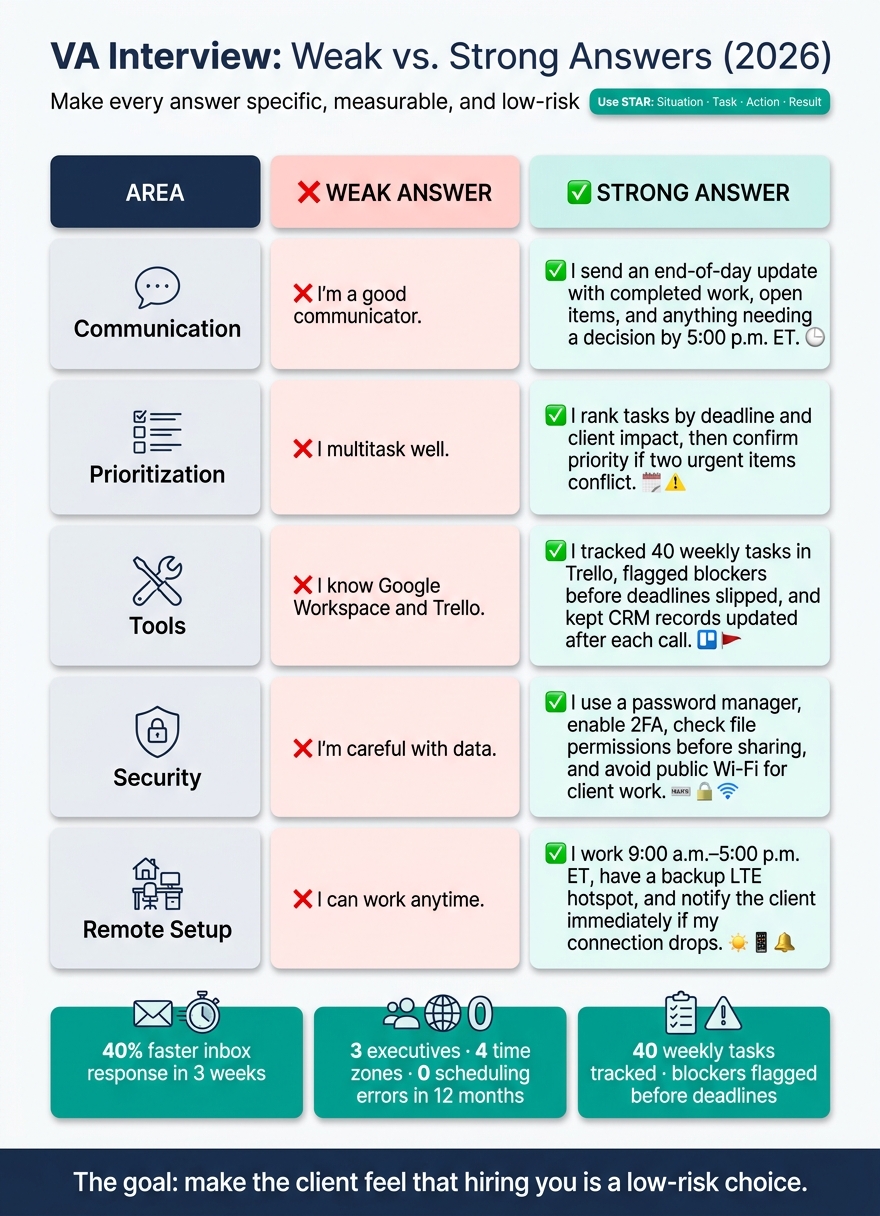
VA Interview: Weak vs. Strong Answers Cheat Sheet (2026)
Virtual Assistant Interview Questions and Answers for 2025
sbb-itb-3690fed
Quick Comparison
| Area | Weak answer | Better answer |
|---|---|---|
| Communication | “I’m a good communicator.” | “I send an end-of-day update with completed work, open items, and anything that needs a decision by 5:00 p.m. ET.” |
| Priorities | “I multitask well.” | “I rank tasks by deadline and client impact, then confirm priority if two urgent items conflict.” |
| Tools | “I know Google Workspace and Trello.” | “I use Google Calendar for time-zone scheduling, Trello for task status, and Google Drive for shared files.” |
| Security | “I’m careful with data.” | “I use a password manager, turn on 2FA, check file access before sharing, and avoid public Wi‑Fi for client work.” |
| Remote setup | “I can work anytime.” | “I work 9:00 a.m.–5:00 p.m. ET, have a backup hotspot, and message the client right away if service drops.” |
If I were preparing for a VA interview today, I’d build every answer around this idea: make the client feel that hiring you is a low-risk choice.
Common VA Interview Questions and How to Answer Them Well
Most VA interviews come down to three things: communication, work management, and whether you can be counted on in a remote setup. If you know what the hiring manager is testing in each area, your answers sound grounded instead of forgettable.
Communication and Client Management Questions
These questions usually cover client communication, hard feedback, mistakes, and progress updates. Interviewers aren't looking for polished lines. They want judgment.
A weak answer like "I just stay calm and try my best" doesn't give them much to work with. A strong answer walks through what you did, step by step, and shows the outcome.
Here's what a strong STAR-based answer looks like for a client frustration scenario:
Situation: A client was frustrated because a deliverable arrived later than expected. Task: I needed to address the concern without damaging the relationship. Action: I acknowledged the delay immediately, explained the cause without making excuses, gave a revised completion time, and sent brief progress updates. I also documented the new deadline in our shared tracker so both sides had visibility. Result: The client appreciated the transparency, and we set up a shared deadline tracker that prevented similar issues going forward.
Interviewers may also ask how you keep clients updated without flooding them with messages. The best answers show a repeatable habit. For example, you might send a short morning update with completed tasks, current priorities, and any blockers, then flag urgent issues right away in Slack and wrap up the day with a quick summary. That shows a system, not just good intent. Clear communication builds trust.
Once that part is covered, the next thing they want to know is whether you can handle competing deadlines without someone checking on you all day.
Time Management, Prioritization, and Productivity Questions
The big question here is usually: "How do you handle multiple deadlines when every task feels urgent?" Interviewers want a method they can picture you using again and again.
A weak answer sounds like this: "I multitask well and just work faster when things pile up." That's a warning sign because there's no process behind it. A stronger answer names the steps and tools: "I review all open tasks at the start of the day, rank them by client impact and urgency, block time on my Google Calendar for focused work, and check in with the client if two priorities genuinely conflict. I use a Trello board to track status so nothing falls through the cracks." That sounds like someone who's done the job, not someone guessing.
The follow-up question, "What do you do when priorities shift suddenly?", matters just as much. Strong candidates confirm the new order with the client, adjust their schedule, and flag any risk to existing deadlines early. That's the point: bring up the risk before it turns into the client's problem. Answers like that show dependability.
After that, interviewers usually shift to the tools and work habits that show you can operate on your own and handle client data with care.
Tools, Security, and Remote Work Readiness Questions
When a hiring manager asks, "What tools have you used in remote work?", they don't just want a list of app names. They want to hear how those tools fit into your day-to-day workflow. Good answers mention the tool and the job it handled: Google Calendar for scheduling across time zones, Trello for task tracking, Google Drive for shared documentation and file tracking, and Slack for fast communication. If you've used a CRM, explain what you kept updated and how that helped the team.
Compare these two answers:
| Skill Area | Weak Answer | Strong Answer |
|---|---|---|
| Tool Proficiency | "I'm proficient in Google Workspace and Trello." | "I use Google Calendar for scheduling across time zones, Trello to track project stages, and Google Drive for shared documentation with file tracking." |
| Confidentiality | "I understand that privacy is important." | "I keep credentials in a password manager, use 2FA whenever available, and never store sensitive files in unsecured personal folders. If I need to share a document, I use permission-based access and verify the recipient before sending." |
| Remote Readiness | "I can work whenever you need me." | "I have a dedicated workspace, a mobile hotspot as a backup connection, and I'm available 9:00 a.m. to 5:00 p.m. ET. If something disrupts my setup, I notify the client immediately." |
Security questions need extra care because confidentiality is a core hiring filter for VAs. If you're asked how you protect client information, a vague answer like "I'm very careful" doesn't help your case. Name the actual habits: a password manager, 2FA, secure file sharing, least-privilege access, and never discussing client work outside the approved workspace. It also helps to say that you avoid public Wi‑Fi for sensitive tasks and keep devices locked when not in use.
Remote readiness questions like "What's your backup plan if your internet goes down?" or "How do you handle time zone differences?" are simple hiring checks. A specific backup, like a mobile hotspot, paired with a clear availability window in U.S. time format, shows you're prepared. It tells the interviewer you can protect information and keep working from home without a lot of hand-holding.
Those answers matter because hiring managers use them to judge whether you can work remotely without daily oversight.
How to Tailor Your Answers for Filipino Remote Talent and FindTalent.ph Hiring
For Filipino VA candidates, the goal is simple: sound like a low-risk hire for U.S. clients. That usually means coming across as clear, dependable, and easy to work with. Once you can explain your tools and remote setup in plain terms, shape those answers around what U.S. clients usually want from a Filipino VA.
What International Clients Expect From Filipino VAs
U.S. clients usually want a VA who communicates well, works without constant hand-holding, and makes their day easier. That’s why small details matter. Use MM/DD/YYYY, a 12-hour clock, send short daily updates, and ask clarifying questions early instead of waiting.
A strong answer might sound like this: "I send a short update at the end of each day with what I completed, what's still in progress, and what needs a decision before tomorrow." That tells a client they won’t have to chase you for updates.
When you talk about availability, be specific. Share how many hours of overlap you can offer, whether you’re okay with night shift work, and how fast you usually reply during the day. A direct answer will always land better than saying, "I can work any hours." The same goes for how you talk about your background, schedule, and communication habits.
How AI-Matched Profiles Shape the Interview Conversation
If the client has already seen your profile, the interview is no longer about broad claims. It’s about backing them up with details. By that stage, the client expects your profile to be accurate. If your profile says one thing and your answer says another, trust can drop fast.
So if your profile lists lead generation, calendar management, or inbox support, don’t stop at naming the task. Walk through a real example. Explain what the workflow looked like, which tools you used, and what came out of it. For example: "I managed a HubSpot pipeline, logged outreach interactions, and flagged stale leads weekly. That helped keep follow-up organized and reduced the number of missed messages." That kind of answer makes the profile claim feel concrete.
How to Show Reliability and Long-Term Value to Clients
Once you’ve shown that you can do the work, the next thing clients want to know is whether you’ll stay steady over time. The best way to answer that is with proof, not vague reassurance.
If it fits your background, mention how long you worked with past clients. A line like "I worked with one client for 14 months, handling their calendar, inbox, and weekly reporting" says a lot more than simply calling yourself reliable. It helps to be clear about how many clients you support right now, what your fixed hours look like, and how you deal with schedule conflicts before they spill into the client’s day.
Clients also tend to like candidates who are comfortable being measured and coached. If you’re open to weekly check-ins, task tracking in a shared board, and regular feedback, say so. That shows you can grow into the role, not just keep things running. A Whitmore Strategy Group operations manager said FindTalent.ph helped them keep costs low while working with a skilled specialist.
How to Build Better Answers and Avoid Common Interview Mistakes
Now turn those interview themes into answers that show process, proof, and reliability.
How to Use STAR to Make Answers Specific and Measurable
STAR - Situation, Task, Action, Result - keeps answers clear and easy to follow. It works especially well for the skills hiring managers want in VA roles: communication, time management, tool use, and remote work habits.
A lot of candidates fall short on the result part. That’s where the proof lives.
For inbox management, a strong answer might sound like: "I inherited a cluttered inbox, created priority labels and canned responses, responded to urgent messages within 2 hours, and reduced average response time by 40% over 3 weeks." For scheduling, it could be: "I managed calendars for 3 executives across 4 time zones with zero scheduling errors over 12 months."
Numbers make your answer more believable because they show scale. If you don’t have exact figures, use simple measures like frequency, volume, or relative improvement instead of leaving out the result.
Use that same structure for CRM work and reporting too. A CRM answer should mention standardized data entry, duplicate checks, and audit-ready records, not just the name of the tool. A reporting answer should spell out what you tracked, how often you sent it, and what decision it helped the client make.
Once your structure is in place, the next problem is easier to spot: answers that sound polished but don’t prove anything.
Weak Answer Patterns That Cost Candidates the Job
The weakest answers often sound smooth on the surface but say very little. If you say "I'm organized" or "I communicate well" without an example, the employer still has no clear picture of how you work.
Confidentiality is another place where candidates often miss the mark. Saying "I'm a trustworthy person" doesn’t show that you understand data security in day-to-day work. A better answer points to habits: using a password manager, working only in client-approved tools, checking file permissions before sharing documents, and keeping sensitive data out of personal folders. In remote and outsourced roles, employers listen for systems, not promises.
Availability can also trip people up. If you say you can work any hour with no limits, it may suggest poor planning or burnout risk. And if you can’t explain what happens when your internet drops or your device stops working, that can sound like a reliability issue. A direct answer - "I have a secondary LTE connection and notify the client immediately if there's a delay" - shows that you’ve planned for disruptions. That makes you look lower-risk to hire.
Quick-Reference Tables: Weak vs. Strong Answers and Remote Tools
Use the tables below to check whether your answers sound specific, credible, and client-ready. The first table shows the difference between weak and strong answers across five common areas. The second shows how to talk about tool experience in a way that points to results.
| Topic | Weak Answer | Strong Answer |
|---|---|---|
| Communication | "I'm a good communicator." | "I flag potential scheduling conflicts 24 hours in advance." |
| Prioritization | "I multitask well." | "I handle time-sensitive client messages first, then tasks blocking others, then routine admin work." |
| Tools | "I know the tools you use." | "I used Trello to track 40 weekly tasks and kept CRM records updated after each call to reduce missed follow-ups." |
| Client Updates | "I keep clients in the loop." | "I send a short end-of-day summary with completed tasks, what's still in progress, and anything that needs a decision before tomorrow." |
| Problem Escalation | "I handle issues on my own." | "I flag risks to the client before they become problems - if two deadlines conflict, I confirm the new priority and note any impact on the other task." |
| Tool | Typical Interview Question | Best Way to Describe Experience |
|---|---|---|
| Google Workspace | "How do you handle calendar conflicts?" | "I resolved a double-booking by checking availability across time zones, rescheduling within the hour, and confirming with all attendees - no meetings were missed." |
| Slack | "How do you stay on top of team messages?" | "I organized channels by project and set status updates so the client always knew when I was available, which cut response delays significantly." |
| Trello / Asana | "How do you manage multiple deadlines?" | "I tracked 40 weekly tasks in Trello, flagged blockers before they affected delivery, and kept due dates visible so the client never had to ask for a status update." |
| HubSpot / Salesforce | "How do you ensure CRM data stays accurate?" | "I standardized entry fields, ran weekly duplicate checks, and flagged stale leads to keep the pipeline clean." |
| Zapier / Make | "How have you improved a workflow?" | "I built a multi-step Zapier flow connecting Typeform to HubSpot that saved 5 hours of data entry weekly." |
What Candidates Need to Do to Get Hired
Use your answers to move from possible fit to a clear hiring choice. In 2026, getting hired comes down to one thing: showing that you're low-risk. That means you're clear, reliable, secure, and likely to stick around.
The best candidates don't just make claims. They back up each one with one measurable result. If you say you're reliable, prove it. Share a concrete metric like your on-time delivery rate, average response time, or attendance record. When your examples show plain results, the client can picture you doing the job well.
Tool fluency, security, and remote reliability often decide who gets the offer. So don't stop at traits. Name the habit, then show the result.
At the end of the interview, connect your skills to the client's needs and offer a paid trial task to prove it. A paid trial shows tool fluency and judgment much faster than a resume.
That's the line between a polite candidate and a hireable one. The people who get hired make it easy to say yes.