Remote Work
Highest-Paying Online Jobs in the Philippines (2026): 15 Roles That Pay in USD
Tech and security roles offer the highest USD pay for Filipino remote workers, while sales and support deliver faster entry.
26 min read

If I wanted the short answer, it’s this: the highest-paying online jobs in the Philippines in 2026 are still in software, AI, cloud, security, product, data, and performance-based client work. Pay often starts around $800 to $1,600 per month for entry-level remote roles, moves into $2,000 to $4,500 per month for mid-level work, and can go past $6,000 to $11,200+ per month for senior tech and security jobs.
Here’s the simple breakdown:
- Top pay: DevOps, cybersecurity, software engineering, and AI
- Strong mid-tier pay: product management, UI/UX, data, content, and customer success
- Lower barrier to entry: VA, e-commerce support, SEO, SDR, bookkeeping, and digital marketing
- Best way to earn more: show proof of results, work with direct clients, and build skills in tools clients already pay for
- Common setup: contractor roles, U.S. time overlap, and payment through Wise or Payoneer
This list covers all 15 roles from the article:
- Software Developer or Engineer
- AI Engineer or Machine Learning Specialist
- DevOps Engineer or Cloud Infrastructure Specialist
- Cybersecurity Specialist or SOC Analyst
- UI/UX Designer
- Product Manager
- Data Analyst or Analytics Specialist
- Digital Marketing Specialist or Media Buyer
- SEO Specialist
- Content Strategist or Conversion Copywriter
- Senior Virtual Assistant or Executive Assistant
- E-commerce Specialist or Amazon/Shopify VA
- Bookkeeper or Accounting Specialist
- Sales Development Representative or Appointment Setter
- Customer Success Manager
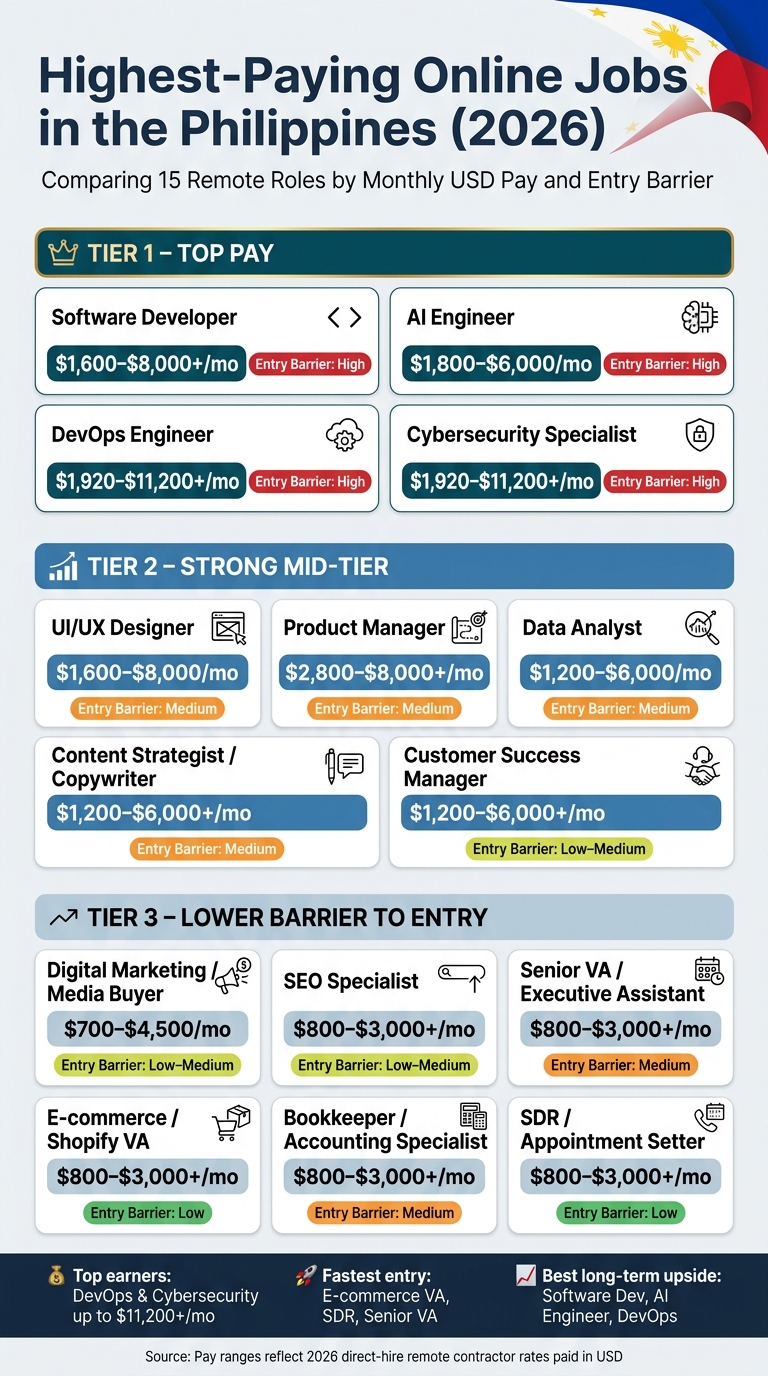
Highest-Paying Online Jobs in the Philippines 2026: Pay, Barrier & Best Fit
10 Highest Paying Remote Jobs in the Philippines
sbb-itb-3690fed
Quick Comparison
| Role | Approx. Monthly Pay | Entry Barrier | Best Fit |
|---|---|---|---|
| Software Developer | $1,600–$8,000+ | High | Coders with shipped projects |
| AI Engineer | $1,800–$6,000 | High | Python and AI system builders |
| DevOps Engineer | $1,920–$11,200+ | High | AWS, Docker, CI/CD users |
| Cybersecurity Specialist | $1,920–$11,200+ | High | Security, SIEM, incident response |
| UI/UX Designer | $1,600–$8,000 | Medium | Designers with product work |
| Product Manager | $2,800–$8,000+ | Medium | PMs with roadmap ownership |
| Data Analyst | $1,200–$6,000 | Medium | SQL, BI, and dashboard work |
| Digital Marketing / Media Buyer | $700–$4,500 | Low–Medium | Paid ads and growth work |
| SEO Specialist | $800–$3,000+ | Low–Medium | On-page, local, or technical SEO |
| Content Strategist / Copywriter | $1,200–$6,000+ | Medium | SEO, conversion, and automation |
| Senior VA / Executive Assistant | $800–$3,000+ | Medium | Admin, client support, systems |
| E-commerce / Shopify VA | $800–$3,000+ | Low | Store support and fulfillment |
| Bookkeeper / Accounting Specialist | $800–$3,000+ | Medium | QuickBooks, Xero, reporting |
| SDR / Appointment Setter | $800–$3,000+ | Low | Outreach, CRM, lead gen |
| Customer Success Manager | $1,200–$6,000+ | Low–Medium | Retention, onboarding, accounts |
My main takeaway: if you want the highest upside, pick tech or security. If you want the fastest path to USD income, pick support, sales, e-commerce, or client-facing roles and move into a specialty from there.
Let me break it down in plain English.
Why These Online Jobs Pay More in 2026
A few plain market forces explain why these online jobs come with higher pay in 2026.
Global demand for skilled remote talent is growing faster than the talent pool. Filipino hires can deliver strong work at 70% to 85% less than Western rates.
At the same time, specialized roles like AI/ML, cybersecurity, and advanced DevOps tend to pay more because they call for hard-to-find skills. These aren’t roles people pick up overnight. Teams pay more when the work has a steeper learning curve and a smaller hiring pool.
There’s also a time-zone edge. Filipino professionals can work U.S. hours or overlap with EST and PST mornings without special scheduling requests. For global teams, that kind of day-to-day reliability matters. It makes handoffs smoother, meetings easier, and response times less of a headache.
Another factor is ease of working together. Strong English fluency, clear documentation habits, and tool fluency help cut down onboarding friction for international clients. Put simply: less back-and-forth, fewer misunderstandings, and less time spent getting someone up to speed.
Pay can also improve when workers deal with clients directly. Direct client contracts can increase take-home pay by cutting out recruiter and agency markups.
These are the main forces behind the roles that come next.
Where Filipinos Find USD-Paying Remote Work
Once you understand why these roles pay more, the next step is simple: figure out where Filipino talent actually gets hired. And yes, where you look matters almost as much as what you can do. Some channels are better for full-time remote jobs. Others work better for freelance gigs or project-based contracts.
Use role-specific keywords like Python, HubSpot, LangChain, and Zapier so your profile shows up in search results. It sounds small, but it can make a big difference. A short voice or video intro also helps, especially if you want to show strong communication skills right away.
For full-time remote roles, some companies hire through Employer of Record services. These services handle local tax compliance and benefits, which can make cross-border hiring much easier.
Local tech and AI communities matter too. They often lead to referrals, and referrals still carry weight, especially for senior roles where clients want someone vouched for, not just someone who applied cold. For direct-hire remote work, FindTalent.ph matches Filipino talent with verified international clients across tech, data, marketing, e-commerce, finance, sales, and support.
Before you apply, set up Wise or Payoneer. Then use these channels as you compare the 15 roles below.
1. Software Developer or Engineer
Software development is still one of the best-paying USD remote jobs for Filipino workers in 2026. The reason is pretty simple: companies pay well for people who can build production-ready apps and talk clearly with teams in English. Those skills are hard to find, and the work ties straight to product growth and sales.
Pay climbs fast as experience builds. Entry-level full stack developers usually earn $1,600–$2,400/month, mid-level developers earn $2,800–$4,500/month, and senior developers who own architecture can reach $5,000–$8,000+/month. Hourly, that comes out to about $10–$15/hr for entry-level roles and $32–$50/hr for senior work. That gap makes sense. Senior engineers don’t just write code - they make calls that shape the product.
Common remote stacks include React or Next.js, Node.js or PHP/Laravel, PostgreSQL or MySQL, and AWS or Docker. For many clients, that stack covers the core of modern web app work.
In 2026, there’s also a clear pay bump for developers who can work on AI features. If you can integrate LLM APIs like OpenAI or Anthropic, build RAG pipelines, or use frameworks such as LangChain, you can often charge a 20%–40% premium over standard web development rates. That extra pay comes from range. A developer who can build the app, wire in AI, and ship it to production saves a client time and hassle.
Most international clients hire Filipino developers as contractors. A common schedule includes a 4- to 5-hour overlap with U.S. morning hours, often around a 12:00 PM–9:00 PM PHT shift for PST-based teams. For longer-term setups, some companies use an Employer of Record service.
Senior developers are usually expected to start contributing solid pull requests within one to two weeks.
Filipino developers find these roles on FindTalent.ph. The portfolios that stand out tend to show shipped applications, not tutorial clones, plus clear proof of AI integrations.
Next is another high-skill role with strong USD pay: AI engineering.
2. AI Engineer or Machine Learning Specialist
AI engineering sits a step above general software work when it comes to both pay and specialization. If a company is building an AI-powered product, it usually needs someone who can build, test, and deploy AI systems with Python - not just set up off-the-shelf tools. That extra layer of technical depth is what separates an AI engineer from a prompt-based automation specialist, and it also helps explain the higher pay. This is the better-paid side of AI work: fewer shortcuts, more responsibility for how the model performs.
Entry-level AI developers earn $1,800–$2,600/month, mid-level engineers earn $2,600–$4,000/month, and senior engineers can reach $4,000–$6,000/month.
The core skill set usually includes:
- Python
- Model evaluation
- Fine-tuning
- Deployment
- Vector databases
Experience with cloud deployment on AWS, Vercel, or Supabase also helps. And yes, precise English matters here more than people sometimes expect. Prompt design and output evaluation depend on clear wording, so small language gaps can lead to messy results. Clients also more often want systems that can switch models without a full rebuild if pricing shifts or a provider changes access.
These jobs usually come through direct-hire contracts. A portfolio with real AI systems or agent workflows - and clear, measurable outcomes - tends to stand out far more than tutorial clones. Filipino AI engineers find these roles on FindTalent.ph.
Next come infrastructure roles that keep AI systems running in production.
3. DevOps Engineer or Cloud Infrastructure Specialist
DevOps and cloud infrastructure work keeps remote software and AI systems up and running. That’s why clients are willing to pay more for it. In many cases, these roles earn 20–40% more than standard web development roles at similar experience levels. And that gap gets bigger when a team needs someone who can keep production stable across cloud, CI/CD, and databases.
Pay also climbs with seniority. Entry-level specialists usually earn $1,920–$3,360/month, mid-level engineers earn $3,360–$6,300/month, and senior engineers with full architecture ownership can reach $6,000–$11,200+/month.
Employers usually expect a hands-on skill set that includes:
- AWS tools like CDK, ECS, ALB, and S3
- Docker
- CI/CD pipeline setup
- Linux server administration
- Database optimization across Postgres, MySQL, and MongoDB
Monitoring, logging, and alerts matter too. It’s not enough to launch systems. You also need to know when something breaks, why it broke, and how to fix it before it turns into a bigger mess.
Getting hired faster often comes down to proof. A GitHub repo with real live deployments and architecture notes carries more weight. Clients want clear proof that you can ship to production on your own. Many teams also expect 4–5 hours of U.S. overlap. Filipino DevOps engineers find these roles on FindTalent.ph.
Next comes cybersecurity, another high-pay role where system knowledge and response speed matter.
4. Cybersecurity Specialist or SOC Analyst
Once the infrastructure is live, protection becomes the next job. That’s why cybersecurity and SOC roles tend to pay well: clients are paying to cut risk. Entry-level specialists usually earn $1,920–$3,360/month, mid-level professionals often land $3,360–$6,300/month, and senior specialists with security architecture ownership can reach $6,000–$11,200+/month. As experience grows, pay usually grows with it.
SOC analysts keep watch on alerts, triage incidents, and escalate threats fast. By the mid-to-senior level, clients usually want hands-on ability in threat detection, vulnerability assessment, SIEM monitoring, incident response, Linux administration, AWS, and Docker . Senior roles often ask for 10+ years of experience plus ownership of security architecture . In healthcare, HIPAA knowledge can help a lot.
The top end of the pay range usually goes to people who can show they’ve handled incident response and owned the security of live systems. That proof matters. It tells clients you can do more than monitor dashboards - you can step in when things go sideways.
Most of these roles are contractor-based and paid through Wise or Payoneer . Clients also often want 4–5 hours of overlap with U.S. business hours . Filipino cybersecurity professionals usually find these roles through FindTalent.ph, direct-hire platforms, and BPO security teams .
Next comes a role where visual thinking and product strategy drive pay: UI/UX design.
5. UI/UX Designer
After infrastructure and security, the next high-paying path is shaping the product experience itself.
UI/UX work usually covers wireframes, prototypes, and light front-end handoff. A lot of international clients also want one mid- to senior-level person who can handle both design and front-end development.
Pay goes up with ownership. As the role grows, clients expect less supervision and more product thinking.
| Experience Level | Monthly Rate (USD) | What Clients Expect |
|---|---|---|
| Entry-Level | $1,600–$2,400 | Supervised UI updates, basic fixes, and small new screens |
| Mid-Level | $2,800–$4,500 | Owning features end-to-end and shipping independently |
| Senior | $5,000–$8,000 | Leading product design, setting UX direction, and mentoring junior staff |
In 2026, clients also want designers who can use AI-assisted design workflows and work with tools like Webflow, WordPress, Wix, Squarespace, and Canva. On top of that, many expect designers to match U.S., U.K., or Australian business hours.
Designers who help shape product decisions often move next into product management.
6. Product Manager
When design calls start turning into roadmap ownership, the job starts to look a lot more like product management. Product Manager roles tend to pay well because PMs own roadmap, scope, and delivery. And the more complex the product, the higher the pay tends to go. AI, SaaS, and mobile products usually pay more, while Technical Product Managers and PMs who own architecture sit at the top end.
| Experience Level | Monthly Rate (USD) | What Clients Expect |
|---|---|---|
| Mid-Level | $2,800–$4,500 | Owning features end-to-end, working with architecture decisions, shipping independently |
| Senior / Lead | $5,000–$8,000+ | Leading product initiatives, technical architecture ownership, mentoring teams |
The core skills are pretty clear: product sense, stakeholder management, and prioritization. Clients want PMs who can catch underspecified tickets before they become a mess, spot scope creep early, and ask sharp clarifying questions. That sounds simple on paper, but in practice, it saves time, money, and a lot of back-and-forth.
Stakeholder management matters just as much. A PM is often the person keeping clients, business owners, vendors, and internal teams aligned. If that coordination breaks down, everything slows down with it.
Data fluency also matters. You should be able to use SQL, Power BI, or Excel to track KPIs and help steer product decisions.
Strong written English is a must for documentation, Jira tickets, and Slack threads. Most roles also ask for 4–5 hours of U.S. morning overlap, which often means working 12:00 PM–9:00 PM PHT.
When you apply, lead with measurable outcomes. Clients respond to ROI. Show hours saved, error rates reduced, or throughput increased instead of just listing tools you’ve used.
If product managers turn ideas into shipped work, data analysts show what actually worked.
7. Data Analyst or Analytics Specialist
If product managers decide what to build, data analysts show what actually worked. They turn raw data into clear next steps by cleaning datasets, building dashboards, and tracking KPIs. A lot of analysts now do more than reporting, too. They also automate workflows and help with AI work like labeling and output review.
Pay tends to move with your toolset. Entry-level analysts who work mostly in Excel usually earn $1,200–$2,000 per month. Mid-level analysts who can use SQL and Power BI often land in the $2,000–$3,500 per month range. Senior analysts - especially those with Python skills, ERP experience like SAP or Dynamics 365, or the ability to build AI-powered data pipelines - can earn $3,500–$6,000 per month in direct-hire roles.
| Experience Level | Monthly Rate (USD) |
|---|---|
| Entry-level | $1,200–$2,000 |
| Mid-level | $2,000–$3,500 |
| Senior-level | $3,500–$6,000 |
Want to move up the pay ladder? SQL, Power BI, and Python matter a lot, especially libraries like pandas or Polars. GA4, Google Tag Manager, and SAP MM/WM can also help you qualify for more specialized roles. And clients usually want proof, not just a skills list. An interactive dashboard with filters and drill-down options says far more than a résumé packed with tool names.
Most roles follow a 12:00 PM–9:00 PM PHT schedule so there’s overlap with U.S. mornings. And direct-hire roles on FindTalent.ph can help analysts keep more of what they earn. It also sets up a smooth move into revenue-focused roles.
8. Digital Marketing Specialist or Media Buyer
After product and analytics roles, the next best-paid path is revenue-focused marketing.
Digital marketing specialists and media buyers build campaigns, watch performance closely, and shift spend fast when results fall short.
Pay is strongest for people who can show clear business results. For dedicated 40-hour remote roles, monthly pay usually looks like this:
| Experience Level | Monthly Rate (USD) |
|---|---|
| Entry-level | $700–$1,200 |
| Mid-level | $1,200–$2,000 |
| Senior/Advanced | $2,000–$3,000 |
| Lead/Principal | $3,000–$4,500 |
Media buyers often earn more because their pay is tied more directly to ROAS, lead quality, and cost per acquisition. In marketing teams, they often sit at the top of the pay range because they control budget and can affect sales more directly.
That’s the key idea here: higher pay goes to marketers who can prove revenue impact, not just run campaigns.
Recent job listings back this up. Senior Meta Ads roles have shown pay at $1,500–$2,500 per month plus profit share, while Google Ads roles have started at $1,700 per month with performance bonuses.
Upper-tier roles usually ask for skills in Meta Ads Manager, Google Ads, TikTok Ads, attribution analysis, A/B testing, budget management, and ad copywriting. Strong copywriting matters because it helps with ad creative and test variations. And when hiring managers compare candidates, case studies usually beat certificates. Showing a 30% drop in cost per lead or a ROAS jump from 1.5x to 3x says a lot more.
In day-to-day work, expect:
- Weekly strategy calls
- Performance reports
- Direct account management
Employers are usually e-commerce brands, DTC companies, B2B SaaS firms, and agencies. Mid-level roles often ask for 3–5 years of hands-on campaign work, plus a portfolio with clear, documented outcomes.
You can find these roles on FindTalent.ph through direct-hire remote listings and staffing opportunities.
That same results-first mindset often leads into SEO, where traffic and rankings shape the next pay tier.
9. SEO Specialist
If paid ads buy traffic, SEO helps bring down customer acquisition costs over time. And pay in SEO usually comes down to scope. Basic on-page tasks sit at the low end, while technical SEO, audits, and lead-gen work bring in more.
For full-time remote roles, monthly rates in 2026 usually look like this:
| Experience Level | Monthly Rate (USD) | Typical Work |
|---|---|---|
| Entry-level | $800–$1,200 | Routine on-page updates, basic data entry, supervised SEO tasks |
| Mid-level | $1,200–$1,800 | Local SEO, Google Business Profile management, content optimization |
| Senior/Technical | $1,800–$3,000+ | Technical audits, Core Web Vitals, schema markup, workflow automation |
The top end usually goes to people who can spot technical problems and connect ranking gains to revenue. That’s where the money is. Technical SEO pays the most because it calls for hands-on work with tools like Google Search Console, Screaming Frog, Ahrefs, SEMrush, and GTM.
At the senior tier, clients also want more than tool knowledge. They expect GA4 reporting, mobile responsiveness, website speed work, and AI integration. That can include using ChatGPT for keyword clustering, metadata drafts, and AI search visibility checks.
Local SEO can also pay well, especially when it helps service businesses book more leads. Filipino specialists who manage Google Business Profiles and build lead-generation sites for home service companies like HVAC, plumbing, and roofing stay in steady demand. These jobs are often contractor-based and may follow U.S. working hours, sometimes from 12:00 p.m. to 9:00 p.m. PHT to overlap with Pacific time.
Case studies help candidates move into senior pay much faster. A clear before-and-after story - rankings, traffic, or leads - often matters more than a long list of tools.
10. Content Strategist or Conversion Copywriter
After SEO, the next high-paying path is content that turns traffic into revenue. Right now, the best-paid roles tend to blend conversion copy, SEO, and automation. Filipino professionals who can tie those skills to clear business results are the ones landing in the higher pay ranges.
Monthly pay for full-time remote roles usually looks like this:
| Experience Level | Monthly Rate (USD) | Typical Work |
|---|---|---|
| Entry-level | $1,200–$2,000 | Content updates, basic SEO support, and admin tasks |
| Mid-level | $2,000–$3,500 | Workflow ownership, CRM management, and AI-assisted content generation |
| Senior | $3,500–$6,000+ | Strategy, complex AI workflows, conversion optimization, and team leadership |
At the senior end, pay comes down to proof. Clients want case studies and documented outcomes, not just a list of tools or job titles. A portfolio that shows what changed after you worked on a page or campaign can push candidates into higher pay brackets faster than credentials alone.
The skills that tend to matter most at that level include:
- Prompt engineering
- Zapier or GoHighLevel automation
- HubSpot content operations
That mix of writing and ops work can also lead to broader client-support roles.
11. Senior Virtual Assistant or Executive Assistant
Senior VAs and Executive Assistants in the Philippines usually earn $12–$18+ per hour or $1,800–$3,000+ per month when they handle operations, coordination, and confidential support. This role tends to pay more when the assistant owns the workflow, not just a checklist of tasks. At that point, the job starts to look less like basic admin support and more like a chief of staff role.
Senior positions often include confidential project handling, coordinating clients, vendors, and internal teams, expense reconciliation, and small-team coordination. In plain terms, the money goes up when the VA can run day-to-day operations, handle client communication, and solve problems without waiting for step-by-step instructions.
| Experience Level | Hourly Rate (USD) | Monthly Rate (Full-Time) |
|---|---|---|
| Entry-level | $5–$8 | $800–$1,200 |
| Mid-level | $8–$12 | $1,200–$1,800 |
| Senior / Specialized | $12–$18+ | $1,800–$3,000+ |
To reach the top end of the market, VAs usually need strong skills with HubSpot, Salesforce, Asana, ClickUp, and AI tools like ChatGPT and Claude. Clients want senior VAs who can spot issues early and manage workflows on their own, not just carry out assigned tasks.
A lot of USD-paying EA roles show up through direct-hire listings on FindTalent.ph. Payments usually arrive through Wise or Payoneer within one to two business days.
From here, the next pay tier often comes from e-commerce operations, where VAs take charge of stores, listings, and fulfillment.
12. E-commerce Specialist or Amazon/Shopify VA

E-commerce specialists keep online stores running day to day. They handle operations, support, and automation for brands that sell online. That matters because when these jobs are done well, sales keep moving, orders get fulfilled, and customers get help without delays.
At the entry level, specialists often start at $5–$8 per hour. Mid-level roles usually land in the $8–$12 range, and senior generalist work can reach $12–$18+ per hour. When the work gets more technical - especially Shopify Liquid development or tricky API troubleshooting - rates can jump to $15–$30 per hour.
The best-paid people in this space usually do two things at once: they run the store and fix the systems behind it. A general e-commerce VA may take care of storefront updates, orders, refunds, and support tickets in tools like Zendesk. A technical specialist goes further. They troubleshoot integrations, automate email flows, and build lead-capture funnels.
| Experience Level | Monthly Pay (Full-time) | Typical Responsibilities |
|---|---|---|
| Entry-level | $800–$1,200 | Order tracking, data entry, basic customer support |
| Mid-level | $1,200–$1,800 | Storefront management, CRM updates, research |
| Senior or Specialized | $1,800–$3,000+ | Technical troubleshooting, funnel building, project coordination |
Store-platform skills alone usually aren’t enough now. Many clients also want people who can use AI tools and automation systems for tasks like content generation, product classification, and workflow automation. In some roles, they also want KPI dashboards built in Power BI or Excel. If you can document the automations you’ve built and show actual storefronts or campaign work in a portfolio, it becomes much easier to prove what you can do.
A lot of USD-paying jobs in this niche show up through direct-hire listings on FindTalent.ph.
Next comes finance work, where accuracy and trust matter just as much as operations.
13. Bookkeeper or Accounting Specialist
Bookkeepers and accounting specialists tend to earn more because the work carries weight. They handle payroll, reconciliations, and compliance-heavy tasks where mistakes can cause real problems. That higher pay usually comes down to three things: accuracy, trust, and deadline pressure. Many Filipino professionals in this space also work as independent contractors for international clients.
Pay usually falls in the mid-to-senior part of the market. Entry-level bookkeepers often earn $5–$8/hr ($800–$1,200/mo). Mid-level specialists usually land in the $8–$12/hr range. Senior positions that involve payroll, tax compliance, or more complex workflows can reach $12–$18+/hr ($1,800–$3,000+/mo).
The main tools here are QuickBooks and Xero. Clients want books that are clean, closeouts done faster, and reports they can actually use. Skills in Power BI or Excel dashboards for cash flow and variance tracking can also help a lot. Strong written and verbal English is the baseline, since these roles deal with sensitive financial records and regular communication with overseas stakeholders.
Most roles follow U.S. business hours, so for workers in the Philippines, that often means overnight shifts. A stable internet connection and backup power are standard job requirements. These finance-focused skills can also open the door to sales roles, where pay is often tied to performance. Direct-hire listings on FindTalent.ph include a dedicated Bookkeeping & Finance category, giving Filipino specialists a way to connect with international clients without agency markups.
14. Sales Development Representative or Appointment Setter
Sales Development Representatives (SDRs) and appointment setters work at the top of the sales funnel. Their job is simple on paper: find leads, qualify them, and book meetings. In practice, the better-paying roles go to SDRs who can book qualified meetings, not just spend the day making calls. That’s why this role is one of the fastest ways to move from support work into U.S. dollar-paid sales. By 2026, many experienced hires are also expected to handle CRM updates and follow-up workflows.
Direct-hire SDRs and appointment setters usually earn $5-$15 per hour, or about $800-$1,200 per month at entry level, $1,200-$1,800 at mid-level, and $1,800-$3,000+ for senior roles. Senior roles often include more than outreach. They can also involve multi-channel outreach, CRM ownership, and team coordination.
This kind of pay tends to climb when results are easy to track. If you can show booked meetings, reply rates, and clean pipeline data, you’re in a much better spot. Employers often look for people who can work inside HubSpot, Salesforce, Pipedrive, or GoHighLevel, manage lead-capture flows, and keep CRM records clean. There’s also more demand now for SDRs who can use AI tools like ChatGPT to draft outreach or set up basic chatbot qualification flows.
A background in the Philippine BPO industry helps here. It usually means you already know how to talk with clients, stay calm under pressure, and work on the schedule that overseas clients expect. That matters because most roles follow U.S. business hours, which often means overnight work in the Philippines.
Many contracts begin with a 30-day trial and weekly targets. It can feel a bit like being thrown into the deep end, but that setup is common in sales. Over time, many SDRs move into customer success roles, where pay is tied more to retention and account growth.
15. Customer Success Manager
If SDRs build pipeline, CSMs protect revenue after the sale. Customer Success Managers sit at the intersection of support, sales, and account strategy. Their job is simple to describe but hard to do well: help clients use the product, get value from it, and stick around. In SaaS, that usually means fewer churned accounts and more expansion revenue.
For Filipino CSMs, pay often starts around $1,200–$2,000 per month at the entry level, moves to $2,000–$3,500 for mid-level roles, and can reach $3,500–$6,000+ for senior positions. Hourly rates usually fall between $7 and $38.
Companies want more than polished communication. They expect solid CRM skills, especially in tools like HubSpot, Salesforce, Pipedrive, or GoHighLevel (GHL). You’ll also need to track KPIs in dashboards, document client workflows, and use AI for follow-ups, account tagging, and call summaries. And here’s the part that often carries more weight than people think: a portfolio with real retention metrics or onboarding workflows you’ve built can matter far more than a long tools list on your resume.
Most of these jobs follow U.S. business hours, so many Filipino CSMs work evening or overnight shifts. FindTalent.ph connects Filipino CSMs straight to international clients, which helps employers avoid recruiter markups and agency margins.
The top-paid CSMs can point to renewals, expansion, and lower churn with actual numbers. That’s the benchmark to use when comparing CSM pay with the roles below.
Quick Comparison of All 15 Roles
Use this table to line up your experience with the right USD-paying role.
| Role | Monthly USD Range (approx.) | Entry Barrier | Ideal Background |
|---|---|---|---|
| Software Developer | $1,600–$8,000+ | High | Production codebase experience |
| AI Engineer | $1,800–$6,000 | High | Python, API integration |
| DevOps Engineer | $1,920–$11,200+ | High | AWS, Docker |
| Cybersecurity Specialist | $1,920–$11,200+ | High | SIEM, incident response |
| UI/UX Designer | $1,600–$8,000 | Medium | Figma, shipped portfolio |
| Product Manager | $2,800–$8,000+ | Medium | Roadmap ownership, stakeholder management |
| Data Analyst | $1,200–$6,000 | Medium | SQL, BI, ERP |
| Digital Marketing / Media Buyer | $700–$4,500 | Low–Medium | Paid ads experience |
| SEO Specialist | $800–$3,000+ | Low–Medium | Technical SEO |
| Content Strategist / Copywriter | $1,200–$6,000+ | Medium | Copywriting, AI-assisted content |
| Senior VA / Executive Assistant | $800–$3,000+ | Medium | Executive support, operations |
| E-commerce / Shopify VA | $800–$3,000+ | Low | Shopify or Amazon admin |
| Bookkeeper / Accounting Specialist | $800–$3,000+ | Medium | QuickBooks, Xero |
| SDR / Appointment Setter | $800–$3,000+ | Low | Sales & Lead Gen, BPO communication |
| Customer Success Manager | $1,200–$6,000+ | Low–Medium | CRM, account management |
This snapshot helps you trim your shortlist before you commit to a path. The next section breaks down how to choose based on your background and income goals.
How to Pick the Right USD-Paying Online Career Path
Use the roles above as your options. This section is here to help you choose the one that lines up with what you can already do well.
Start with your current strengths, not the job title that sounds the most impressive. That usually leads to a better fit and a faster path to paid work.
If you already code, even if you're self-taught in JavaScript or Python, pick the path with the best portfolio fit and the clearest market demand. Technical roles like Software Developer, AI Engineer, and DevOps Engineer tend to offer the best long-term upside. But there's a catch: global clients want production-level work, not tutorial projects.
If your background is in BPO, customer service, or admin work, specialized support roles like Senior VA and Customer Success are often the fastest route to USD income. These roles let you turn soft skills, communication, and process management into remote work that pays in dollars.
For systems-minded non-coders, no-code automation sits in the middle. The closest fits in this article are Senior VA, E-commerce Specialist, Data Analyst, and Content Strategist roles that lean on automation. The smart move here is to go deep on one or two tools instead of trying to learn everything at once.
Use this table to match your strengths to one of the 15 roles in this article.
| Your current strength | Best career path | Key tools to learn |
|---|---|---|
| Coding (JS, PHP, Python) | Software Developer / AI Engineer / DevOps Engineer | React, Next.js, LLM APIs, AWS |
| Process mapping & logic | Senior VA / E-commerce Specialist | Zapier, Make, REST APIs |
| Client communication | Customer Success Manager / SDR / Senior VA | HubSpot, Salesforce, GHL |
| Data & organization | Data Analyst / Analytics Specialist | SQL, Power BI, Python |
Once you've chosen a path, the next step is learning how international clients hire and what they expect.
How to Get Hired by International Clients
After you choose a path, the next step is turning your skills into actual offers. International clients tend to look for three things: proof, clarity, and fast, dependable communication.
Start with a portfolio that shows outcomes, not just tasks. For each project, spell out your role, the tools you used, and the result. Increased organic traffic by 45% in 6 months tells a client something concrete. Worked on SEO projects doesn't. If you're a developer, link to shipped work people can view, not tutorial clones. If you're a designer, Behance or Dribbble works well. If you're in marketing or VA work, a clean Notion page or Google Doc with anonymized case studies is often enough.
LinkedIn is often the first filter. Use a clear headline. In your About section, add 3–5 wins with numbers. Then use the Featured section to link to your portfolio, GitHub, or testimonials. If you're looking for remote work, set your profile to Open to Work.
Once your profile is in good shape, show that you can work well without constant meetings. Use short, structured async updates that cover:
- what you finished
- what's blocked
- what you're doing next
If you've worked across time zones, say so directly. Name the tools you used and explain the workflow in plain terms.
On rates and contracts, give a rate range tied to a defined scope. Before any work starts, agree on the scope of work, payment schedule, IP ownership, and a clear termination clause. Walk away from clients who refuse a written agreement, ask for unpaid trial work, or want financial data they don't need. Set payment terms before you begin.
Conclusion
In 2026, the best USD-paying online roles in the Philippines tend to reward two things: hard-to-find skills and clear business results. Across these 15 roles, the signal is pretty clear. People who can do work that’s in short supply and tie that work to outcomes tend to earn more. If you want a strong mix of pay, entry barriers, and room to grow, software development, AI, DevOps, and cybersecurity stand out with the highest upside.
The main takeaway is simple: proof beats claims. What gets people hired is real work they can show. Pick one path that fits your current strengths, stick with it, and build one project that leads to one measurable result. Then put that work in a clean portfolio. Communication matters too, especially when you’re working across time zones and need to keep things moving without live meetings.
It also helps to apply straight to USD-paying employers so you can protect your rate. A focused profile, clear results, and strong async communication will do more for you than trying to learn everything at once. Pick one path, show results fast, and apply direct.
FAQs
Which online job is best for beginners?
For beginners, general virtual assistant roles are often the best place to start. The work usually includes email management, scheduling, data entry, and basic research.
That makes this kind of role a manageable way to build remote work experience without getting overwhelmed at the start.
Entry-level virtual assistants usually earn $3.00 to $6.00 per hour. As you build experience, learning to use tools like AI can help you earn more.
How can I qualify for higher-paying USD roles faster?
Focus on three things: specialization, tech skills, and proof that your work gets results.
If you want to charge more, move toward high-demand technical work like AI development, integration engineering, or advanced data analytics. Skills with tools like ChatGPT, Zapier, LangChain, and LlamaIndex can strengthen your profile. Relevant certifications help too. They show employers that you’ve put in the work and can use these tools in practice.
Tenure matters less than performance you can point to. Employers want to see what you’ve built and what changed because of it. That means putting together a portfolio with production-grade work, project reports, or GitHub repositories. The goal is simple: show that you can solve problems on your own, deal with messy real-life systems, and make workflows better.
Are these jobs usually freelance or full-time remote?
Usually, yes. These roles are often remote, and the workload can range from part-time to full-time depending on what the business needs.
A lot of people do this work as independent contractors. Others stay on long enough that the role turns into a full-time job. It’s also common to begin on a part-time schedule, like 20 hours per week, and then move into full-time as trust builds and the workload grows.