Business Operations
Filipino Remote Workers vs Other Markets: Full Analysis
Compare global remote talent—Philippines, India, Eastern Europe, LATAM, Africa—by skills, costs, time zones, and best-fit roles.
16 min read

Looking to hire remote talent? Here's a quick breakdown of global options:
- The Philippines: Best for customer support, virtual assistance, and admin roles due to strong English proficiency, alignment with U.S. business practices, and cost savings of 60–85% compared to U.S. hires.
- India: Go-to for technical roles like software development and IT systems, offering a vast talent pool and low costs, though communication in client-facing roles can be a challenge.
- Eastern Europe: Ideal for high-quality software engineering and complex systems work, with costs 40% lower than Western Europe but a 6–8-hour time gap with the U.S.
- Latin America: Perfect for real-time collaboration with U.S. teams, specializing in UI/UX design, product management, and executive support, though costs are higher for admin roles.
- Africa: Emerging as a hub for specialized tech talent, offering English-speaking professionals and up to 70% cost savings, with infrastructure improving in major cities.
Quick Comparison:
| Region | Strengths | Weaknesses | Best Roles |
|---|---|---|---|
| Philippines | Strong English skills, U.S. alignment, low costs | Time gap with U.S., smaller tech pool | Customer support, virtual assistance, admin |
| India | Large tech talent pool, low developer costs | Communication challenges in client-facing roles | Software development, IT systems |
| Eastern Europe | High technical quality, reduced developer costs | Time gap with U.S., less suited for back-office tasks | Software engineering, QA, complex systems |
| Latin America | Time zone overlap with U.S., bilingual workforce | Higher costs for admin roles | UI/UX design, product management, executive support |
| Africa | Growing tech talent, cost savings, English fluency | Infrastructure challenges in rural areas | Software engineering, AI, data science |
This guide helps you match roles to the right talent pool while balancing costs, skills, and communication needs.
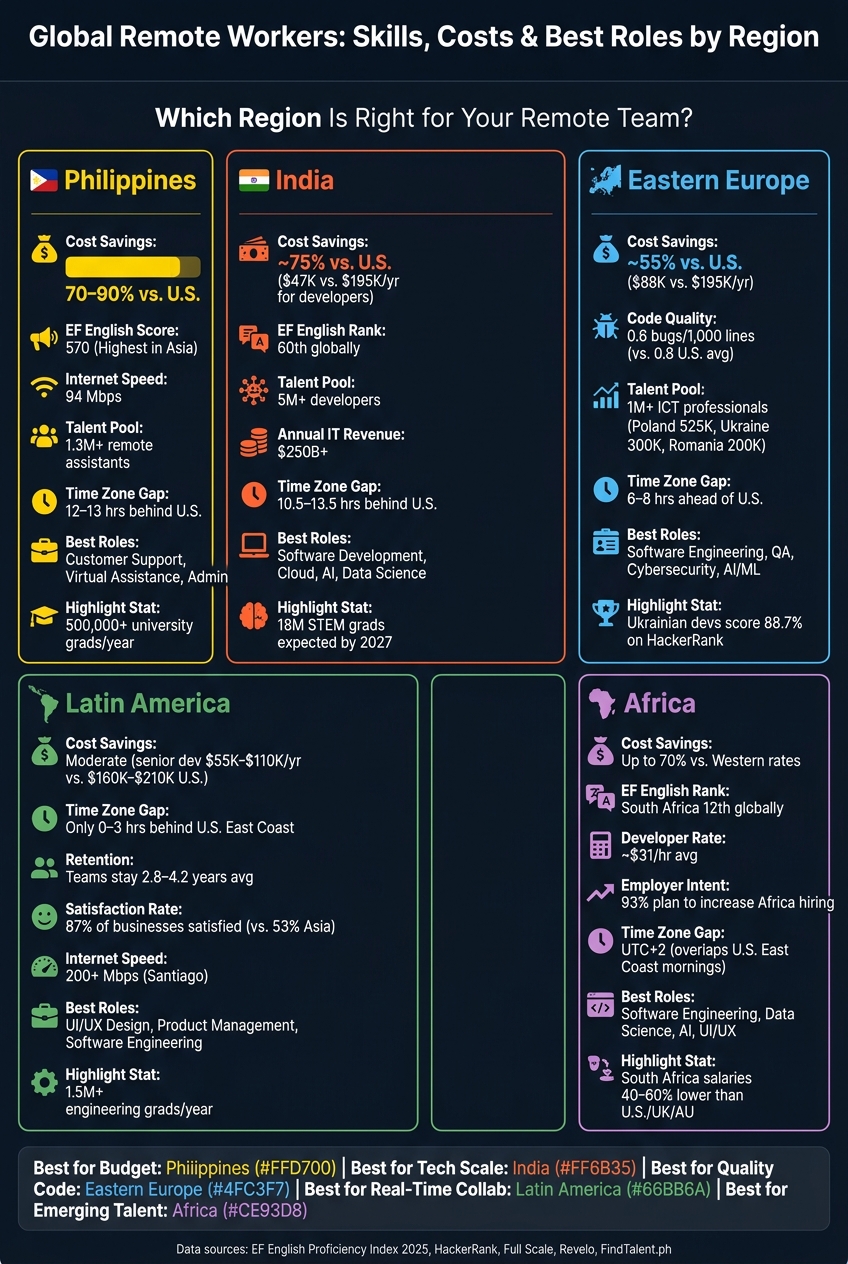
Global Remote Workers Compared: Skills, Costs & Best Roles by Region
What Everyone Gets Wrong About Filipino Remote Workers
sbb-itb-3690fed
1. Filipino Remote Workers
The Philippines boasts a well-established remote work ecosystem. Even before the COVID-19 pandemic, over 52% of Filipino workers were already engaged in remote work. This early start helped shape a solid foundation of effective work habits, tools, and professional norms, long before remote work became a global necessity.
Skills and Role Specialization
Filipino professionals are known for their expertise in various fields, including customer support, general virtual assistance, content creation, administrative tasks, and back-office operations. In fact, the country stands out as the world's leading provider of remote assistants, with over 1.3 million professionals specializing in this area. But the talent pool isn’t static - it’s evolving. By 2025, more than 60% of outsourced roles are expected to focus on specialized fields like AI, data analytics, software development, and telemedicine. Adding to this, the Philippines produces over 500,000 university graduates annually in fields such as IT, engineering, and business.
Work Ethic and Reliability
Filipino workers are often praised for their service-oriented mindset, patience, and loyalty. They excel at following established processes with precision.
"If you want someone who'll challenge your assumptions in a product meeting, you're more likely to find that in LATAM. If you want someone who'll execute a defined process with precision and minimal friction, the Philippines is excellent." - Mark Gotauco, GoldPenguin
However, their deferential communication style may lead to hesitancy in addressing unclear or unrealistic requirements. Managers who actively encourage open feedback and foster a supportive environment typically achieve the best results.
Cost-Effectiveness
Hiring remote workers from the Philippines offers substantial savings, with labor costs often 70–90% lower compared to US-based hires. These savings are driven by differences in living costs rather than disparities in skills or education. Here’s a comparison of typical annual salaries:
| Role | US Annual Salary | Philippines Annual Salary |
|---|---|---|
| Entry-Level Virtual Assistant | $35,000 – $45,000 | $4,500 – $8,500 |
| Executive Assistant | $55,000 – $80,000 | $12,000 – $24,000 |
| Junior Software Developer | $65,000 – $85,000 | $6,000 – $14,000 |
| Senior Software Developer | $130,000 – $180,000 | $28,000 – $50,000 |
Even when accounting for the standard 13th-month bonus, the cost advantages remain substantial.
Cultural Compatibility
English proficiency is a strong advantage for Filipino professionals. The Philippines scored 570 on the EF English Proficiency Index in 2025, the highest in Asia and classified as "High Proficiency". Along with fluency in English, Filipino workers have a strong understanding of American business practices, making communication and collaboration seamless.
Remote Work Infrastructure
The Philippines has made significant progress in its internet infrastructure. By early 2025, average fixed broadband speeds reached 94 Mbps, a 51% improvement since 2022. Major urban centers like Metro Manila and Cebu offer dependable fiber connections, although workers in more rural areas may require backup power and internet solutions. Further improvements are on the horizon, thanks to the government's National Broadband Plan. With a $288 million investment, this initiative aims to bring high-speed internet to underserved areas by 2026, expanding access to a broader talent pool.
This strong foundation provides a useful reference as we move on to explore the capabilities of Indian remote workers.
2. Indian Remote Workers
India's strength in the remote workforce lies in its technical expertise and large-scale engineering capabilities. With over 5 million developers and an IT-BPM industry bringing in more than $250 billion in revenue annually, India has built a strong reputation for outsourcing technical work. By 2027, the country is expected to produce 18 million STEM graduates, further solidifying its position as a global tech hub.
Skills and Role Specialization
Indian remote workers are highly skilled in software development, cloud computing, artificial intelligence (AI), data science, and enterprise IT architecture. The country's educational institutions, such as the IITs and IIMs, focus heavily on technical fields, producing top-tier talent. Beyond tech, India is also a leader in finance, research and development (R&D), and large-scale shared services. For companies looking to scale their engineering teams quickly, India offers unparalleled capacity.
"India has the deepest pool of engineering talent. If the role is code-heavy or system-heavy, India is where you'll find the most options." - Mark, Culture Writer, HireTalent.ph
Work Ethic and Reliability
Indian professionals are often described as ambitious and performance-oriented, particularly in technical roles. However, the country's hierarchical work culture can sometimes discourage employees from questioning unclear instructions. This dynamic can pose challenges, especially in fast-moving environments. As one firm noted:
"Each replacement costs 6–9 months salary in lost productivity plus recruiting overhead. At 40% annual turnover, you're not building a team - you're running a training program for someone else's company." - Full Scale
Cost-Effectiveness
India remains cost-effective for outsourcing, but rising global demand has led to higher rates for its talent. Here's a breakdown of current hourly rates for various roles:
| Role | Hourly Rate |
|---|---|
| Admin / Operations VA | $5–$9/hr |
| Customer Service | $5–$8/hr |
| Mid-Level Software Developer | $15–$35/hr |
| Senior Tech / Dev Roles | $15–$40/hr |
| Enterprise IT Architect | $35–$80/hr |
The real cost concern in India lies in its high turnover rates. The BPO sector experiences annual turnover rates of 30–40%. For a team of 10 developers, this could lead to hidden costs exceeding $280,000 per year due to recruiting fees, onboarding, and lost productivity.
Cultural Compatibility
India ranks 60th globally on the EF English Proficiency Index. While Indian professionals are generally effective in technical communication, regional accents and a formal communication style can sometimes pose challenges in customer-facing roles or US-market interactions. However, these issues are less significant for backend-focused tasks or documentation-heavy projects.
Remote Work Infrastructure
India's major IT hubs, including Bangalore and Hyderabad, boast reliable, enterprise-grade infrastructure that supports large-scale operations. While connectivity in these cities is dependable, the GMT+5:30 time zone creates a 10.5- to 13.5-hour difference from US teams. This requires companies to adopt asynchronous communication and carefully plan workflows. These factors, combined with India's robust infrastructure, make it a key player in the global remote work ecosystem.
3. Eastern European Remote Workers
Eastern Europe has emerged as a hub for specialized tech expertise, following closely behind India's expansive technical talent pool. The region is home to a highly skilled workforce. For instance, Poland boasts over 525,000 ICT professionals, Ukraine adds around 300,000, and Romania contributes approximately 200,000. These professionals are often specialists in their fields, with Ukrainian developers achieving an impressive HackerRank score of 88.7%, ranking them among the world's most technically skilled.
Skills and Role Specialization
Each country in Eastern Europe has carved out its own areas of expertise. Poland stands out for its strengths in enterprise software, cybersecurity, and data engineering. Ukraine excels in artificial intelligence, machine learning, and systems programming. Romania focuses on web and mobile development, while Bulgaria is known for its cloud solutions. This specialization makes the region an attractive choice for businesses tackling complex backend systems or managing sensitive data infrastructures. The technical depth in these areas also shapes the region's work culture and pricing models.
Work Ethic and Reliability
The work culture in Eastern Europe is known for its structured and execution-driven approach. Teams here emphasize clear processes, feedback loops, and ownership of tasks. This makes Eastern European developers particularly well-suited for projects with clearly defined goals and mature workflows. However, they may contribute less in highly open-ended or brainstorming-heavy settings.
Cost-Effectiveness
Eastern Europe offers a compelling balance of quality and cost. Senior developers in Poland typically earn between $40,000 and $65,000 annually, while their counterparts in Romania earn $35,000 to $55,000, and in Ukraine, $25,000 to $50,000. Additionally, developers in the region average just 0.6 bugs per 1,000 lines of code, outperforming their peers in the US and Southeast Asia, who average 0.8.
"Quality matches Western Europe at 40% lower cost." - Elton Chan, Co-Founder, Second Talent
| Country | Key Specializations | Avg. Hourly Rate | Talent Pool Size |
|---|---|---|---|
| Poland | Enterprise Software, Cybersecurity, Data Engineering | $35–$60/hr | 525,000+ |
| Ukraine | AI, Machine Learning, Systems Programming | $25–$50/hr | 300,000 |
| Romania | Web & Mobile Development, E-commerce | $30–$50/hr | 200,000 |
| Bulgaria | Cloud Solutions, E-commerce | $25–$45/hr | 108,000 |
Cultural Compatibility and Remote Work Infrastructure
Eastern Europe also benefits from strong cultural alignment with Western business practices. Romania, for example, ranks 15th globally on the EF English Proficiency Index, and English fluency is generally high across the tech sector in the region. Communication styles align well with Western norms, making collaboration smoother. However, the 7-hour time difference with the US East Coast can pose challenges for real-time interaction, making asynchronous workflows an effective solution. Additionally, EU membership in countries like Poland and Romania brings legal advantages, such as GDPR compliance and streamlined labor regulations, which are particularly valuable for handling sensitive data.
4. Latin American Remote Workers
Latin America has become a top choice for U.S. companies looking to hire remote technical talent. Why? The region combines competitive rates with the ability to collaborate in real time. Each year, Latin America produces over 1.5 million engineering graduates, with Brazil alone accounting for more than 500,000 active software developers. This growing talent pool is packed with professionals equipped with specialized skills that meet today’s technical demands.
Skills and Role Specialization
Professionals in LATAM shine in areas like software engineering (React, Node.js, Python, Go), UI/UX design, product management, and digital marketing. These skill sets make the region an ideal fit for roles that require a mix of creativity and technical expertise. LATAM workers thrive in dynamic, challenging environments while also excelling in structured, well-defined roles. This technical strength is paired with a proactive and entrepreneurial mindset, which adds even more value to their contributions.
Work Ethic and Reliability
LATAM workers are often praised for being entrepreneurial, direct, and proactive. They’re not afraid to question decisions or suggest improvements, which aligns well with U.S. workplace dynamics. Retention is another strong point - nearshore LATAM teams tend to stay with companies for an average of 2.8 to 4.2 years. In fact, a 2024 report found that 87% of businesses were satisfied with outsourcing to LATAM, compared to 53% for Asia.
Cost-Effectiveness
LATAM may not offer the lowest rates, but it delivers excellent value. For example, while Filipino workers often cost 30% to 50% less, the gap narrows for technical roles. A senior developer in LATAM typically earns between $55,000 and $110,000 per year, compared to $28,000 to $50,000 in the Philippines and $160,000 to $210,000 in the U.S.. Beyond salary, the ability to collaborate in real time reduces management overhead and minimizes delays caused by asynchronous communication.
"The 'cheaper' option doesn't always stay cheaper. Factor in meeting scheduling friction, async delays, and management overhead." - Mark Gotauco, SaaS Tools and Apps Expert
Cultural Compatibility and Remote Work Infrastructure
LATAM’s time zone alignment with the U.S. is a major advantage. Cities like Mexico City, Bogotá, and Buenos Aires are only 0–3 hours behind U.S. Eastern Time, making real-time collaboration seamless. Tamyris Cuppari Kohler of Revelo highlights this benefit:
"Timezone overlap is a competitive advantage, not a preference; nearshore engineers in Latin America share working hours with U.S. teams, which directly shortens code review cycles."
English proficiency varies across the region. Argentina scores 562 (High) on the 2025 EF English Proficiency Index, while Mexico scores 459 (Low). Additionally, urban hubs like Santiago in Chile boast reliable infrastructure, with average internet speeds exceeding 200 Mbps. To simplify compliance with local labor laws and IP protection, both LATAM and the Philippines benefit from Employer of Record (EOR) services.
5. African Remote Workers
Africa is becoming a major player in the global remote work scene. Countries like Nigeria, Kenya, and South Africa are leading the charge, especially in areas such as software engineering, data science, AI, UI/UX design, and product management. South Africa also shines in professional services like bookkeeping, marketing, and executive support. Interestingly, surveys reveal that 93% of employers plan to increase hiring in Africa, with 59% choosing to prioritize skill access over cost savings. This trend highlights the region's growing expertise and its shift toward highly specialized roles.
Skills and Role Specialization
African remote workers are carving out a niche in specialized, knowledge-driven roles rather than focusing on high-volume service work. As Modern Day Talent aptly puts it:
"For scale and volume, the Philippines is unmatched. For specialised, knowledge-based roles, South Africa offers deeper expertise."
This focus on specialization is supported by Africa's bilingual workforce. English is widely spoken in Nigeria, Kenya, and South Africa, while French dominates in North and West Africa, making the region more accessible to a global market.
Cost-Effectiveness
In addition to their expertise, African professionals offer substantial cost advantages. Hiring remote workers from Africa can save employers up to 70% compared to Western rates. Here's a general breakdown of monthly salaries:
- Junior roles (0–3 years): $500–$1,000
- Intermediate roles (3–6 years): $1,000–$2,000
- Senior roles (7–15 years): $3,000–$7,000
South African salaries, in particular, are 40–60% lower than those for similar roles in the U.S., UK, or Australia. Developers in Africa typically charge around $31 per hour, making them an attractive choice for businesses worldwide.
Cultural Compatibility and Remote Work Infrastructure
African professionals stand out for their combination of affordability and excellent communication skills. South African workers, for instance, align well with corporate norms in the U.S. and UK, reducing cultural barriers and the need for intensive management. With a 95% literacy rate and a 12th-place ranking on the EF English Proficiency Index, South Africa ensures smooth communication from the start.
When it comes to infrastructure, South Africa’s main cities - Cape Town, Johannesburg, and Durban - are equipped with reliable telecom networks. While power outages were once a concern, most professionals now have backup power systems, making load shedding a rare issue. Additionally, the region's time zone (UTC+2) overlaps conveniently with U.S. East Coast hours, allowing for seamless real-time collaboration.
Pros and Cons by Region
Here's a breakdown of the strengths, weaknesses, and ideal roles for different regions.
| Region | Strengths | Weaknesses | Best Roles |
|---|---|---|---|
| Philippines | Strong English skills in Asia, excellent U.S. cultural alignment, cost-effective, mature remote work setup | 12–13-hour time gap with the U.S.; smaller pool of high-end engineering talent compared to India | Customer support, operations virtual assistance, admin, content |
| India | Vast technical talent pool; much lower developer costs (~$47,000/year vs. $195,000 in the U.S.) | Variability in communication for client-facing roles; rising costs for senior tech positions | Backend development, data analysis, IT systems |
| Latin America | Real-time overlap with U.S. time zones, bilingual workforce (Spanish/English), strong U.S. cultural fit | Costs for admin and VA roles are 30–50% higher than in the Philippines | UI/UX design, product management, executive support |
| Eastern Europe | High standards in technical education; senior developer costs ~$88,000/year vs. $195,000 in the U.S. | 6–8-hour time gap with the U.S.; less suited for large-scale back-office tasks | Software engineering, QA, complex systems |
| Africa | Rapidly growing specialized tech talent; up to 70% cost savings compared to Western rates; strong English in Nigeria, Kenya, and South Africa | Infrastructure challenges outside major cities; risks tied to emerging markets | Software engineering, data science, AI, UI/UX |
The Philippines leads for roles requiring excellent English fluency, strong process reliability, and affordability. Elton Chan, Co-Founder of Second Talent, highlights this:
"Filipino developers typically communicate fluently in both written and spoken English... This extends beyond basic communication to include understanding Western business culture, idioms, and working styles."
India dominates in technical talent and offers the lowest developer costs, though communication in client-facing roles can sometimes be a hurdle. Latin America shines for its real-time collaboration with U.S. teams, despite higher costs for administrative roles. Eastern Europe combines near-Western technical quality with significantly reduced costs, while Africa is emerging as a strong contender in specialized fields like software engineering and AI.
To maximize efficiency, consider blending teams across regions - for example, pairing Filipino support staff with Latin American product managers or Eastern European developers. These regional insights provide a clear foundation for making informed staffing decisions.
Conclusion
When comparing global remote workforces, it's clear that each region offers unique advantages tailored to different business needs. Filipino remote workers stand out for their strong English proficiency (EF score of 570), alignment with U.S. communication styles, and cost savings of 60%–85% compared to U.S. hires. These qualities make them an excellent choice for roles like customer support, virtual assistance, and back-office operations, where both quality and affordability are key.
Other regions also shine in specific areas. India is the leading choice for handling large-scale, complex engineering projects. Latin America excels in real-time collaboration due to its time zone proximity, while Eastern Europe combines near-Western technical expertise with significantly lower developer costs. The most effective remote hiring strategies leverage these regional strengths to align roles with the best-suited talent pool.
Mark Gotauco summed it up perfectly:
"The Philippines is the strongest option for English-heavy, customer-facing, and admin roles. This isn't just a cost decision - it's a quality one."
To put this analysis into action, consider assigning process-driven and client-facing roles to professionals in the Philippines. For intricate technical projects, India and Eastern Europe remain top contenders. Hiring directly rather than through agencies ensures better rates and clearer communication. Additionally, verify internet speeds and backup power setups for candidates outside major urban centers to ensure reliability.
Simplify your remote hiring process with FindTalent.ph and connect with the talent that perfectly fits your operational needs.
FAQs
How do I choose the best region for each role?
Selecting the right region for outsourcing depends on factors like language skills, time zone alignment, industry expertise, and budget constraints. Here's a quick breakdown:
- The Philippines: A top choice for roles requiring strong English proficiency, such as customer service and administrative tasks. The workforce here is well-versed in Western culture, which enhances communication and customer interactions.
- India and Vietnam: These regions are leaders in technical fields, offering a vast pool of skilled professionals for IT, software development, and engineering roles.
- Latin America: Perfect for real-time collaboration with U.S.-based teams due to overlapping time zones. This region is ideal for roles where immediate communication is crucial.
By aligning your role's specific needs with a region's strengths, you can improve talent quality, streamline communication, and manage costs effectively.
What hidden costs should I budget for beyond hourly rates?
When evaluating remote staffing costs, it's important to look beyond hourly rates. Hidden expenses can quickly add up, including the time spent on management, training, and overcoming communication delays. Time zone differences may also require extra effort to coordinate effectively.
Other potential costs include providing essential tools like hardware, software, and secure internet access. On top of that, you may need to handle legal compliance, taxes, and even employee benefits. High turnover rates can add another layer of expense, as recruitment and training efforts are rarely cheap.
While hourly rates might appear low at first glance, these additional factors can significantly raise the overall cost of working with a remote team.
How can I manage time zone gaps without slowing work down?
To manage time zone differences smoothly, focus on smart scheduling and asynchronous communication. Plan overlapping working hours, such as a daily standup during a shared 2-4 hour window when both teams are online. Leverage tools like Slack or Jira for project updates and tracking tasks asynchronously. Recording meetings and sharing detailed written updates can also help keep the workflow on track, ensuring progress even across different time zones.