Business Operations
10 Benefits of Outsourcing to the Philippines
Outsourcing to the Philippines cuts labor costs while providing skilled, English‑proficient teams, 24/7 coverage, and easy scaling.
16 min read

The Philippines is a leading outsourcing hub, offering U.S. businesses cost savings, skilled professionals, and seamless operations. Here's why companies choose the Philippines:
- Cost Savings: Labor costs are up to 70% lower than in the U.S. For example, a managed customer support agent costs $1,200–$1,800 per month versus $38,000–$52,000 annually in the U.S.
- Skilled Workforce: Over 1.5 million professionals work in outsourcing industries, excelling in IT, finance, healthcare, and more.
- English Proficiency: With 92% English speakers, communication is smooth, supported by familiarity with U.S. culture.
- 24/7 Operations: The time zone difference enables round-the-clock service for global businesses.
- Scalability: Quickly expand or reduce teams without the complexities of domestic hiring.
- Focus on Core Tasks: Outsource routine operations to prioritize business growth.
- High-Quality Customer Support: Filipino professionals deliver empathetic, professional service across multiple channels.
- Simplified Legal and Administrative Processes: BPO providers handle compliance, payroll, and labor laws.
- Remote Work Readiness: Strong infrastructure supports reliable remote operations.
- Government Support: Incentives, tax benefits, and robust data privacy laws create a business-friendly environment.
Outsourcing to the Philippines reduces costs, improves efficiency, and connects businesses with highly skilled professionals. Platforms like FindTalent.ph simplify the process, offering pre-vetted candidates for various roles.
The Benefits of Outsourcing to the Philippines [7 Reasons Why Outsourcing to the Philippines]
sbb-itb-3690fed
1. Cost Savings and Budget Flexibility
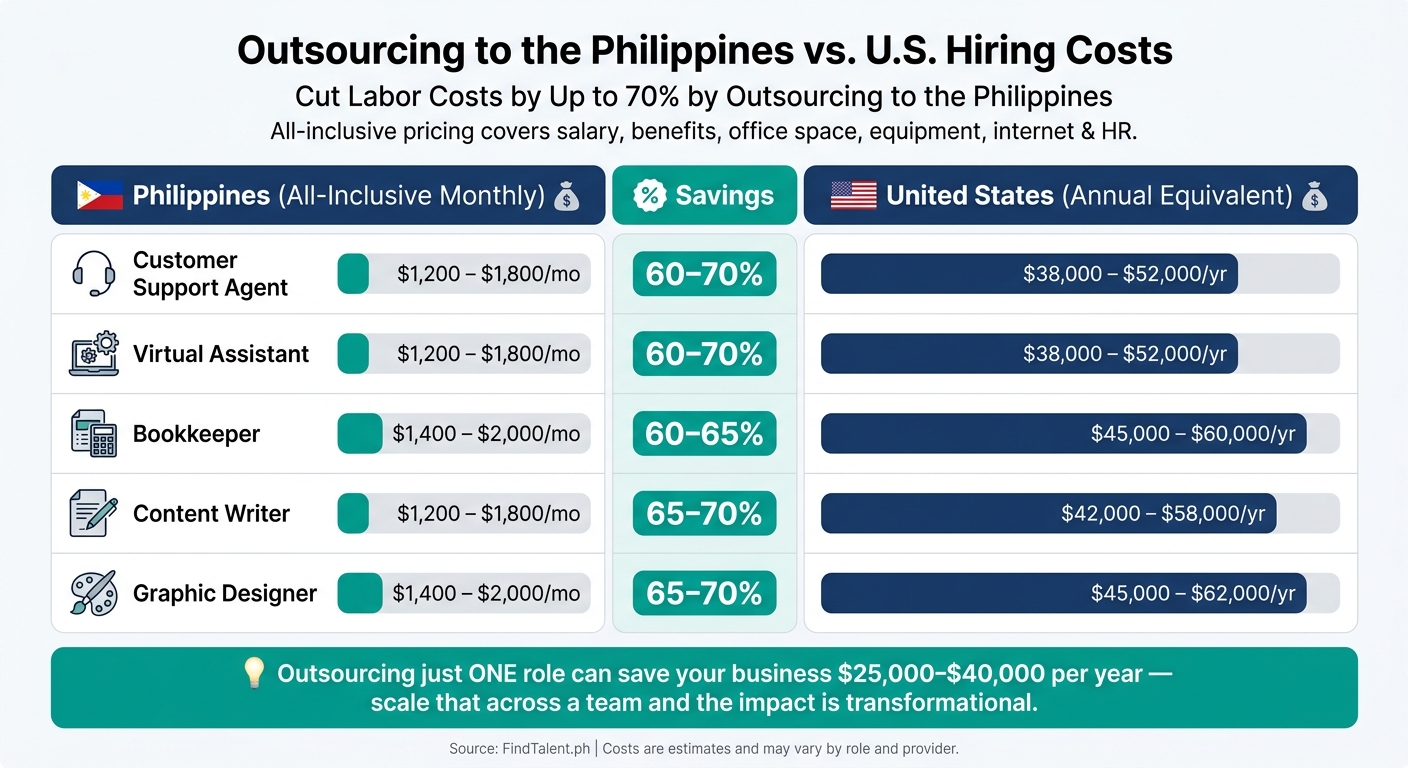
Outsourcing to the Philippines: Cost Savings by Role vs. U.S. Hiring
Hiring a customer support agent in the Philippines costs about $1,200–$1,800 per month on a managed basis. Compare that to the $38,000–$52,000 per year you’d typically pay for the same role in the U.S. - that’s a 60%–70% reduction in costs per position. And when you scale this across multiple roles, the savings grow even more substantial. What’s included in that cost? Everything: salary, benefits, office space, equipment, internet, and HR services. Plus, you won’t need to worry about onboarding expenses or capital investments - it’s all bundled into one straightforward monthly fee.
Here’s a breakdown of the estimated annual savings for some common roles:
| Role | Philippines Monthly Cost (All-Inclusive) | Estimated Annual Savings vs. U.S. |
|---|---|---|
| Customer Support Agent | $1,200 – $1,800 | 60% – 70% |
| Virtual Assistant | Virtual Assistant | $1,200 – $1,800 |
| Bookkeeper | $1,400 – $2,000 | 60% – 65% |
| Content Writer | $1,200 – $1,800 | 65% – 70% |
| Graphic Designer | $1,400 – $2,000 | 65% – 70% |
But the benefits don’t stop at wages. Outsourcing also brings budget flexibility that’s hard to achieve with domestic full-time employees. Need to expand your team for a seasonal rush? You can do so without committing to long-term contracts or dealing with the complexities of layoffs when the project ends. This adaptability allows you to allocate resources more effectively, focusing your spending on core business priorities. Outsourcing to the Philippines isn’t just about cutting costs - it’s a smart way to enhance your operational strategy.
2. Access to a Large Pool of Skilled Professionals
The Philippines isn't just about cost savings; it’s also home to a thriving talent pool that adds real value to businesses. Currently, around 1.5 to 1.8 million professionals are engaged in BPO and remote services, with this number steadily increasing year after year. This growing workforce spans a wide variety of roles, as shown in the table below.
The country’s strong education system plays a key role in building this talent pool. Over 28% of the population, which exceeds 116 million, has attended college. Each year, Filipino universities produce hundreds of thousands of graduates who meet global industry standards. Additionally, more than 4,075 technical-vocational institutions provide training tailored to the needs of global industries. This ensures businesses don’t just fill vacancies - they gain skilled professionals who are job-ready.
Filipino professionals now excel in a variety of fields beyond traditional call center roles, including:
| Service Category | Common Roles Available |
|---|---|
| IT & Development | Software Developers, QA Testers, Cloud Support, Automation Testers |
| Finance & Accounting | Bookkeepers, FP&A Analysts, Payroll Specialists, Loan Processors |
| Healthcare BPO | Medical VAs, Billing & Claims Specialists, Telehealth Support |
| Creative & Marketing | Content Writers, Video Producers, Digital Marketers |
| Legal Services | Legal Researchers, Contract Reviewers, Intake Specialists |
| Specialized AI | AI Prompt Engineers, Data Annotators, AI Ethics Consultants |
The outsourcing industry in the Philippines is evolving, with a noticeable shift toward high-value, knowledge-intensive roles such as data analytics, financial analysis, and legal research. In fact, the Philippines has been ranked No. 1 in the 2026 Global Outsourcing Talent Index by Ataraxis, a testament to years of focused investment in workforce development. This, combined with cost efficiency, allows businesses to achieve exceptional operational results.
Through platforms like FindTalent.ph, businesses can connect with pre-screened, qualified professionals. Whether you’re looking for a bookkeeper, a healthcare billing expert, or an AI prompt engineer, verified candidates are ready to contribute immediately.
3. Strong English Skills and Cultural Fit
When it comes to outsourcing, communication can often be the deciding factor between success and failure. And this is where the Philippines stands out. With an impressive 92% of Filipinos speaking English proficiently and a total of around 75 million English speakers, the country is ranked as the world's third-largest English-speaking nation. Even more impressive, the Philippines holds the 14th spot globally on the EF English Proficiency Index, surpassing many other outsourcing hubs.
For U.S. businesses, this isn’t just about numbers. Filipino English feels natural and relatable, with professionals understanding American idioms and business jargon effortlessly. This ensures smooth, effective communication across various roles. Additionally, their neutral accents make them highly suited for customer-facing positions.
Industry leaders have highlighted this advantage:
"A [Filipino] call center agent can make small talk with a U.S. customer about the latest fashion trend in the U.S. or a graphic artist can create a perfect color combination that is pleasing to the eyes of an American." - Paulo Cheung, EVP and Site Head – Manila, Personiv
But it’s not just language skills that set the Philippines apart. The country’s strong cultural alignment with the U.S. makes collaboration even easier. Thanks to historical ties, the Philippine education, legal, and business systems are closely modeled after American frameworks. This familiarity with Western workplace norms and communication styles helps streamline onboarding and reduces potential misunderstandings. In fact, Gartner has awarded the Philippines a 5-star rating for cultural compatibility with the United States.
Adding to this, Filipino values like malasakit (compassion) and pakikisama (harmony) foster loyalty and teamwork. Through FindTalent.ph, you can connect with professionals who are not only fluent in English but also equipped to meet your communication and collaboration needs seamlessly.
4. Time Zone Coverage and Extended Availability
In addition to cost savings and access to skilled professionals, time zone alignment is another advantage that boosts efficiency.
The Philippines operates on UTC+8 year-round, and it doesn’t observe Daylight Saving Time. This consistency simplifies scheduling for U.S.-based businesses. For teams on the East Coast, the Philippines' 13-hour time difference creates a seamless workflow. Tasks like account reconciliation, resolving support tickets, and processing data can all be completed overnight, ready for review when your team starts their day. This approach is often referred to as the "follow-the-sun" model.
The Philippine BPO industry is built to accommodate these time zone differences. Rotating shifts, graveyard schedules, and holiday work are part of the norm, ensuring 24/7 service coverage without any special arrangements.
"BPO companies in the Philippines can offer 24/7 service coverage for your operational needs. So whether you're in the US or the UK, the time zone difference won't matter since rotating shifts and holiday work are common standards in the industry." - TeleworkPH
This constant availability is particularly valuable for customer-facing operations. U.S. companies can provide voice, chat, and email support during overnight hours without the hefty costs associated with staffing those shifts domestically. Creating a 24/7 operation in the U.S. is significantly more expensive, but outsourcing to the Philippines can reduce labor costs by 60–70%. This ability to maintain uninterrupted service highlights the strategic advantage of partnering with Philippine BPOs.
5. Easy Scaling and Workforce Flexibility
Outsourcing to the Philippines doesn’t just offer extended availability; it also brings unmatched flexibility when it comes to scaling your workforce. Whether you need to expand quickly or downsize during slower periods, this approach eliminates the usual hiring headaches and allows for swift team adjustments based on your business needs.
In the U.S., hiring can be a lengthy process, often stretching over weeks or even months. It involves job postings, multiple interviews, onboarding, and setting up benefits. In contrast, outsourcing providers in the Philippines maintain ready-to-go talent pools, enabling roles to be filled in as little as 10 days. This means you can transition from hiring a single virtual assistant to assembling an entire support team without starting from scratch.
The flexibility works both ways. During quieter periods, you can scale back without dealing with the complications of domestic layoffs. Employer of Record (EOR) and staff-leasing models take care of local compliance, payroll, and mandatory benefits like the 13th-month pay, removing significant barriers to managing an offshore team.
Another advantage? Many Filipino BPO teams are cross-trained to handle multiple functions. For example, if customer support demands drop but data processing tasks increase, resources can be reallocated within hours rather than weeks. As Ralf Ellspermann, CSO of Cynergy BPO, explains:
"The hardest problem in service delivery is not the median day; it is the unpredictable day. ... A mature Philippine delivery environment addresses this problem on three fronts: workforce agility, process elasticity, and governance clarity."
This adaptability gives businesses a strategic edge, ensuring their offshore teams can pivot quickly to meet changing demands.
A smart way to approach this is by starting with a pilot project. Hire a small team for a specific task, set clear KPIs, and use the experience to gauge the provider’s ability to scale effectively before committing to a long-term contract. Platforms like FindTalent.ph make this process even easier - begin with a single pre-vetted hire and expand as your needs grow, all without overcommitting.
6. More Focus on Core Business Activities
Outsourcing isn't just about saving money or scaling operations - it’s also a way to ensure your team can focus on what truly matters: growing your business.
When your in-house employees are tied up with routine tasks like data entry, payroll, or IT troubleshooting, they have less time to dedicate to the strategic decisions that fuel growth. By outsourcing these non-core functions to skilled professionals in the Philippines, you free up your team to zero in on initiatives that move the needle.
"By outsourcing tasks like accounting, IT support, or customer service, your team can concentrate on strategic activities that drive growth."
This redistribution of work allows your leadership team to prioritize key business goals without being bogged down by day-to-day operations.
Another advantage? The Philippines' time zone difference. While your U.S.-based team is off the clock, your outsourced team can handle essential tasks like account reconciliation, invoice processing, or customer support. By the time your team starts their day, they’ll have updated data and completed tasks ready to support timely, informed decisions.
Take a close look at your workflows to pinpoint tasks that consume too much time from your highest-paid employees. This often includes areas like bookkeeping, HR administration, medical billing, legal research, and technical troubleshooting. Platforms like FindTalent.ph can connect you with pre-vetted professionals in these fields, making it easier to delegate these functions without the hassle of long hiring processes.
7. Better Customer Support and Service Quality
Strong customer support lays the groundwork for lasting relationships, and the Philippines has proven to be a powerhouse in delivering exceptional service. This success in customer engagement has become a hallmark of the country’s BPO industry.
In 2024, the Philippine BPO sector generated $38 billion in revenue and employed 1.82 million professionals. Decades of refining their approach to customer service have enabled Filipino teams to consistently deliver outstanding results for U.S. and global brands.
What truly sets Filipino support teams apart isn't just their English proficiency; it’s their approach to communication. Deeply rooted in cultural values like Pakikiramdam (a sensitivity to others' needs) and a service-oriented mindset, Filipino professionals bring a unique blend of empathy and professionalism. As Avatara Garcia from Liveops puts it:
"Filipino professionals typically bring... a service mindset rooted in politeness, patience, and a genuine desire to help."
This emphasis on empathy and tone becomes especially critical in high-stakes interactions, such as resolving insurance claims, addressing billing issues, or handling healthcare-related inquiries. In these moments, accuracy matters, but so does the ability to connect with customers on a human level.
Filipino teams excel across multiple communication channels, including live chat, email, social media, and even technical support and troubleshooting. By combining human expertise with AI tools for real-time quality monitoring, they consistently achieve demanding SLA and CSAT targets. All of this is delivered with cost efficiency, making outsourcing to the Philippines a smart choice for businesses worldwide.
For companies needing to quickly fill customer-facing roles, platforms like FindTalent.ph provide pre-vetted customer support professionals who are ready to represent your brand from day one. This ensures your team is equipped to deliver the high standards your customers expect while supporting broader operational goals.
8. Lower Legal and Administrative Overhead
Outsourcing doesn’t just offer operational flexibility - it also cuts down on the legal and administrative headaches of managing an international workforce. Hiring employees directly in another country comes with its fair share of challenges, like setting up a local entity, handling payroll taxes, navigating complex labor laws, and ensuring compliance with government regulations. Outsourcing to the Philippines takes these burdens off your plate.
A trusted Philippine BPO acts as the Employer of Record (EOR), managing all legal employment responsibilities on your behalf. They handle payroll processing, tax withholding, and remittance of mandatory government contributions such as SSS, PhilHealth, and Pag-IBIG. They also ensure compliance with the Philippine Labor Code, covering everything from employee benefits to leave policies and termination protocols. Additionally, they apply the same rigor to safeguarding sensitive business data.
This setup helps U.S. businesses steer clear of co-employment risks. By partnering with a provider that complies with DOLE Department Order No. 174, your company avoids being classified as a direct employer under Philippine law. This reduces exposure to potential labor disputes and liabilities tied to labor-only contracting. As legal experts at Tan Hassani and Counsels explain:
"The vendor should warrant that it is compliant with the Labor Code of the Philippines... This gives you protection and recourse."
BPO providers also bolster data privacy measures. They adhere to the Philippine Data Privacy Act of 2012 (RA 10173) by implementing strong security protocols and appointing Data Protection Officers (DPOs) to oversee sensitive information. For U.S. businesses handling customer data, this is crucial - violations of the Philippine DPA can result in fines of up to PHP 5 million or 3% of annual gross income.
To streamline governance and reduce administrative overhead, responsibilities between your business and the BPO provider are clearly defined. Here's a breakdown:
| Responsibility | U.S. Business | Philippine BPO |
|---|---|---|
| Recruitment & Onboarding | No | Yes |
| Payroll & Tax Withholding | No | Yes |
| Statutory Benefits (SSS, PhilHealth, Pag-IBIG) | No | Yes |
| Local Labor Law Compliance | No | Yes |
| Workplace Infrastructure & IT | No | Yes |
| Core Business Strategy | Yes | No |
| Performance Standards (SLAs) | Yes | Jointly |
Before finalizing any agreement, it’s wise to request documentation like DOLE registration, tax clearances, and proof of statutory remittances. Including a compliance warranty in your Master Services Agreement (MSA) can also provide added protection and recourse in case of issues. Platforms such as FindTalent.ph can connect you with pre-vetted professionals through providers that already have these compliance systems in place, allowing you to build your team without the need to navigate local legal complexities.
9. Strong Remote Work Infrastructure and Readiness
The Philippines has been a leader in remote work for years. With over 1.8 million people already employed in remote services, the country’s workforce was well-prepared even before the COVID-19 pandemic. In fact, more than 52% of Filipino workers were working remotely before the pandemic, and when it hit, remote work adoption surged to over 80%. This demonstrates the country’s ability to scale its remote work infrastructure effectively.
Improved internet connectivity has further boosted the performance of remote teams. By early 2025, median broadband speeds reached 94 Mbps, and approximately 89% of the population had internet access. The government continues to prioritize expanding digital infrastructure through initiatives like digital highways and smart city projects, ensuring reliable connectivity even in areas outside major hubs like Manila.
Power reliability has also become a key focus. Around 80% of serious remote workers in the Philippines now use Uninterruptible Power Supply (UPS) systems to maintain productivity during outages. When hiring remote professionals, it's a good idea to confirm their internet speed and UPS backup capabilities with a quick video call.
Filipino professionals are highly proficient with digital tools commonly used by U.S.-based teams. Platforms like Slack, Zoom, Asana, Google Workspace, and various CRM systems are part of their daily operations. This familiarity ensures smoother onboarding and quicker integration into existing workflows. Additionally, Filipino workers bring institutional maturity, with well-established professional norms, clear expectations for deliverables, and a strong understanding of Western business culture.
The Philippines also maintains high security standards in its BPO sector. Many service providers are ISO 27001 certified and comply with global regulations like GDPR and HIPAA. For U.S. businesses, this means they can rely on the Philippines for secure handling of sensitive data without needing to build these safeguards themselves. These strengths in remote work infrastructure, combined with cost efficiency, skill, and cultural alignment, make the Philippines an ideal choice for remote teams. Platforms like FindTalent.ph can help you connect with professionals who meet these high standards, ensuring your remote team is ready to hit the ground running.
10. Government and Industry Backing for Outsourcing
One of the standout reasons companies choose to outsource to the Philippines is the strong government support that has bolstered the industry. Through targeted laws, tax incentives, and infrastructure investments, the government has created a favorable environment for outsourcing businesses.
The Corporate Recovery and Tax Incentives for Enterprises (CREATE) Act is a prime example. It reduced the corporate income tax rate to 20% and extended income tax holidays for eligible businesses. Additionally, under the CREATE MORE provisions, BPO companies can benefit from a simplified 5% gross income tax, full deductions on electricity costs, and duty-free importation of capital equipment. Foreign companies operating within Philippine Economic Zone Authority (PEZA) zones also enjoy perks like zero-rated VAT on exported services and exemptions from local taxes. In 2023, PEZA approved 27 new projects, representing a total investment of PHP 14.04 billion.
Data security is another area where the Philippines excels. The Data Privacy Act of 2012 (RA 10173), modeled after GDPR, and the Cybercrime Prevention Act (RA 10175) provide a strong legal foundation for safeguarding sensitive information. For U.S. businesses, these laws ensure accountability and data protection standards that align closely with domestic requirements. This legal framework is further strengthened by active advocacy from industry groups.
Organizations like the Information Technology and Business Process Association of the Philippines (IBPAP) play a critical role in maintaining the sector's global edge. IBPAP works to advance policies that enhance competitiveness and forecasts that by 2026, the industry will generate $42 billion in export revenue and support nearly 1.97 million jobs. The association also collaborates with institutions such as TESDA and universities to create training programs tailored to meet the needs of BPO clients.
In a forward-thinking move, the government now allows registered businesses to adopt 100% remote work models without losing fiscal incentives. This policy shift is a game-changer for U.S. companies, ensuring that their Philippine partners can operate under a stable, modern framework optimized for remote work.
Conclusion
Outsourcing to the Philippines offers undeniable benefits. U.S. companies can cut labor costs by up to 60%–80% compared to hiring domestically. Plus, they gain access to a talent pool of over 1.3 million skilled professionals, all while maintaining smooth communication thanks to the country's strong English proficiency. These advantages - ranging from cost savings and scalability to excellent customer service and government support - position the Philippines as a standout destination for outsourcing.
"The Philippines consistently ranks as a top outsourcing destination because it combines world-class English proficiency, significant cost savings, a skilled workforce, and strong cultural compatibility with Western businesses." - Lina Rafi, GigaBPO
This statement highlights the country's readiness to meet the needs of global businesses. Looking ahead, Roadmap 2028 aims to create 2 million jobs and generate $59 billion in export revenue, with a focus on expanding into advanced sectors like fintech, e-commerce, and AI-driven services.
For businesses ready to take advantage of these opportunities, FindTalent.ph makes outsourcing simple. Using AI-powered matching, FindTalent.ph connects you with pre-vetted Filipino professionals for roles in customer support, bookkeeping, web development, digital marketing, and more. Whether you need one expert or an entire team, FindTalent.ph streamlines the hiring process, saving you time and effort.
FAQs
What roles should I outsource first to the Philippines?
If you're considering outsourcing, some of the best roles to start with in the Philippines include customer service, data entry, telemarketing, digital marketing, and back-office tasks. These roles are popular choices because the Philippines offers a highly skilled workforce that excels in these areas. Plus, the cost savings make it an attractive option for businesses looking to streamline operations without compromising quality.
How do I protect customer data when outsourcing to the Philippines?
To ensure customer data remains secure while outsourcing to the Philippines, it's crucial to follow the Philippine Data Privacy Act of 2012 (RA 10173). Here's how you can stay compliant:
- Appoint a Data Protection Officer (DPO): Assign someone responsible for overseeing data privacy measures and ensuring adherence to the law.
- Conduct Privacy Impact Assessments (PIAs): Regularly evaluate how your processes affect data privacy to identify and address potential risks.
- Sign Data Processing Agreements (DPAs): Formalize agreements with vendors to clarify their responsibilities regarding data handling.
On top of these steps, make sure to follow the breach notification rules set by the National Privacy Commission (NPC). This ensures you're not only protecting sensitive information but also meeting all legal obligations.
How fast can I hire and scale a team in the Philippines?
Hiring and building a team in the Philippines can happen fast - sometimes in just a few weeks. Thanks to the country's mature outsourcing industry, businesses benefit from smooth recruitment processes and a vast pool of skilled professionals, making team expansion more straightforward and efficient.