Business Operations
Remote Hiring FAQs: 20 Questions Answered
Answers to 20 common remote hiring questions with practical tips on hiring, onboarding, managing, and paying Filipino remote workers.
16 min read

Remote hiring has transformed from a temporary solution during the pandemic to a core strategy for businesses worldwide. Companies now leverage remote work to cut costs, access global talent, and scale operations efficiently. By 2025, 22% of full-time workers are expected to work entirely remotely. The Philippines, with its skilled workforce and high English proficiency, has become a leading hub for remote professionals.
Here’s why hiring remote workers, especially from the Philippines, is a smart move:
- Cost Savings: U.S. businesses save 60%-90% on labor costs by hiring Filipino professionals, with salaries ranging from $12,000–$24,000 annually compared to $50,000–$75,000 in the U.S.
- Skilled Workforce: The Philippines produces over 500,000 graduates annually and ranks 2nd in Asia for English proficiency.
- Retention: Filipino workers have an average job tenure of 6.8 years, significantly longer than U.S. counterparts.
- Cultural Compatibility: Familiarity with Western business practices and time zone flexibility make them ideal for global teams.
Platforms like FindTalent.ph simplify the hiring process with AI-powered matching, pre-vetted profiles, and transparent pricing. Whether you need virtual assistants, developers, or customer support agents, Filipino professionals deliver quality work at a fraction of the cost.
This guide answers 20 common remote hiring questions, from crafting job descriptions to managing time zones, ensuring you can build and manage a productive remote team effectively.
How to Hire the Best Remote Employees: 10 Essential Tips
sbb-itb-3690fed
Why Businesses Should Hire Remote Workers
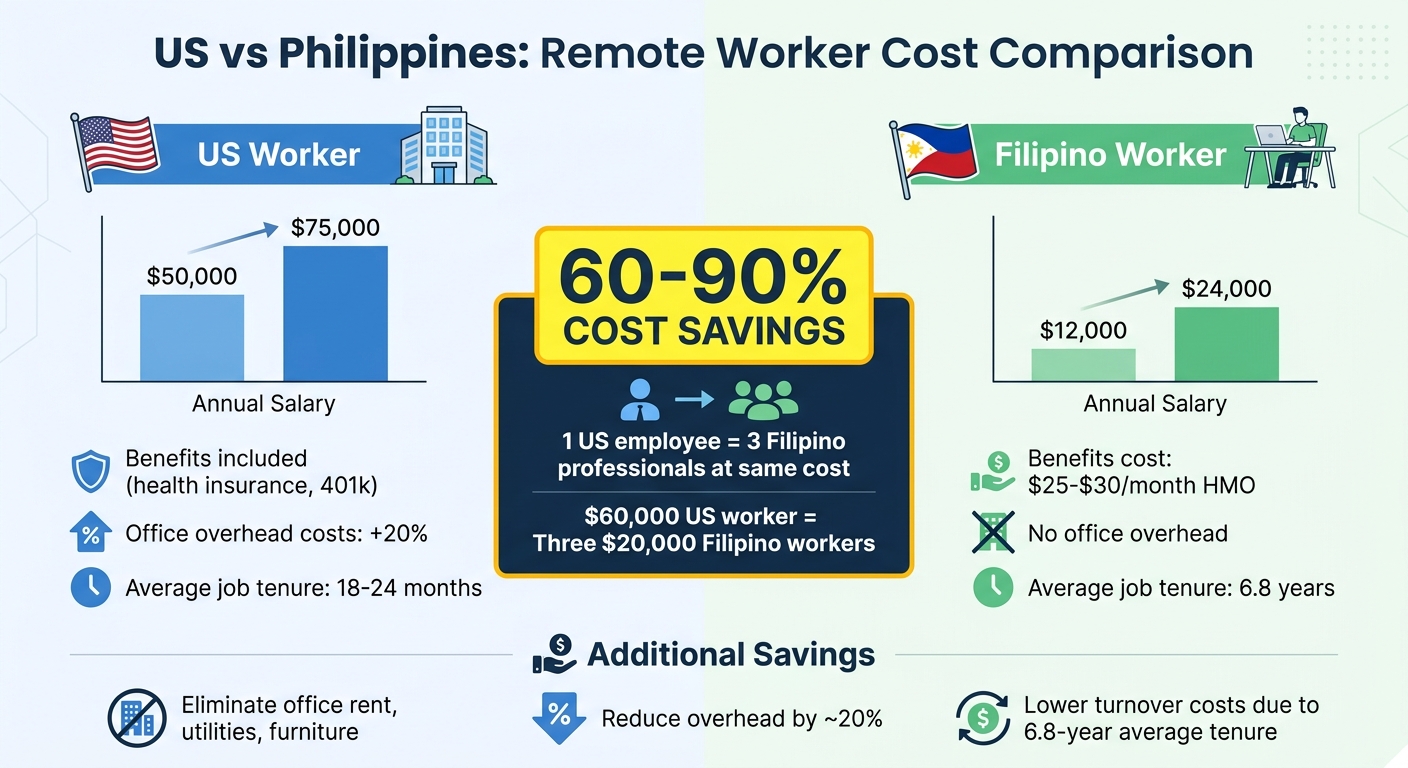
Cost Comparison: US vs Filipino Remote Workers - Savings Breakdown
Lower Costs and Access to Skilled Workers
Hiring remotely can significantly reduce expenses for businesses. For example, U.S. companies can save 60% to 90% on labor costs by employing workers from the Philippines. A U.S.-based administrative assistant typically costs $50,000–$75,000 annually, including benefits. In contrast, a skilled remote worker from the Philippines costs between $12,000 and $24,000 annually. This means one $60,000 U.S. employee could be replaced with three Filipino professionals earning $20,000 each, effectively tripling the workforce capacity.
The savings go beyond salaries. Remote hiring eliminates costs like office rent, utilities, and furniture, cutting overhead by about 20%. Additionally, U.S. employees often come with costly benefits, such as health insurance and 401(k) matching. Filipino remote workers, however, are often hired as independent contractors, with benefits like HMO coverage costing only $25–$30 per month.
Retention is another area where remote hiring shines. In the Philippines, the average job tenure is 6.8 years, compared to just 18–24 months for U.S.-based administrative assistants. This stability reduces the ongoing costs of recruiting, hiring, and training replacements.
Boutique Rugs, an e-commerce startup in Minnesota, leveraged Filipino e-commerce specialists to scale its operations. Within a year, the company reported increased productivity and significantly lower operational costs by assigning administrative and support tasks to remote workers.
Beyond financial perks, Filipino professionals bring a level of cultural compatibility that enhances team cohesion.
Why Filipino Workers Fit Well with Western Companies
Filipino remote workers offer more than just cost savings - they bring cultural and operational strengths that align well with Western businesses. English is an official language in the Philippines and the primary language of instruction in schools. This results in high fluency and neutral accents, making Filipino professionals ideal for client-facing roles. The Philippines ranks 2nd in Asia for English proficiency. Additionally, the country’s historical ties to the West mean many workers are familiar with Western business etiquette, holidays, and communication styles.
The Philippines also has a strong infrastructure for remote work. Even before the pandemic, over 52% of Filipino workers were already working remotely or in hybrid setups. The country produces over 500,000 university graduates annually in fields like IT, engineering, and business, creating a steady pipeline of skilled professionals. A service-oriented culture that emphasizes hospitality and patience makes Filipino workers particularly well-suited for roles in customer support and administration.
Zendesk, a global customer service software company, launched a remote support team in the Philippines in 2014. By 2024, this team had become the backbone of their 24/7 operations, managing over 50,000 support tickets daily.
Filipino workers also excel in time zone flexibility. Many are accustomed to working night shifts to align with North American or European business hours. This enables businesses to adopt a "Follow the Sun" model, where tasks handed off at the end of the U.S. workday are completed overnight, ensuring seamless productivity.
How FindTalent.ph Makes Remote Hiring Easier
FindTalent.ph takes the hassle out of remote hiring by combining advanced technology with human expertise. Instead of spending weeks sifting through resumes and conducting endless interviews, this platform connects businesses with pre-vetted Filipino professionals quickly and efficiently.
AI-Powered Candidate Matching
The platform’s plain-English search interface simplifies finding the right talent. Just describe your needs (e.g., "I need someone to manage my inbox and schedule meetings"), and the AI instantly identifies the best-fit specialist from over 50,000 verified profiles.
To ensure quality, every candidate profile undergoes manual review and scoring by a recruitment team. This scoring system ranks candidates based on their verified skills and experience, making it easier for businesses to find the perfect match. For those who prefer a hands-off approach, there’s a recruiter-led service that delivers 1–3 pre-vetted candidates directly to your inbox, complete with a free replacement guarantee.
"Not only can we find candidates 5x faster, the quality of these candidates have been better than any of the other tools we've used in the past." – Sam Hollander, Autopilot
Verified Profiles and Clear Pricing
FindTalent.ph has a rigorous screening process that includes ID verification, portfolio reviews, validation of prior experience, and testing of AI-certified skills across tools like ChatGPT, Claude, and Zapier. Only 35% of applicants pass this process to be listed on the platform, ensuring a high standard of quality.
The platform’s direct hiring model eliminates agency fees and middleman costs. Pricing is straightforward, with options like a free plan for accessing 50,000 profiles (with 10 bookmarks), the Employer Plan at $88/month (3 job posts and team tracking), or the Team Plan at $219/month for more advanced features.
Businesses can also test candidates with paid trial tasks (2–5 hours) to evaluate their work quality and communication style before making a long-term commitment. To promote fair pay and commitment, the platform enforces a minimum full-time salary of $600 per month.
"We found a VA with specific experience in Zillow, MLS and DocuSign. Quite nice to sort by specific skills and tools." – Forrest Webber, Oak Forest Realty
Professional Categories Available
FindTalent.ph offers specialists across more than 20 professional categories. Whether you need administrative help, technical expertise, or creative talent, the platform has you covered:
| Category | Example Roles |
|---|---|
| Admin & Virtual Assistants | Executive Assistant, Operations VA, Data Entry, Personal Assistant |
| Customer Support | Chat Support, Technical Support, Email Support, Call Center Agent |
| Web & Tech | Web Developer, Full Stack Developer, WordPress Expert, Mobile App Developer, Frontend Developer |
| Content & Social Media | Social Media Manager, Video Editor, Content Writer, Copywriter |
| Creative & Design | Graphic Designer, UI/UX Designer, Brand Designer, Canva Specialist |
| AI & Automation | AI Specialist, Prompt Engineer, Zapier Expert, AI Chatbot Developer |
| Sales & Lead Gen | Cold Caller, Appointment Setter, Sales Closer, Lead Conversion Specialist |
| Specialized Roles | Healthcare VA, Bookkeeper, Real Estate VA, E-commerce Manager |
Filipino professionals typically charge $5 to $15 per hour, significantly lower than the $80–$150 per hour charged for similar roles in the US or Europe - offering up to 80% in cost savings. Plus, integrated tools for time tracking, contracts, compliance, and payroll management allow businesses to oversee their entire remote team from one dashboard. This extensive range of categories ensures you can build a team tailored to your business needs.
How to Find and Evaluate Remote Candidates
Start with a clear job description and end with a practical skills test. The Philippines ranks as the 6th largest market for remote talent globally, with over 1.5 million individuals engaged in online freelancing. Job postings tailored specifically to Filipino remote workers tend to perform better, receiving 2–3 times more applications and filling 60% faster - averaging just 4.7 days compared to 12 days for global postings.
Writing a Clear Remote Job Description
A strong job post should cover three main points: what the role involves, the tools required, and the working hours expected. Be specific about daily tasks instead of using vague phrases like "wearing many hats". For instance, write "Respond to 30–50 customer emails daily using Zendesk" rather than "Handle customer support."
Use precise, location-specific titles like "Filipino Shopify Specialist" instead of generic ones like "E-commerce Specialist." Including a salary range upfront helps improve visibility and attracts more qualified applicants. Clearly state time zone overlap requirements (e.g., "4 hours overlap with EST") and list the software or tools candidates should know, such as Notion, Slack, or Python 3.8+.
Mentioning the 13th-month pay - a legally required bonus in the Philippines equivalent to one month's salary, typically given in December - shows an understanding of local employment standards and can help attract better candidates.
Once your job post is ready, the next step is to verify candidates through video interviews.
Running Effective Video Interviews
Save video interviews for the final 2–3 candidates after they've completed a trial task. This approach saves time and allows you to focus on assessing personality and culture fit instead of basic qualifications. During the interview, discuss their approach to the trial task, ask how they handle power or internet outages, and evaluate their communication style.
"The trial task is where you learn who someone really is. Save the call for the final decision." – HireTalent.ph
To quickly assess English fluency and communication skills, ask candidates to submit a 2-minute video introduction as part of their application. The Philippines ranks 2nd in Asia for English proficiency, with 95% of Filipino remote workers scoring B2+ (near-native) on proficiency exams.
While interviews are important, practical assessments are equally vital.
Testing for Remote Work Skills
Use a paid trial task lasting 2–5 hours to evaluate candidates' problem-solving abilities, attention to detail, and communication skills. A budget of $20–$50 for this task is reasonable. A simple four-step hiring process works best: review applications, shortlist 5–10 candidates, assign paid trial tasks, and then conduct video interviews with the top performers. Design trial tasks that leverage the strengths of Filipino candidates, such as their adaptability and strong English proficiency.
Be alert for red flags during the screening process. Candidates who avoid video calls, provide vague answers about their experience, lack a portfolio, or submit poorly written applications may not be a good fit. Additionally, check their technical setup by requiring a speed test (minimum 10 Mbps download/5 Mbps upload) and asking about backup internet options like mobile hotspots.
Focus on measurable outcomes rather than tracking hours. For example, assess performance based on resolution rates in support roles or accuracy in data entry. Since communication issues cause 21% of remote work challenges, encourage candidates to ask at least one clarifying question during their first month to address any potential hesitations about reporting problems.
Onboarding and Managing Filipino Remote Workers
Once you've chosen the right candidate, a structured onboarding process is key to ensuring productivity from the start. When properly set up, remote workers can be up to 13% more productive than their in-office counterparts. The aim is to guide new hires from hands-on support in the first week to independent work by week four, with clear goals at every step.
How to Onboard Remote Workers
Start with a tech audit before Day 1. Confirm that the new hire has internet speeds of at least 10 Mbps download and 5 Mbps upload, along with a backup connection in case of outages. On their first day, send a welcome package that includes a team video, a one-page mission statement, and a checklist of tools and accounts they'll need.
In the first week, focus on learning and shadowing. Schedule daily 15-minute check-ins and allow the new hire to observe key workflows. By week two, transition to guided practice by assigning tasks and providing immediate feedback while introducing them to key team members. During weeks three and four, the new hire should be handling their full workload, with weekly one-on-one meetings replacing daily check-ins. Wrap up the onboarding process with a 30-day review.
To make onboarding smoother, prepare one-page SOPs with screenshots for repetitive tasks. This allows new hires to troubleshoot independently, especially when time zones make immediate assistance tricky. It's also important to address cultural nuances early. For example, you might say:
"I need you to tell me immediately when something's unclear, when you're blocked, or when you think something won't work. I won't be upset. I'll be grateful. We can only fix problems I know about." – HireTalent.ph
Filipino culture often emphasizes maintaining harmony, which can make workers hesitant to raise concerns. Directly encouraging openness from the start can help overcome this.
Once onboarding is set, focus shifts to managing time zones and establishing strong communication practices.
Managing Time Zones and Communication
For U.S.-based companies, the time difference with Manila means that 9:00 AM EST is 9:00 PM in the Philippines. Aim for 3–4 hours of overlap for live meetings or urgent discussions, while letting the rest of the workday proceed asynchronously. Time zone challenges are a common issue, with 19% of remote workers citing them as a major concern, and 42% of remote employees reporting overwork from trying to stay available across zones.
Set clear expectations for communication. For example:
- Slack messages should be answered within 2 hours during working hours.
- Emails should receive a response within 24 hours.
Clearly label urgent items and define what qualifies as "urgent" (e.g., a client emergency versus a routine request). Use a single project management tool like Asana or Trello to centralize tasks and deadlines, reducing the risk of miscommunication.
Loom videos can also be a game-changer. Record instructions for recurring tasks so workers can review them privately, which respects the cultural value of hiya (avoiding embarrassment). Additionally, ask for a quick end-of-day report summarizing:
- What was completed.
- Plans for the next day.
- Any blockers or challenges.
These practices create a framework for clear communication and help bridge cultural and time zone gaps.
Building Trust with Remote Team Members
Focus on results, not hours. Measure success by outcomes like task completion or resolution rates, rather than micromanaging time spent. Filipino workers tend to stay longer in roles - an average of 6.8 years - especially when they feel trusted and appreciated.
Provide feedback promptly, ideally within 24 hours. Keep it action-focused rather than personal. For instance, say, "This response was too formal for our brand voice", instead of "You were too formal". Always deliver constructive feedback in private one-on-one meetings, as preserving dignity and public image is highly valued in Filipino culture.
To foster loyalty, consider offering:
- A 13th-month bonus.
- A monthly internet stipend of $20–$30.
- A one-time home office allowance of $200–$400.
Recognize that family is a central priority in Filipino culture. Allowing flexibility for family events or emergencies can deepen loyalty and improve performance. These thoughtful gestures build a foundation of trust and mutual respect with your remote team.
Common Remote Hiring Problems and Solutions
Drawing from recruitment insights, this section dives into common challenges in remote hiring and offers practical ways to address them, ensuring productivity and team cohesion. Communication and collaboration issues make up 21% of all remote work problems, while time zone differences are a major concern for 19% of remote leaders. These challenges often follow predictable patterns, making it possible to address them proactively.
Warning Signs to Watch for When Hiring
Certain red flags can signal potential issues during the hiring process. For instance, missing portfolios, reluctance to attend video calls, or vague work histories are worth noting. Unrealistically low salary expectations (e.g., under $600/month) might indicate inexperience or desperation, which could lead to high turnover rates.
Technical reliability is another critical factor. Candidates need to show they have a stable internet connection (at least 10 Mbps download and 5 Mbps upload) and backup power options like a UPS. During interviews, be mindful of background noise or connection drops, as they may point to an unreliable workspace.
Cultural red flags can be harder to spot but are just as important. For example, silence or constant agreement during instructions might reflect cultural norms like hiya (shame) or pakikisama (harmony), which emphasize avoiding conflict. Darin Phillips from FilipinoContractors.com explains:
"Filipino professionals often avoid saying 'no' directly due to cultural norms of respect and harmony (hiya and pakikisama). This can lead to overpromising".
Once these potential concerns are addressed, shift your focus to setting clear performance metrics to ensure accountability.
Tracking Performance and Accountability
After hiring, it’s crucial to establish clear, measurable goals to maintain accountability. Focus on outcomes and deliverables rather than micromanaging daily activities. This not only builds trust but also respects the independence of remote team members. Create a consistent workflow with tools like daily Slack updates, weekly one-on-one video calls for feedback, monthly performance reviews, and end-of-day reports summarizing tasks completed, plans for the next day, and any blockers.
If you notice recurring missed deadlines or unreported blockers, address these issues privately. In Filipino culture, preserving dignity is important, so feedback should always be constructive and delivered respectfully.
Working Across Different Cultures
Managing a team across a significant time difference - such as the 12–16-hour gap between EST and Manila - requires thoughtful scheduling. Aim for 3–4 hours of live overlap (e.g., 8:00 PM–11:00 PM EST/8:00–11:00 AM Manila) and rely on asynchronous tools outside of that timeframe. Written standard operating procedures and recorded Loom videos can help team members review instructions at their own pace.
Encourage open communication from the start. Use explicit language to make it clear that questions and feedback are welcome. For example:
"I need you to tell me immediately when something's unclear, when you're blocked, or when you think something won't work. I won't be upset. I'll be grateful. We can only fix problems I know about."
– Mark, HireTalent.ph
This approach helps counter hesitation to admit confusion, which can be a cultural barrier. Additionally, respecting Philippine national holidays and family commitments is essential, as family is a central priority in Filipino culture. Small gestures like acknowledging holidays or offering flexibility for family emergencies can go a long way in building loyalty and trust. By understanding and leveraging these cultural strengths, you can strengthen team unity and overcome common challenges.
Conclusion
Hiring remotely doesn’t have to be complicated. With a workforce of 1.8 million skilled professionals, the Philippines offers a unique advantage. Boasting a 95% literacy rate and ranking 2nd in Asia for English proficiency, Filipino remote workers not only cost 50%–66% less than traditional hires but also deliver 13% higher productivity.
Platforms like FindTalent.ph make the process even easier. By offering pre-vetted profiles and AI-powered matching, they allow you to start interviewing candidates within 24 hours. With a $600/month minimum for full-time roles, the platform ensures you’re connecting with dedicated professionals. These features have already revolutionized operations for numerous companies.
"The real win is what you can build when you have access to a deep pool of skilled people who want long-term careers."
– HireTalent.ph
Success stories from companies like Zendesk and Boutique Rugs highlight the impact of well-structured offshore teams. Zendesk, for example, built 24/7 operations capable of handling over 50,000 tickets daily, while Boutique Rugs scaled their business and significantly reduced costs in under a year. These examples show that focusing on results, valuing remote workers, and building strong teams can lead to impressive efficiency and savings.
FAQs
How do I handle payroll and taxes for Filipino contractors?
To handle payroll and taxes for Filipino contractors, it's important to familiarize yourself with local laws and tax obligations. This includes mandatory contributions to SSS (Social Security System), PhilHealth, and Pag-IBIG Fund, which are key benefits for workers in the Philippines.
Make sure you have the right paperwork in place, like a well-defined contractor agreement, to avoid any issues with worker classification. Misclassification can lead to legal complications, so clarity is crucial.
For a smoother process, consider partnering with a payroll provider or a local expert. They can help ensure compliance with local regulations, calculate deductions accurately, and handle tax payments on time. This approach reduces legal risks and keeps the process efficient.
What’s the best way to protect company data with remote hires?
To keep company data safe when working with remote hires, it's important to follow some key security practices. Start by using strong authentication methods, like multi-factor authentication, to add an extra layer of protection. Make sure remote employees connect through secure networks, ideally using a reliable VPN to safeguard data transmissions. Encourage them to avoid public Wi-Fi, which can leave sensitive information exposed. Lastly, educate your team about phishing attempts and how to recognize and report suspicious emails or links. These proactive measures can help protect your company's sensitive information while enabling remote work.
When should I choose async work vs. set hours?
When deciding between asynchronous work and set hours, it really comes down to the nature of your tasks and how your team operates.
- Asynchronous work gives team members the freedom to work at their own pace, making it perfect for tasks that require deep focus or for teams spread across multiple time zones.
- Set hours, on the other hand, are ideal when real-time collaboration, meetings, or addressing urgent tasks is a priority.
Many organizations find success with a hybrid model, combining the flexibility of async work with the immediacy of set hours to suit both project goals and team dynamics.