Business Operations
7 Ways to Reduce Operational Costs Through Outsourcing
Outsourcing Filipino remote talent slashes labor and overhead costs while boosting scalability and efficiency.
18 min readUpdated

Outsourcing is one of the most effective ways to cut business costs without compromising quality. Here's how companies are saving up to 70% by hiring Filipino professionals for roles like customer support, IT, and virtual assistance. With rising salaries in North America, outsourcing offers a cost-efficient alternative, turning fixed expenses into flexible solutions.
Key takeaways:
- Labor cost savings: Outsource roles like virtual assistants, developers, and customer support to the Philippines to save 60–80%.
- High-quality talent: Filipino professionals are fluent in English, skilled in various fields, and familiar with Western business practices.
- Scalability: Easily expand or reduce teams based on business needs, with quick hiring timelines (1–2 weeks).
- Cost breakdown examples:
- U.S. customer support: $38,000–$52,000/year vs. $14,400–$21,600/year in the Philippines.
- Filipino developers: $1,200–$4,300/month, compared to $80,000–$120,000/year in the U.S.
- Additional benefits: Reduced overhead costs like office space, payroll taxes, and equipment.
Outsourcing to the Philippines is a proven way to lower costs while maintaining efficiency. Whether you're a startup or an established company, this strategy can help you allocate resources more effectively.
How Outsourcing Is Changing the Business Game in 2025
sbb-itb-3690fed
1. Outsource Non-Core Functions to Filipino Virtual Assistants
Tasks like managing emails, data entry, scheduling, and social media updates can consume valuable time and resources without directly driving revenue. Handing off these routine responsibilities to Filipino virtual assistants allows your core team to focus on more strategic initiatives. This approach not only boosts overall productivity but also offers substantial cost advantages.
Cost Savings
The financial benefits of outsourcing are hard to ignore. A Filipino virtual assistant typically earns about $498 per month, compared to the $35,000 annual salary of a similar U.S.-based employee. This translates to potential yearly savings of $25,000 to $28,000 per position.
Additionally, outsourcing reduces overhead expenses. You won’t need to allocate funds for office space, equipment, payroll taxes, health insurance, or retirement plans, as remote workers handle their own setups. This shift turns fixed costs into more manageable variable expenses.
Quality of Work
Saving money doesn’t mean compromising on quality. English is one of the official languages of the Philippines and is taught from elementary school through college. The country also produces over 750,000 graduates annually in fields like business, IT, and finance. Filipino professionals are skilled in communication, understand Western business practices, and are proficient in industry-standard tools. These strengths ensure that outsourcing supports operational efficiency without sacrificing performance.
"I replaced a $70,000/year campaign manager with a Filipino VA at $12/hour. Same output, same tools, same results. I used the savings to hire two more VAs - now I have a three-person team for what one local hire used to cost me." - US Marketing Agency Owner
Scalability and Flexibility
The 12- to 13-hour time difference between the Philippines and the U.S. offers a unique advantage. Tasks assigned at the end of your U.S. workday can be completed by the time you start the next morning. This asynchronous workflow is especially effective for tasks like administration, social media management, and bookkeeping that don’t require immediate collaboration. For real-time coordination, schedule meetings during the overlapping hours of 8:00 AM EST and 9:00 PM Philippine Time. This setup maximizes both efficiency and flexibility.
2. Use Filipino Customer Support Teams to Lower Costs
Customer support plays a vital role in keeping customers happy and driving growth, but running an in-house team can get expensive fast. Between competitive salaries, benefits, and infrastructure, domestic teams require a hefty investment. Filipino customer support teams offer a cost-effective alternative, delivering excellent service at a much lower price.
Cost Savings
In the U.S., a customer support agent typically costs between $38,000 and $52,000 per year. In the Philippines, that same role costs just $14,400 to $21,600 annually - a 60% to 70% reduction in labor costs. Many managed BPO providers offer an all-inclusive monthly fee of $1,200 to $1,800 per agent. This fee covers everything: salary, benefits, equipment, and overhead. On top of that, businesses can benefit from PEZA incentives, such as up to eight years of full corporate income tax exemption, making outsourcing even more cost-effective.
Outsourcing also lets you turn fixed costs into variable ones. For example, if demand slows, you can scale from seven agents down to two, cutting costs by roughly $20,000 per month - without dealing with the headaches of layoffs. When business picks up, you can add more agents in just one to two weeks. This kind of flexibility makes it easy to adjust your operations based on your needs.
Quality of Work
Filipino customer support agents are fluent in English and familiar with American idioms, making them a natural fit for U.S.-based customers. Their neutral accents and strong communication skills ensure a smooth interaction. The Philippines' IT and business services sector employs about 1.82 million people and generates $38 billion in revenue annually, highlighting the depth of talent and experience available.
"The Philippines is the third-largest English-speaking country in the world. Filipino professionals speak with neutral accents, understand American idioms, and communicate naturally with US clients and customers." - iSuporta Team
To further enhance service, many Filipino BPO providers are now using AI tools to assist with call and chat reviews. These tools give agents real-time guidance, helping them resolve complex issues more efficiently.
Scalability and Flexibility
The Philippines' 12- to 13-hour time difference with the U.S. makes 24/7 support possible without paying overtime premiums. Providers use precise scheduling to match staffing levels with demand, cutting down on idle time while ensuring peak periods are fully covered. For small teams of 1 to 20 people, managed BPO providers take care of hiring, equipment, and daily operations - no need to set up a local entity. Start small with just one or two agents to test the quality and processes, then scale up as your business grows. This ability to adjust quickly gives you a clear edge over maintaining a fixed in-house team.
Next, we’ll look at how hiring Filipino IT and Development Specialists can further improve cost efficiency.
3. Hire Filipino IT and Development Specialists
Managing IT talent effectively is a key strategy for controlling operational costs. Building a tech team in the U.S. can quickly become expensive, with high salaries, benefits, and infrastructure costs adding up. Filipino IT and development specialists present an affordable solution, offering comparable technical expertise at a much lower cost.
Cost Savings
Hiring Filipino developers can significantly reduce expenses. For example, a front-end developer in the Philippines earns about $673 per month, while a full-stack developer costs around $747 per month. Compared to U.S. salaries, businesses can cut labor costs by as much as 80%. For a 50-person engineering team, annual expenses can drop from $8.75–$11.9 million to just $2.48–$3.37 million - a reduction of 30% to 45%.
Additionally, bundled service fees for DevOps, security, and QA tools eliminate the need for separate tooling budgets, saving $830,000 to $1.4 million annually. Companies can also benefit from PEZA tax incentives, which include up to eight years of income tax holidays for registered IT-BPO providers.
Quality of Work
Filipino IT professionals are highly skilled and certified to meet global industry standards. The Philippines ranks 22nd globally in the EF English Proficiency Index 2025, the highest in Asia, ensuring smooth communication on even the most complex technical projects. With over 500,000 STEM graduates entering the workforce annually, the country boasts a rich talent pool of developers and engineers.
AI-enhanced teams in the Philippines can speed up development cycles by 35%–55% while reducing production incidents by 40%–60%. For technical support, these AI-augmented teams resolve 78%–88% of issues on the first attempt. The Philippines also maintains 99.97% uptime across Tier 3+ data centers in key cities like Manila and Cebu, ensuring dependable support for mission-critical operations.
"The convergence of Philippine engineering talent, AI tooling, and cloud infrastructure has fundamentally changed the economics of technology operations." - John Maczynski, CEO, PITON-Global
Access to Specialized Expertise
The Philippine IT-BPM sector employed 1.9 million professionals in 2025, with technology services being its fastest-growing area. Filipino IT teams handle a wide range of tasks, from basic coding to advanced functions like Predictive Site Reliability Engineering (SRE), FinOps, and AI-driven Security Operations Centers (SOC). They also work seamlessly with AI development tools like GitHub Copilot and SonarQube to enhance productivity and code quality.
To ensure the right fit, consider using short coding or design tests during the hiring process. Scheduling stand-up meetings during the overlapping hours of 8:00 AM EST and 9:00 PM PHT can facilitate real-time collaboration. Centralized SOPs stored in tools like Google Drive can also help streamline workflows across time zones.
Learn more about how Filipino remote workers can optimize shared services in the next section.
4. Set Up Shared Services with Filipino Remote Workers
Shared services are all about centralizing routine tasks like data entry, bookkeeping, and customer support. By outsourcing these functions to Filipino remote workers, businesses can turn fixed overhead costs into more flexible and scalable operations while significantly cutting expenses. This strategy aligns perfectly with the broader approach of utilizing Filipino remote talent to reduce operational costs in a big way.
Cost Savings
Switching to Filipino remote professionals for shared administrative roles can save businesses a lot of money. For instance, hiring a U.S.-based employee for these tasks can cost $60,000–$90,000 annually. Meanwhile, a Filipino professional with similar skills earns between $14,000 and $22,000 per year, resulting in a 60% to 80% reduction in costs.
Let’s take a team of five bookkeepers as an example. Domestically, their annual expenses might range from $210,000 to $290,000. In contrast, outsourcing to the Philippines brings that figure down to about $85,000–$120,000.
Another plus? Remote workers often provide their own equipment and internet, or these expenses are bundled into a managed service fee. This eliminates costs like office leases, hardware, and utilities. Managed service providers also handle recruitment, payroll taxes, benefits, and HR tasks - overheads that can add an extra 18% to 35% to the cost of a local hire.
| Role | US Annual Total Cost | Philippines Annual Total Cost | Estimated Savings |
|---|---|---|---|
| Customer Support | $38,000–$52,000 | $14,400–$21,600 | 60–70% |
| Executive Assistant | $80,000–$100,000 | $14,000–$22,000 | Up to 80% |
| Bookkeeper | $42,000–$58,000 | $16,800–$24,000 | 60–65% |
These savings make it easier to build and grow scalable teams without breaking the bank.
Scalability and Flexibility
One of the biggest advantages of shared services powered by Filipino talent is how easily they scale with your business. Managed providers can add team members in as little as 1–2 weeks, and you can start reviewing top candidates in just two days. Need more hands during busy seasons? No problem. Teams can be expanded quickly. When things slow down, you can scale back just as easily, saving as much as $20,000 a month without worrying about layoffs or severance.
The Philippines' time zone difference (12–13 hours ahead of the U.S.) also works to your advantage. This "follow-the-sun" model ensures tasks submitted at the end of the U.S. workday are completed by the next morning. Additionally, the Philippine Department of Labor and Employment supports compressed workweeks, allowing businesses to adjust schedules without triggering immediate overtime costs.
This flexibility makes it easier to adapt to changing business needs while maintaining efficiency.
Access to Specialized Expertise
The Philippines offers a deep talent pool, with over 750,000 graduates annually in business-related fields. Add to this the 1.82 million professionals in the IT-BPM industry, and you’ve got access to skilled workers for specialized roles.
A smart way to start is by outsourcing process-heavy tasks like data entry or accounts payable to test workflows. Using managed BPO providers for teams of 1–20 people simplifies the process, as they handle office infrastructure, equipment, and local compliance. Tools like Loom can help document critical workflows, ensuring consistency and quality during the transition.
When integrated effectively, distributed teams can improve operational efficiency by up to 25%. This combination of cost savings, scalability, and expertise makes shared services with Filipino remote workers a game-changer for businesses looking to streamline operations.
5. Automate Routine Tasks with Filipino AI and Data Experts
Automation takes the efficiency of shared services to the next level by eliminating repetitive tasks that drain time and resources. Filipino AI and data experts are skilled at using tools like Robotic Process Automation (RPA) and AI-powered software to handle tasks such as data entry, billing, invoicing, and rebate processing. This allows your team to focus on high-impact, strategic initiatives that drive business growth.
Cost Savings
Filipino AI specialists offer a compelling cost advantage. At an average rate of $2,000 per month, they deliver labor cost reductions of 60–70% compared to U.S.-based roles, which typically range from $85,000 to $115,000 annually. When factoring in payroll taxes and benefits, total savings can reach up to 80%. Additionally, outsourcing reduces overhead expenses since professionals often provide their own equipment and internet. These immediate savings free up resources to invest in more specialized skills that enhance operational efficiency.
Access to Specialized Expertise
The Philippines boasts a deep talent pool, with 1.82 million professionals in the IT-BPM industry. Filipino AI experts do more than just execute tasks - they design, deploy, and evaluate AI models. Their expertise spans building multilingual chatbots and AI virtual assistants that offer 24/7 support, as well as creating predictive analytics models that optimize supply chains and detect fraud in real time. For example, a U.S. tech startup enlisted Filipino NLP specialists to fine-tune multilingual chatbots for global markets. By leveraging the 12–13 hour time difference, the team achieved deployment 30% faster through continuous testing and refinement.
"The key isn't just hiring people who can build models, it's hiring professionals who can make those models matter." – Hire Overseas
Scalability and Flexibility
Filipino teams provide the agility to quickly scale operations, test ROI, and expand as needed. Many teams can begin within one to two weeks, offering businesses a fast turnaround. The follow-the-sun model ensures overnight refinement of AI outputs, so they're ready for review by the time U.S. teams start their day. Filipino professionals are proficient in frameworks like TensorFlow and PyTorch, as well as automation tools such as Zapier and Make. Whether it's data labeling for self-driving technology or designing fraud detection systems, the talent pool is equipped to scale with your business needs. This adaptability strengthens the cost-efficient outsourcing strategy.
6. Reduce Vendor Costs Through Filipino Talent Platforms
Cutting vendor costs is a smart way to streamline operations, and Filipino talent platforms offer an efficient solution. These platforms bring everything under one roof, making it easier and more affordable to manage tasks that would otherwise require multiple vendors.
Traditional vendor arrangements often include recruitment fees of 15–25% of an employee's annual salary and demand significant internal HR resources for onboarding and training. Filipino talent platforms simplify this by offering a single monthly fee that covers everything - office space, equipment, payroll, high-speed internet, utilities, and secure facilities. All of this is provided at a fraction of what it would cost locally.
Cost Savings
The financial benefits are clear. For example, running a 50-employee operation in-house costs $512,000 in the first year and $387,000 annually after that. In contrast, using a Philippines-based platform costs only $240,000 per year. On an individual level, the savings are just as impressive. A customer support agent in the U.S. typically costs $38,000–$52,000 annually, but through a managed platform in the Philippines, the cost drops to $1,200–$1,800 per month, or $14,400–$21,600 per year. And that price includes infrastructure and compliance.
Quality of Work
The Philippines is a global leader in outsourcing, ranking as the third-largest English-speaking country and the second-largest destination for business process outsourcing (BPO). The industry employs over 1.3 million professionals. Managed platforms in the region source, vet, and train talent who are already familiar with Western business practices and key performance indicators (KPIs). Employees typically work from secure office environments with enterprise-grade security measures that comply with global standards like GDPR and HIPAA. The cultural alignment and strong English proficiency reduce communication barriers, while the time zone difference allows for a seamless follow-the-sun workflow.
"Offshore hiring is no longer a backup plan. It is a competitive advantage when executed with the right sourcing, training, and integration framework." – 032 Outsourcing
Scalability and Flexibility
Flexibility is another key advantage. Platforms like FindTalent.ph offer month-to-month contracts and can onboard new staff within one to two weeks, making it easy to adapt to changing needs. Businesses can start small - testing workflows with one or two roles - and eventually scale to entire departments without the burden of building local infrastructure. These platforms handle recruitment, HR, and daily operations, allowing companies to focus entirely on deliverables. With salaries in North America and Australia rising 18–22% since 2022, the cost stability in Southeast Asia makes this approach even more appealing as we move into 2026.
7. Use Geographic Arbitrage with Filipino Offshore Talent
Geographic arbitrage offers a way to significantly cut costs while maintaining high-quality work by hiring skilled professionals from countries with lower living expenses. For U.S. businesses, the Philippines stands out as a prime choice. Salaries for equivalent roles in the Philippines are typically 60–70% lower than in the U.S., and the workforce is highly educated and well-versed in Western business practices.
Cost Savings
The financial benefits go far beyond just lower salaries. Hiring domestically involves expenses like recruitment (averaging $4,700 per hire), benefits, taxes, office space, and equipment. Additionally, replacing an employee can cost up to six to nine months' worth of their annual salary. By hiring offshore, these costs are bundled into a single, much lower monthly fee.
For example, an Amazon Operations Manager costs about $7,600 per month in the U.S., but the same role in the Philippines averages just $1,500 - a reduction of 80%. Similarly, a domestic bookkeeper earning $3,500–$4,833 per month would cost only $1,400–$2,000 offshore. With over 500,000 college graduates entering the workforce annually - many with degrees in fields like IT, engineering, and healthcare - this approach frees up significant budget while ensuring access to skilled talent.
Quality of Work
The Philippines is the third-largest English-speaking country in the world and ranks as the second-largest destination for business process outsourcing (BPO), employing over 1.3 million professionals. The workforce has evolved from basic call center roles to more advanced positions in areas like cybersecurity, AI data labeling, and commercial finance.
"The Philippines is not simply a stopgap... The country has become a partner for innovation, not just for execution." – Clara Crisostomo, KMC Solutions
Major hubs like Metro Manila, Cebu, and Clark boast enterprise-grade IT infrastructure and subsea cable redundancy, ensuring reliable operations. Managed providers take care of vetting, training, and compliance, delivering high-quality work that meets the demands of growing businesses.
Scalability and Flexibility
The 12–13-hour time difference between the U.S. and the Philippines creates a "follow-the-sun" workflow, boosting productivity and helping reduce burnout - a problem that affects 76% of U.S. employees performing repetitive tasks.
Scaling up is quick and efficient. Managed providers can onboard new hires in just 1–2 weeks, while filling a domestic role in the U.S. takes an average of 44 days. Businesses can start small with one or two roles to refine processes, then quickly expand entire teams without needing to invest in local infrastructure. Flexible month-to-month contracts make it easy to adjust staffing levels as business needs change.
Cost Comparison: In-House vs. Outsourced IT and Development Roles
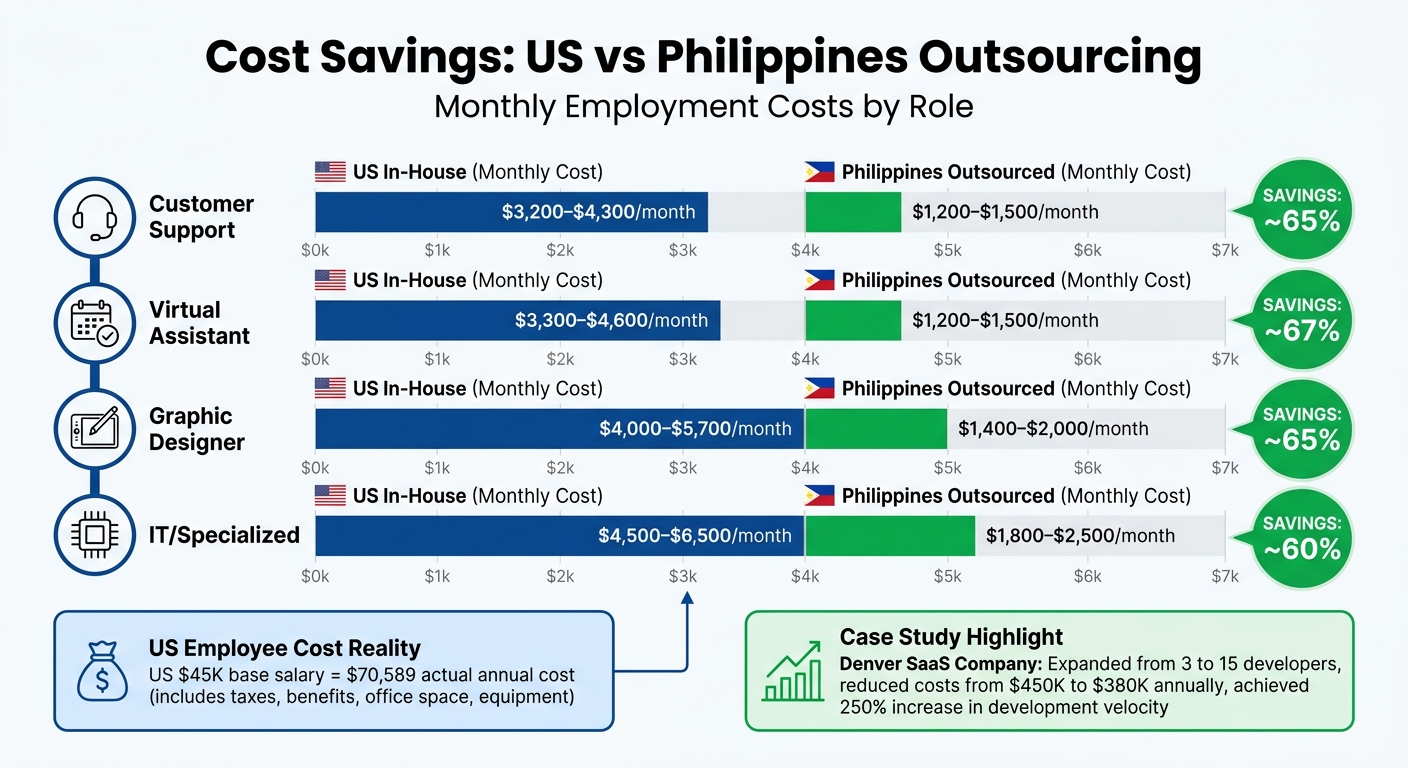
Cost Comparison: US vs Philippines Outsourcing Salaries by Role
Let’s break down the cost benefits of outsourcing IT and development roles, especially when compared to hiring in-house staff.
In the U.S., an employee with a base salary of $45,000 actually costs around $70,589 annually - or about $5,882 per month - once you factor in payroll taxes, health insurance, 401(k) matching, office space, equipment, and recruiting costs. Many business owners focus solely on the base salary, overlooking these additional expenses that can add over 20% to the total cost.
By outsourcing IT and development roles to the Philippines through managed providers like FindTalent.ph, all these costs are bundled into a single monthly fee. For instance, a mid-level developer in the Philippines costs between $1,200 and $2,000 per month, while specialized IT roles range from $1,800 to $2,500. This fee includes salary, statutory benefits, health insurance (HMO), office space, equipment, and HR management - expenses that would otherwise be separate with an in-house hire.
Here’s a side-by-side comparison of monthly costs:
| Role | U.S. In-House Cost (Monthly) | Philippines Outsourced Cost (Monthly) | Estimated Savings |
|---|---|---|---|
| Customer Support | $3,200–$4,300 | $1,200–$1,500 | ~65% |
| Virtual Assistant | $3,300–$4,600 | $1,200–$1,500 | ~67% |
| Graphic Designer | $4,000–$5,700 | $1,400–$2,000 | ~65% |
| IT / Specialized | $4,500–$6,500 | $1,800–$2,500 | ~60% |
One real-world example comes from a Denver-based SaaS company. Between 2024 and 2025, they expanded their engineering team from 3 U.S.-based developers to a total of 15 developers (3 in the U.S., 12 in the Philippines). Despite quintupling their team size, their annual development costs decreased from $450,000 to $380,000. This allowed them to achieve a 250% increase in development velocity and improve their time-to-market for new features by 40%.
"The Philippines isn't another 'cheap coding factory.' It's the world's best-kept secret for building high-performing, integrated development teams." – Full Scale
This comparison highlights the clear savings and flexibility outsourcing offers. By considering the true cost of in-house hires - not just their base salary - you can better calculate your ROI. Managed providers also offer month-to-month contracts, giving you the flexibility to scale your team up or down based on your business needs, turning fixed labor costs into variable ones.
Conclusion
Cutting operational costs doesn't have to mean sacrificing quality or productivity. The strategies discussed show how outsourcing Filipino remote talent can reduce costs by 40–60% while maintaining efficiency.
To recap, outsourcing non-core functions like customer support, IT development, shared services, routine automation, and vendor management helps turn fixed labor costs into flexible, scalable solutions. This approach has the potential to lower overall employment costs by as much as 70%. Additionally, companies that effectively integrate distributed teams have reported up to a 25% boost in operational efficiency.
"Offshore hiring is no longer a backup plan. It is a competitive advantage when executed with the right sourcing, training, and integration framework." – 032 Outsourcing
This insight highlights how strategic offshore hiring can become a powerful tool for gaining a competitive edge.
The best way to begin is by starting small. Test the waters with one or two roles to refine your workflow. Platforms like FindTalent.ph can simplify recruitment, screening, and HR management, helping you avoid the hidden costs and risks tied to traditional hiring processes.
With North American salaries climbing 18–22% since 2022, while offshore rates remain stable, the financial benefits of outsourcing are only growing. Whether you're a startup aiming to stretch your budget or a larger business looking to scale efficiently, tapping into Filipino remote talent offers a proven way to save costs and enhance operational performance. Now is the time to adopt these strategies and reshape your cost structure for better efficiency.
FAQs
Which roles should I outsource first?
Start by outsourcing roles that are expensive to maintain or challenging to fill locally. Positions in administration, marketing, finance, and technical fields are great starting points. Examples include administrative assistants, customer service representatives, and marketing specialists. These roles often come with notable cost benefits, as hourly rates typically range between $7 and $25. By outsourcing these positions first, you can simplify operations and cut costs, creating room to expand into more specialized roles down the line.
How do I protect data when outsourcing?
To keep your data safe while outsourcing, it's essential to put strong security measures in place. This includes using encryption to protect data both when it's stored and when it's being transmitted, as well as techniques like data masking and implementing secure access controls.
Make sure to work with providers that have HIPAA-compliant infrastructure and follow key regulations such as GDPR and CCPA. Regular audits, secure file-sharing methods, and well-defined contracts that clearly outline each party's data security responsibilities are also critical steps to protect sensitive information.
How do I manage time zone differences?
Managing time zone differences with remote team members, especially those based in the Philippines, requires thoughtful planning and clear communication. Start by establishing well-defined communication protocols and setting clear expectations from the outset. For recurring tasks, create detailed standard operating procedures (SOPs) that include screenshots or step-by-step instructions to help clarify priorities.
To facilitate real-time collaboration, schedule overlapping "core hours" where team members can connect directly, even if only for a few hours each day. Additionally, leverage remote-friendly tools to monitor performance and ensure accountability without micromanaging. By being proactive and providing clear guidelines, you can overcome time zone challenges and keep operations running smoothly.