Business Operations
Why the Philippines Leads in Customer Support Outsourcing
Why US companies pick the Philippines for voice customer support: near‑neutral English, cultural fit, 86% CSAT and big cost savings.
11 min read

The Philippines is the top choice for U.S. businesses outsourcing customer support. Here's why:
- Skilled Workforce: Filipino agents handle complex tasks like medical billing, fintech fraud analysis, and technical support, with 58% holding college degrees and certifications like ITIL.
- English Proficiency: Ranked 22nd globally, Filipinos speak near-neutral U.S. English, reducing miscommunication and improving customer satisfaction.
- Cultural Alignment: U.S. idioms and conversational tone naturally integrate into interactions, cutting call times by 12%.
- Cost Savings: Filipino agents cost $375–$525 per week, saving businesses up to 70% compared to U.S. operations.
- Strong Results: Filipino agents consistently outperform global averages with an 86% CSAT score.
While India excels in technical support and Latin America offers bilingual expertise, the Philippines remains unmatched for affordable, high-quality, English-focused voice support.
Philippines Outsourcing: Customer Service Representatives #business #customerservice
sbb-itb-3690fed
1. Philippines
The Philippines has become a leader in customer support outsourcing. Here's what makes it stand out.
Workforce Skills
Filipino agents go beyond basic call handling, taking on specialized roles like medical billing, insurance claims, fintech fraud analysis, and Tier 1–3 technical support. These tasks include API checks, log reviews, and root-cause troubleshooting. Impressively, about 58% of Filipino agents hold college degrees, with many earning certifications such as ITIL and ISO 20000. The country also boasts a 97.1% literacy rate.
What sets Filipino agents apart is their innate "CX DNA", which leads to an average Customer Satisfaction (CSAT) score of 86% - well above the global average of 79%.
English Proficiency
The Philippines stands out as the top-ranked country in Asia for English proficiency, placing 22nd globally on the EF English Proficiency Index. In the 2026 Ataraxis Global Outsourcing Talent Index, it scored an impressive 90 out of 100 for English skills. Filipino English goes beyond just grammar; it incorporates U.S.-style spelling, idioms, and cultural nuances. This is largely due to the country's history as a U.S. territory from 1898 to 1946, during which English became an official language - a status it retains today.
"Filipino English carries a near-neutral US accent because the Philippines was a US territory from 1898–1946 and English remains an official language with US-style spelling, idiom, and cultural references." - F5 Hiring Solutions
Cultural Compatibility
Filipino agents naturally use American idioms and phrases, which helps reduce call handle times by 12%. This familiarity makes interactions with U.S. customers feel conversational and unscripted. It's no surprise that 70% of the Philippines' BPO business comes from U.S. companies.
Additionally, the workforce is accustomed to working overnight shifts to align with U.S. business hours. Unlike other regions, this doesn't require steep shift-differential premiums.
Cost Efficiency
Hiring a Filipino support agent costs $375–$525 per week, offering businesses about 70% savings compared to running operations in the U.S.. Hourly rates for voice support average $14, while non-voice support is around $11.
Platforms like FindTalent.ph make it easy for companies to connect with skilled Filipino customer support professionals. Using AI-powered matching, businesses can efficiently find vetted talent without the high costs of traditional recruitment.
With a combination of skill, cultural alignment, and affordability, the Philippines consistently outshines other outsourcing destinations. Its edge in expertise, language fluency, and cost-effectiveness makes it the go-to choice for customer support outsourcing.
2. India
India holds its place as the world's third-largest outsourcing destination, showcasing impressive capabilities. However, its strengths don't always align perfectly with the specific needs of U.S. businesses for customer support. While India excels in technical expertise, there are trade-offs when it comes to meeting U.S. consumer expectations.
Workforce Skills
India boasts a massive talent pool of over 1.6 million workers and achieves a perfect score of 100 in talent depth. With a strong foundation in engineering, the workforce thrives in technical support areas like Tier 2/3 IT support, SaaS troubleshooting, developer-facing helpdesks, and financial analysis.
"India holds an edge for technical support tickets requiring deep product knowledge, code-adjacent troubleshooting, or developer-facing issues." - F5 Hiring Solutions
However, for high-volume B2C voice support from Filipino call center agents, India's First Call Resolution (FCR) rates, ranging from 60% to 72%, fall behind the Philippines' 70% to 78%. While India shines in technical roles, challenges in verbal communication affect its performance in voice-based support.
English Proficiency
India ranks 60th globally on the EF English Proficiency Index with a "moderate" rating. The country's strength lies in written communication, excelling in areas like email support, technical documentation, and chat interactions.
"Indian written English is excellent for technical documentation, ticket responses, and chat-based support - Indian engineers contribute the second-largest national share of Stack Overflow activity." - F5 Hiring Solutions
Despite this, regional accents can make voice interactions more time-consuming and sometimes lower customer satisfaction scores. For U.S.-facing calls, operations in the Philippines often achieve CSAT scores that are 5 to 15 points higher than India's.
Cultural Compatibility
India's compatibility with Western markets is strongest in B2B and technical contexts. The formal tone of Indian agents fits well in these areas but may feel overly scripted for consumer-facing issues like billing disputes.
"India's customer service reputation in Western markets has been shaped by years of call centre experiences where accent differences and scripted responses created friction." - VA Masters
While cultural fit is an important consideration, cost and agent retention are also key factors for U.S. businesses evaluating outsourcing options.
Cost Efficiency
India offers competitive pricing, though the cost difference compared to the Philippines is not substantial. A vetted customer service representative typically costs between $400 and $575 per week (all-inclusive). Hourly rates for email and chat support range from $5 to $7, while technical support roles cost between $7 and $11 per hour. Annual salaries for customer support positions fall between $15,000 and $26,000, with technical support roles earning $22,000 to $38,000.
However, high attrition rates, ranging from 30% to 45% annually, drive up recruitment and retraining expenses.
3. Eastern Europe
Eastern Europe - featuring outsourcing hubs in Poland, Romania, Ukraine, Bulgaria, and the Baltic states - has carved out a specialized role in the global outsourcing market. However, its strengths don’t always align with the needs of U.S.-focused customer support.
Workforce Skills
Agents in this region stand out for their technical expertise and multilingual capabilities. They excel in Tier 2 and Tier 3 support roles and provide native-level service in languages like German, French, Spanish, Dutch, and Scandinavian. This makes them a strong choice for tasks requiring language diversity or technical depth.
That said, for U.S. businesses needing high-volume, empathy-driven customer service - common in B2C interactions - Eastern Europe doesn’t match the Philippines' performance in this area.
English Proficiency
While English proficiency in Eastern Europe is solid, it isn’t the region’s primary strength. Agents often speak with noticeable regional accents, which can sometimes lead to challenges during voice calls in English-only markets like the U.S.
"For companies serving English-speaking customers (US, UK, Australia, Canada), the Philippines delivers comparable or better quality at 40 to 60 percent lower cost [than Eastern Europe]." - VA Masters
Cultural Compatibility
Eastern Europe aligns closely with European business norms, which are formal and process-driven - ideal for B2B clients or EU-based companies. However, for U.S. businesses, the cultural alignment is less seamless compared to the Philippines. On the other hand, Eastern Europe offers a clear advantage for companies needing EU data residency compliance, making it a logical choice for businesses with strict regulatory requirements.
Cost Efficiency
Among the regions discussed, Eastern Europe is the priciest. Hourly rates range from $10 to $15 for email and chat support, $12 to $18 for English phone support, and $14 to $22 for technical roles. These rates are 50% to 100% higher than equivalent services in the Philippines.
| Support Type | Eastern Europe (per hour) | Philippines (per hour) |
|---|---|---|
| Email/Chat Support | $10–$15 | $7–$9 |
| Phone Support (English) | $12–$18 | $7–$10 |
| Technical Support | $14–$22 | $9–$13 |
| Multilingual Support | $14–$20 | - |
While the higher costs can be justified for businesses requiring multilingual support or advanced technical expertise, they make Eastern Europe less appealing for U.S.-focused, English-only voice support. These factors highlight the region's niche strengths and set the stage for comparisons with other outsourcing destinations, such as Latin America.
4. Latin America
Latin America - featuring key hubs in Mexico, Bogotá (Colombia), Costa Rica, Honduras, and the Dominican Republic - has become an appealing outsourcing option for U.S. companies. Its proximity to the U.S. and strong bilingual capabilities make it stand out.
Workforce Skills
Unlike the Philippines, which relies on scale, Latin America focuses on proximity and bilingual expertise. LATAM agents are often praised for their ability to collaborate on technical tasks and respond quickly in fast-paced roles like Agile development and Fintech operations. However, while the Philippines boasts a massive talent pool of over 1.9 million specialized agents built over 25 years, LATAM's workforce is smaller and concentrated in select cities.
English Proficiency
English proficiency in Latin America typically falls between 65% and 80%. What sets LATAM apart is its bilingual strength - agents seamlessly combine native Spanish with solid English skills. This makes it a natural fit for businesses catering to Spanish-speaking customers. For English-only voice support, however, the Philippines holds an edge with over 92% proficiency in American-standard English.
Cultural Compatibility
LATAM's time zone alignment with the U.S. is a key advantage. With a difference of only 0–2 hours, teams can easily hold real-time meetings, conduct same-day training, and avoid the challenges of overnight shifts.
"The 2026 paradigm shift is simple: Nearshore is where you go to build with your team in real-time, but the Philippines is where you go to scale a world-class operational engine."
Cost Efficiency
LATAM's rates for English-only support are generally 15% to 50% higher than those in the Philippines. However, lower attrition rates - 20–30% compared to offshore averages of 40–60% - can help offset long-term recruiting and training costs.
| Support Type | LATAM Rate (per hour) | Philippines Rate (per hour) |
|---|---|---|
| Email/Chat (English) | $8–$12 | $7–$9 |
| Phone Support (English) | $9–$14 | $7–$10 |
| Bilingual (English/Spanish) | $9–$16 | - |
| Technical Support | $11–$18 | $9–$13 |
These factors make LATAM a strong option for companies needing bilingual or nearshore support. While it excels in real-time collaboration and bilingual services, the Philippines remains the go-to choice for cost-effective, English-only customer support.
Pros and Cons
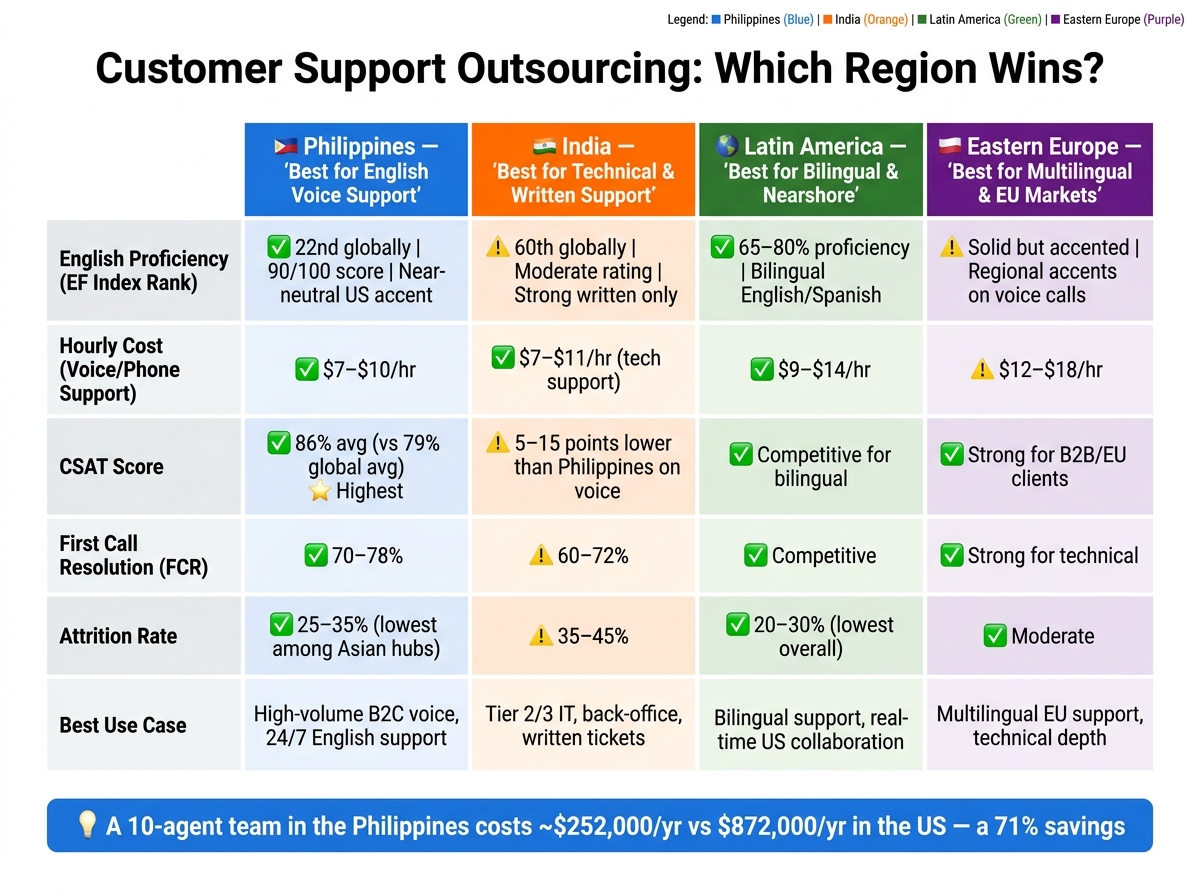
Customer Support Outsourcing: Philippines vs India vs LATAM vs Eastern Europe
Choosing the right region for outsourcing depends on what matters most to your business - whether that's cost, language proficiency, technical expertise, or time-zone alignment. Here's a quick breakdown of the strengths and weaknesses of each region to help you weigh your options.
| Region | Pros | Cons |
|---|---|---|
| Philippines | Near-neutral US accent; top English proficiency in Asia; empathy-driven service culture; 24/7 operational capability; lowest attrition among Asian hubs (25–35%) | Prone to natural disasters; less technical depth compared to India for Tier 2/3 support |
| India | Lowest hourly rates ($6–$12/hr); vast, scalable talent pool; strong technical and IT support expertise | Higher attrition rates (35–45%); regional accents may increase handle times on US voice calls; ranked lower in global English proficiency (60th globally) |
| Latin America | Real-time alignment with US time zones (0–2 hour difference); strong bilingual English/Spanish capabilities; lower long-term attrition (20–30%) | Smaller talent pools compared to Asian hubs; labor costs 15–30% higher than in the Philippines; varying political stability across countries |
| Eastern Europe | High technical skills; multilingual capabilities (German, French, etc.); close proximity to Western Europe | Most expensive offshore option ($14–$22/hr); limited overlap with US business hours; geopolitical risks in some parts of the region |
The Philippines emerges as a top contender for voice-based, B2C support targeting US consumers, thanks to its neutral accents, cultural alignment, and competitive pricing.
"The Philippines wins on neutral US accent and voice CSAT; India wins on technical support depth and written ticket work." - F5 Hiring Solutions
If cost is your main concern and the work is non-voice - like back-office processing or technical ticket handling - India is the better choice. Latin America suits teams that require real-time collaboration or need to cater to Spanish-speaking customers. Meanwhile, Eastern Europe is ideal for businesses focused on European markets with multilingual demands.
For businesses looking to scale affordable, high-quality, English-language customer support, the Philippines offers the most balanced solution. Platforms like FindTalent.ph make accessing this talent pool easier than ever.
Conclusion
The Philippines emerges as a standout option for US businesses prioritizing voice-based customer support. When comparing costs, a 10-agent team in the Philippines runs about $252,000 annually, compared to $872,000 in the US - a staggering 71% savings. Beyond cost, the country excels in delivering quality service, making it a top choice for voice-based, B2C customer support.
"The Philippines tops the index due to a strong balance of cost, English, and talent." - Ataraxis Global Outsourcing Talent Index
For companies looking to test the waters, starting with a six-month pilot of five agents is a smart way to measure customer satisfaction (CSAT) and efficiency. If your business relies heavily on voice support for English-speaking American customers, the Philippines offers unmatched advantages. For technical or back-end support, a hybrid approach - Philippine agents for voice paired with Indian agents for written tasks - can be highly effective.
To simplify your transition, platforms like FindTalent.ph provide access to verified, AI-matched Filipino professionals, eliminating the complexities of traditional BPO setups.
FAQs
What support tasks are Filipino agents best suited for?
Filipino agents are known for their exceptional performance in voice-based support roles. Their strong English skills, clear communication, and ability to empathize make them well-suited for tasks like Tier 1 customer support, billing inquiries, general customer service, and managing complex or sensitive conversations. Additionally, their familiarity with Western cultural norms further enhances their effectiveness in these roles.
How do I measure outsourcing success (CSAT, FCR, handle time)?
To gauge the success of outsourcing efforts, it's crucial to track a few important metrics like Customer Satisfaction (CSAT), First Contact Resolution (FCR), and Average Handle Time (AHT). These indicators offer valuable insights into performance and areas for improvement.
- Customer Satisfaction (CSAT): Gather regular feedback from customers to ensure satisfaction levels remain steady, ideally around 86%. This helps you understand how well outsourced teams are meeting expectations.
- First Contact Resolution (FCR): Strive to address and resolve customer issues during the first interaction. High FCR rates indicate effective problem-solving and a smoother customer experience.
- Average Handle Time (AHT): Keep an eye on how long calls or interactions take. Shorter durations often reflect efficiency, but balance is key - rushing through calls can compromise quality.
By regularly comparing these metrics against industry standards and internal targets, you can identify trends and make adjustments to improve performance over time.
What’s the fastest way to hire vetted Filipino support agents?
The fastest way to bring onboard vetted Filipino support agents is by using platforms like FindTalent. These platforms let you browse pre-screened profiles, compare potential fits, message candidates directly, and start collaborating within a matter of days. This simplified approach makes it easy to connect with skilled professionals without the usual hassle.