Business Operations
The $2,000/Month Filipino VA: Meet the AI Automation Specialists Every SMB Is Racing to Hire
Filipino AI automation VA at $2,000/month automates lead intake, CRM, support triage, scheduling, and reporting—saving 10–20 hours/week.
10 min read

If your team is stuck doing manual follow-ups, CRM updates, scheduling, and reports, a Filipino AI automation VA can take over those workflows for about $2,000/month - often saving 10 to 20 hours a week and cutting lead response time from 24 hours to under 2 minutes in some cases.
I’d sum it up like this: this role is not about basic admin help. It’s about hiring one person to connect tools like ChatGPT, Zapier, Make, HubSpot, Slack, and Google Workspace so your sales, support, and admin work move with less manual effort.
Here’s the short version:
- What they do: automate lead intake, CRM updates, support triage, scheduling, reporting, and content repurposing
- What you pay: about $2,000/month for a full-time remote hire
- What you get back: fewer missed follow-ups, cleaner CRM data, faster replies, and less owner involvement
- What they are not: custom software developers or heavy backend engineers
- What to look for: systems thinking, workflow mapping, webhook/API comfort, and clear SOP writing
- How to test them: use a paid project like a lead form-to-CRM automation or dashboard build
- Why the Philippines: strong English, long remote-work history, and a large talent pool from the IT-BPM sector
A general VA handles tasks. An AI automation VA builds the process behind those tasks. That’s why many SMBs see this hire as a lower-cost way to get more done without adding a full U.S. in-house role.
| Role | Main Focus | Common Output | Typical Cost |
|---|---|---|---|
| General VA | Manual task support | Admin work completed | Varies |
| AI automation VA | Workflow setup and upkeep | Automated follow-through across tools | About $2,000/month |
| U.S. in-house automation/ops hire | Full internal function | Higher-level system support | $60,000–$90,000/year |
If I were hiring for this role, I’d focus less on titles and more on whether the person can map a workflow, build it across tools, explain it in plain English, and keep it running without constant hand-holding.
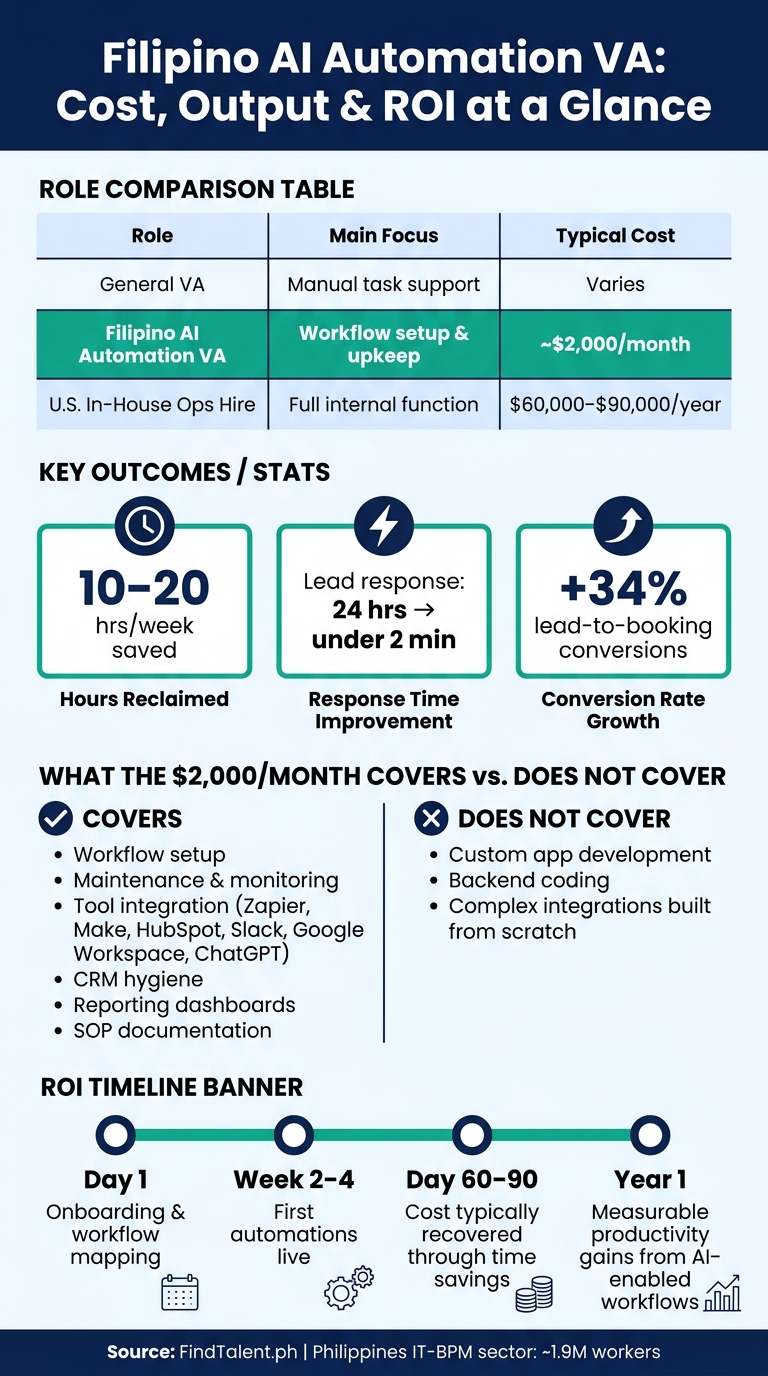
Filipino AI Automation VA vs. General VA vs. U.S. In-House Hire: Cost & Value Breakdown
AI Agent Team vs Virtual Assistant Team from the Philippines
sbb-itb-3690fed
What a Filipino AI Automation VA Actually Does
A Filipino AI automation VA is less of a task-taker and more of an operations-minded helper. Their job is to spot repeat work, connect the right tools, and cut down manual busywork.
Core Tasks They Can Handle for You
They can take care of lead intake, support triage, scheduling, CRM updates, reporting, and AI content creators for repurposing. On the customer and sales side, that often looks like AI-assisted support triage, routing urgent issues to the right person in Slack, logging new leads into the CRM on autopilot, sending appointment confirmations, and updating deal stages after calls.
On the internal operations side, they can pull together weekly performance reports from Google Sheets or HubSpot, document SOPs, and keep work visible across tools like ClickUp or Asana. For content operations, a skilled VA might turn one recorded webinar into email copy, social posts, and a blog outline. ChatGPT can help draft and repurpose, while a person handles final edits and makes sure the tone fits the brand.
That kind of output only works at scale when the apps talk to each other.
Tools and Systems They Should Know Well
The core stack usually includes ChatGPT for drafting, summarization, and content support; Zapier or Make for linking apps and building multi-step automations; HubSpot for CRM workflows and lead tracking; Slack for team communication; and Google Workspace for Docs, Sheets, Calendar, and reporting.
The point isn't just knowing each tool on its own. The point is knowing how to connect them into one working flow.
For example, a lead fills out an intake form. Zapier sends the data to HubSpot with the right tags. A follow-up task is created right away. A calendar link goes to the prospect. Then the sales rep gets a Slack notification. No manual re-entry. No dropped handoffs.
How an AI Automation VA Differs From a General VA
The simplest way to say it: a general VA follows tasks, while an AI automation VA improves the process behind those tasks.
| General VA | AI Automation VA | |
|---|---|---|
| Workflow role | Follows existing SOPs | Maps and builds new SOPs |
| CRM work | Updates records manually | Automates data entry and hygiene |
| Problem-solving | Handles individual requests | Identifies systemic gaps and fixes them |
| Output | Completed tasks | Reliable, repeatable systems |
That gap shows up in how the person thinks about workflows, not just how they finish a checklist.
Strong candidates can walk through a process from start to finish - from lead intake to CRM entry to follow-up to reporting - and point out where automation should step in and where a human still needs to review. You’ll also see the difference in clear SOP documentation. A solid AI automation VA doesn’t build a workflow and disappear. They document how it works, what triggers it, and what to check if something breaks. That level of documentation is often what separates a low-value helper from someone who can deliver strong output at this budget.
What SMBs Can Expect for $2,000/Month
With the role set, here’s what $2,000 per month tends to get you.
At this price point, SMBs often bring on a full-time specialist for about 160 hours per month. Their focus is usually automation and day-to-day ops support.
Typical Results: Less Manual Work, Faster Responses, Better Follow-Through
This kind of role can give back 10 to 20 hours a week by handling inbox triage, lead follow-up, scheduling, and reporting. That means fewer handoffs, less rework, and less stuff slipping through the cracks.
In plain English: the business runs with less chasing, less copy-pasting, and fewer dropped balls.
Fast follow-up also has a direct effect on sales. When lead tracking was manual, faster follow-up and unified CRM capture cut lead response time from 24 hours to under 2 minutes and increased lead-to-booking conversions by about 34%.
Reporting gets easier too. Instead of pulling weekly numbers by hand, the owner gets a dashboard or summary that the VA keeps up to date and watches over. If something starts to go off course, like a dip in inbound leads or a jump in support tickets, the VA flags it and suggests what to do next.
What This Budget Covers and Where the Limits Are
$2,000/month covers hands-on execution, workflow upkeep, and coordination across tools.
That said, not every workflow fits inside this budget.
This price usually covers:
- Setup of existing workflows
- Maintenance and monitoring
- Optimization of systems already in place
- Coordination between tools
It does not cover custom app development, backend code, or complex integrations built from scratch.
For most SMBs, the owner still sets the direction. The VA’s role is to put that plan into action, keep things running, and make sure the process works the way it should.
Comparison Table: Manual Process vs. AI Automation VA Support
In day-to-day ops, the difference often looks like this:
| Workflow Area | Manual Process | With an AI Automation VA |
|---|---|---|
| Lead follow-up speed | Slow, inconsistent, or missed | Fast, standardized follow-up |
| CRM accuracy | Missing tags, outdated stages, manual errors | Auto-tagged, consistently updated, duplicates removed |
| Support response consistency | Varies by staff workload | Standardized templates, tiered routing, AI-assisted drafts |
| Reporting effort | Hours of manual data pulling each week | Maintained dashboards; owner reviews, not assembles |
| Appointment scheduling | Back-and-forth emails, manual calendar updates | Automated confirmations, reminders, and calendar sync |
| Owner involvement | High; owner handles routing, follow-up, and fixes | Low; owner reviews outcomes and approves changes |
How to Evaluate and Hire the Right Specialist
Skills to Screen for Before You Hire
Start by screening for systems thinking, not just tool knowledge.
That matters because the right person doesn't simply know how to click around in Zapier or Make. They know how to cut manual admin, speed up follow-up, and keep workflows from falling apart when something goes wrong. A strong specialist thinks in triggers, actions, and backup steps.
Ask them to walk you through the most complex multi-platform workflow they've built. Listen for how they explain the logic, where things could fail, and what they did to handle edge cases. You should also ask if they can:
- Read API docs
- Configure webhooks
- Write simple SOPs for each workflow
That last point is easy to miss, but it's a big one. If they can't explain what they built in plain English, someone on your team may struggle to maintain it later. Use that same lens when you move into a paid test.
A Simple Paid Test Project to Confirm Fit
Use a short paid test based on a real workflow. In plain terms, give them something they would actually own if you hire them.
| Project Type | What to Ask For | What It Reveals |
|---|---|---|
| Lead Intake Workflow | Connect a web form to a CRM with automated notifications | Integration logic |
| CRM Cleanup | Deduplicate and normalize a sample dataset of 2,000+ records | Data cleanup and platform skill |
| Reporting Dashboard | Build an automated Google Sheets dashboard pulling from a CRM export | Reporting accuracy |
| SOP Creation | Document a manual process and flag 3 steps ready for automation | Process clarity and writing |
No matter which test you choose, ask for a short written summary of what they built and why.
That habit tells you a lot. It shows whether this person leaves behind clean systems that another hire can step into later, or a mess only they can untangle.
Using FindTalent.ph to Find Verified Filipino AI-Capable Talent
Once your test project is set, the next step is sourcing from a pre-screened talent pool.
FindTalent.ph helps shorten that search by screening specialists for identity and skills before their profiles become visible to employers. So you're not starting from scratch with every applicant. You're reviewing people who have already passed a baseline screen. That's useful when you need someone who can work inside a stack that already includes ChatGPT, Zapier, Make, HubSpot, Slack, and Google Workspace.
The platform also uses AI-powered matching to surface profiles that fit your stack and workflow needs. If you want more hands-on support, recruiter-assisted sourcing starts at $600 for SMBs. Employer subscription tiers are $69 or $99 per month.
Because it's a direct-hire model, the full $2,000/month goes to the specialist, with no agency markup in the middle.
A lot of top Filipino automation specialists come from the Philippines' IT-BPM sector, which employs about 1.9 million workers. That kind of background often means strong process mapping, solid exception handling, and clear documentation habits. And honestly, those are the traits that separate a steady operator from someone who builds brittle workflows that break quietly.
Conclusion: Why This Hire Works for SMBs That Need More Output Without a Full In-House Team
Manual admin work slows down sales, customer service, and growth. It eats up time that your team should be using on work that moves the business forward.
That’s why this hire makes the most sense when repetitive workflows are already creating drag. A Filipino AI automation VA at $2,000/month can own repetitive workflows from end to end: lead intake, CRM updates, support triage, appointment setting, reporting, and content operations, all inside the systems you already use.
"Structured workflows make automation useful instead of messy."
The budget makes sense because the savings are measurable. Many SMBs earn back the cost within 60–90 days through time savings, and AI-enabled workflows often lead to measurable productivity gains within the first year.
For SMBs that need more output without building a full in-house team, the upside comes from workflow ownership, not just task completion. This hire fits best when you have a steady flow of leads, repeat customer interactions, and a team spending too much time on manual coordination. Scope the role around owning specific workflows, like lead intake, CRM hygiene, support triage, and reporting. Set clear outcomes, and treat this person like an operations partner, not a task runner. That’s where the return starts to show.
FAQs
Is an AI automation VA right for my business?
Yes - if your business runs on repetitive, manual work that eats up your time or your team’s bandwidth.
They make the most sense when you need to connect tools like CRMs, project management software, and communication platforms through Zapier, Make, or n8n. They’re also a good fit if you want to use AI for customer support, lead management, and content operations.
The main upside is simple: less manual work, more time back for your team. In many cases, they also cut costs, with businesses often saving 70–80% compared to local consultants.
What tools should an AI automation VA already know?
An AI automation VA should already know the core tools behind business automation, including Zapier, Make, and n8n. They should be able to build multi-step workflows, add conditional logic, and handle errors without things falling apart the moment one step fails.
They should also be comfortable working with AI tools and APIs, along with your current SaaS stack, such as CRMs and project management platforms. On top of that, they should understand the basics of REST APIs and webhooks, and have some light Python or JavaScript skills for jobs that go past what no-code tools can do.
How long does it take to see ROI from this hire?
You can typically expect ROI within the first 3 to 6 weeks.
Workflow automation experts often launch their first end-to-end automated system in 3 to 4 weeks. Marketing automation specialists usually deliver a functional lifecycle automation suite in 4 to 6 weeks.
That short timeline comes down to deep tool-stack experience. They know how to get systems live fast, cut setup delays, and reduce manual work early on.