Business Operations
In-House vs Outsourced Teams: Cost Comparison 2026
Compare loaded annual costs, hiring speed, and control for US in-house hires versus Filipino remote outsourcing in 2026.
11 min read

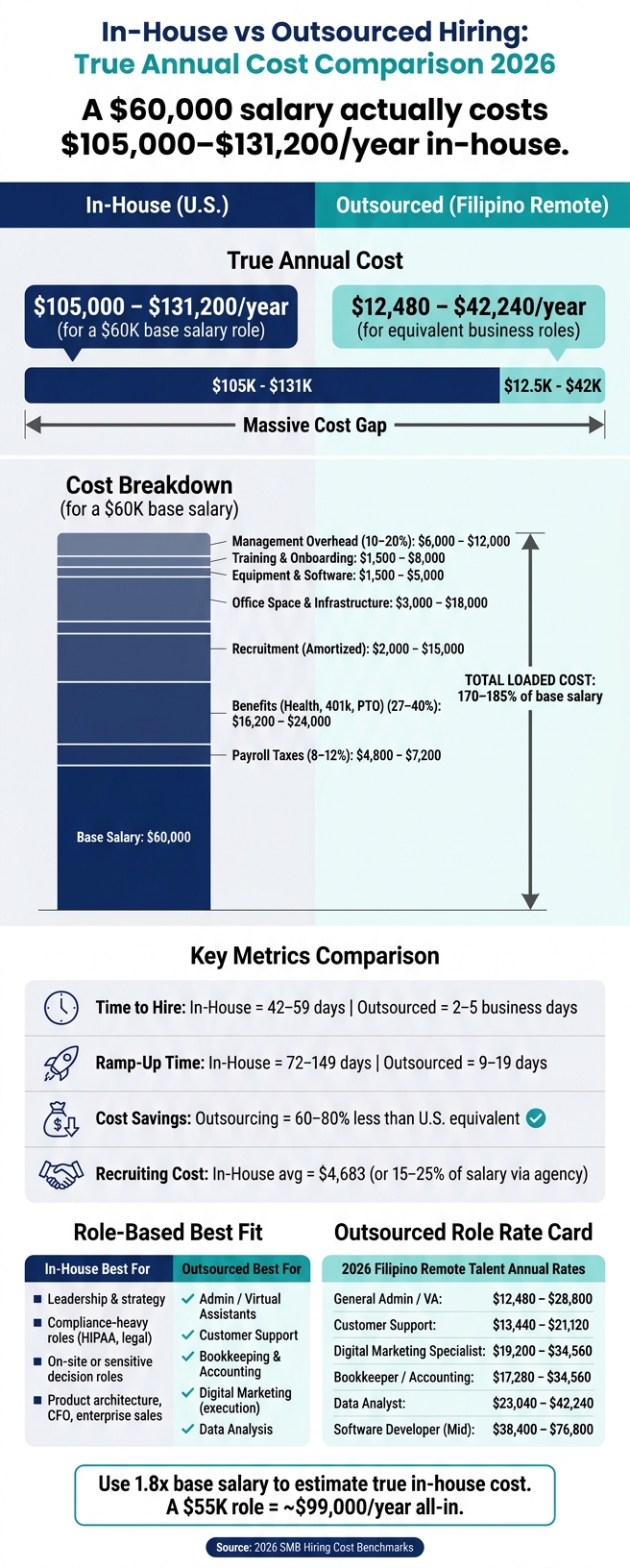
A $60,000 U.S. hire can cost about $105,000 to $131,200 a year once you add taxes, benefits, hiring, tools, space, training, and manager time. By contrast, a full-time outsourced hire in the Philippines often lands between $12,480 and $42,240 a year for many business roles, with higher totals for technical work.
If I had to boil this article down to one point, it’s this: salary is not the true comparison. Loaded cost is. And in 2026, that gap is big enough to change hiring plans for many U.S. small and midsize businesses.
Here’s what matters most:
- In-house U.S. hiring usually runs about 1.75x to 1.85x base salary
- Recruiting alone can cost $4,683 on average, or 15% to 25% of first-year salary with an agency
- New U.S. hires often take 2 to 4 months to ramp up
- Filipino remote talent often costs 60% to 80% less than a similar U.S. hire
- Outsourcing works best for process-based roles like admin, support, bookkeeping, and parts of marketing
- In-house still makes more sense for leadership, sensitive work, and roles tied closely to company direction
In-House vs Outsourced Hiring: True Annual Cost Comparison 2026
Outsourcing vs Insourcing | What to Outsource First / Outsourcing Calculator
sbb-itb-3690fed
Quick Comparison
| Factor | In-House (U.S.) | Outsourced (Filipino Remote) |
|---|---|---|
| Annual cost | $105,000 to $131,200 for a $60,000 base-salary role | Often $12,480 to $42,240 for many business roles |
| Upfront hiring cost | Higher | Lower |
| Time to hire | 42 to 59 days | 2 to 5 business days in many cases |
| Ramp time | 72 to 149 days to full output | 9 to 19 days in many cases |
| Control | Higher | Lower |
| Flexibility | Lower | Higher |
| Best fit | Leadership, sensitive work, on-site jobs | Repeatable remote work |
My take: if a role sets direction, handles risk, or owns key decisions, keep it in-house. If the role follows a clear process and needs steady output at a lower cost, outsourcing will often win on cost and hiring speed.
That’s the lens I’d use for the rest of this comparison.
The True Annual Cost of Hiring In-House in the US
A $60,000 salary rarely costs just $60,000.
For many U.S. employers, the full annual cost lands closer to $105,000 to $131,200. That gap catches a lot of small and midsize businesses off guard. Base pay is only one part of the bill. Once you add taxes, benefits, hiring costs, tools, space, training, and manager time, the loaded cost climbs fast.
Here’s what that looks like for a typical U.S. SMB hire.
Base Pay, Benefits, and Payroll Taxes
Start with salary, then add payroll taxes. In the U.S., employers usually pay about 8% to 12% in payroll taxes, including FICA, FUTA, and SUTA.
Then come benefits. Health insurance, 401(k) match, PTO, and management overhead often add 40% to 70% on top of base pay. On their own, a 3% to 6% 401(k) match, PTO, and 10% to 20% in management overhead can push total cost up in a hurry.
So even before recruiting or equipment enters the picture, the math has already changed.
Recruiting, Equipment, Office Space, and Training
Hiring itself isn’t cheap either. Agency fees, recruiter time, job boards, interviews, and background checks all stack up.
External recruiting agencies usually charge 15% to 25% of first-year salary. For a $60,000 role, that means $9,000 to $15,000 upfront. Even without an agency, the average U.S. cost-per-hire is $4,683.
After that, you still need to get the person set up. Hardware and software licensing usually cost $1,500 to $5,000 per employee. Office space and related overhead add another $3,000 to $18,000 per seat each year, depending on location. Training and onboarding add about $1,500 to $8,000 per year.
And there’s one more cost people tend to miss: ramp time.
New hires almost never operate at full speed on day one. Most need two to four months to fully ramp up, which means you’re paying full salary while getting partial output during that period.
Here’s the full breakdown for a $60,000 base salary:
| Cost Component | % of Base Salary | Annual Range ($60K Base) |
|---|---|---|
| Base Salary | 100% | $60,000 |
| Payroll Taxes (FICA, FUTA, SUTA) | 8% – 12% | $4,800 – $7,200 |
| Benefits (Health, 401(k), Life, PTO) | 27% – 40% | $16,200 – $24,000 |
| Recruitment (Amortized) | - | $2,000 – $15,000 |
| Office Space & Infrastructure | - | $3,000 – $18,000 |
| Equipment & Software | - | $1,500 – $5,000 |
| Training & Onboarding | - | $1,500 – $8,000 |
| Management Overhead | 10% – 20% | $6,000 – $12,000 |
| Total Loaded Annual Cost | 170% – 185% | $105,000 – $131,200 |
In most SMB settings, a $60,000 role ends up costing $105,000 to $131,200 per year. That loaded number is the right baseline to use before comparing in-house hiring with outsourcing.
That’s the in-house baseline; next comes the outsourced cost model.
The True Annual Cost of Outsourcing, Including Filipino Remote Talent
Compared with a loaded U.S. hire at $105,000–$131,200 per year, outsourcing can cost far less. But the total depends on the setup you choose and how much of the work your team still handles on its own, like hiring, payroll, compliance, and day-to-day management. So the next step is pretty direct: what do Filipino remote rates look like by role?
In 2026, U.S. companies usually go with one of two paths when hiring Filipino remote talent. Managed Service Providers (MSPs) roll recruitment, HR, payroll, and compliance into one hourly rate, which usually lands at $12–$16/hour. Direct remote hiring through platforms or agencies gives you more control and often costs $6.50–$15/hour, depending on the role.
Here are the 2026 benchmark rates for Filipino remote talent, based on 160 hours per month:
| Role Type | Hourly Rate | Monthly (Full-Time) | Annual Total |
|---|---|---|---|
| General Admin / VA | $6.50 – $15.00 | $1,040 – $2,400 | $12,480 – $28,800 |
| Customer Support | $7.00 – $11.00 | $1,120 – $1,760 | $13,440 – $21,120 |
| Digital Marketing Specialist | $10.00 – $18.00 | $1,600 – $2,880 | $19,200 – $34,560 |
| Bookkeeper / Accounting | $9.00 – $18.00 | $1,440 – $2,880 | $17,280 – $34,560 |
| Software Developer (Mid) | $20.00 – $40.00 | $3,200 – $6,400 | $38,400 – $76,800 |
| Data Analyst | $12.00 – $22.00 | $1,920 – $3,520 | $23,040 – $42,240 |
Even at the top end of these ranges, outsourcing a full-time role to a Filipino specialist usually costs 60%–80% less than a similar U.S. hire.
Platform Fees, Monthly Rates, and Setup Costs
The hourly rate is only part of the bill.
With direct hiring through a platform or agency, you can usually expect a one-time setup or onboarding fee of $500–$1,000. If the platform uses an Employer of Record (EOR) setup to manage local payroll and compliance, that often adds $400–$700 per month. On top of that, software and role-specific tools often cost another $100–$300 per month per worker, and that expense is usually separate no matter which model you use.
There’s also a cost that doesn’t show up neatly on an invoice: management time. When workflows are messy or poorly documented, the effective outsourcing cost can climb by 15%–25%. That’s the kind of expense that sneaks up on teams.
MSPs keep pricing more predictable by bundling the moving parts into one rate. Direct hiring usually costs less, but it also puts more coordination work on your side.
How FindTalent.ph Changes the Cost Structure
Direct hiring can save money, but it also pushes sourcing, screening, and replacement risk back onto your team. FindTalent.ph changes that math by cutting down sourcing and screening time with AI matching and recruiter-assisted vetting. It can reduce fill time from the U.S. average of 42 days to 2–5 business days.
That means lower time-to-hire and less risk of paying for someone who turns out to be the wrong fit.
Cost is only one side of the choice; the next section looks at how it stacks up against control, speed, and output.
In-House vs. Outsourced: Cost, Productivity, and Control Compared
Cost, ramp-up time, and control usually decide which model makes more sense. The table below shows where each option cuts costs, where it slows teams down, and where it keeps control closer to home.
| Dimension | In-House (US) | Outsourced (Filipino Remote) |
|---|---|---|
| Cost Stability | High fixed costs | Lower fixed cost; high flexibility |
| Speed | 42–59 days to hire; 72–149 days to full productivity | 2–5 business days to hire; 9–19 days to full productivity |
| Scalability | Slow; notice periods and legal risk | High; adjust hours or team size quickly |
| Operational Load | Standard HR and management | 15%–25% additional coordination load |
| Oversight | Direct; high | Indirect; requires strong SOPs and QA layers |
| Turnover Cost | 50%–200% of salary to replace | Backed by replacement guarantees |
When In-House Teams Cost More but Give You More Control
In-house is worth the extra spend when the role is tied closely to strategy or carries too much risk to hand off.
Some jobs earn that premium. If a role sits at the center of your edge in the market - like product architecture, legal strategy, or proprietary data systems - keeping it in-house is often the safer call.
The same goes for compliance-heavy work. Roles that deal with HIPAA-covered data, financial auditing, or work that needs someone on-site are usually better kept in-house.
In those cases, the higher loaded cost buys something plain and simple: tighter control, stronger compliance, and less risk around key knowledge.
When Outsourcing Delivers Better Cost Efficiency
Outsourcing tends to work best when the role is repeatable, remote-friendly, and easy to document.
For roles like customer support, bookkeeping, digital marketing, and admin work, Filipino remote talent often gives U.S. companies a much better cost setup. A U.S.-based admin costs far more once you include the full loaded cost, while a Filipino VA can handle the same work with savings that often reach 75%–83% for one role.
It also helps when speed matters. If a U.S. company needs extra help for a product launch or a seasonal rush, waiting 42–59 days for an in-house hire can drag things down. Outsourced teams can often get up and running in 2–5 business days through remote staffing providers.
There is a trade-off, of course. You give up some direct oversight, and that means better SOPs and QA matter a lot more. But for execution-heavy roles, lower cost and faster ramp-up usually beat the loss of day-to-day control.
How to Choose the Right Model for Your Business in 2026
Use the cost comparison above to line up each role with the hiring model that makes the most sense. Look at four things: cost, urgency, workload swings, and how close the role is to your core business. Start with the loaded-cost figures above, then match each role to the model that fits its day-to-day job.
Which Model Fits by Role Type, Budget, and Growth Stage
Here’s the rule: the closer a role is to your competitive edge, the more it should stay in-house. Roles built around repeatable processes usually fit outsourcing better.
For most SMBs, a hybrid setup works best. Keep strategy in-house. Outsource repeatable execution.
The easiest way to make the call is by role, not headcount.
| Role | Best Model | Why |
|---|---|---|
| Administrative Assistant | Filipino Remote (FindTalent.ph) | $13,500–$20,800/year vs. $72,000–$95,000/year in-house |
| Customer Service Rep | Filipino Remote (FindTalent.ph) | High-volume, remote-friendly, and pre-vetted candidates can be placed in 2–5 business days |
| Bookkeeper | Filipino Remote (FindTalent.ph) | Process-driven; about 68%–73% lower cost than a U.S. hire |
| Digital Marketing Specialist | Filipino Remote or Hybrid | Execution tasks like research, reporting, and lead generation outsource well; strategy stays in-house |
| Product strategy, CFO, and enterprise sales leadership | In-House | Core strategy, leadership, and sensitive judgment are better kept local |
| Contract Specialist | Contractor | Good for fluctuating work where you only pay for the capacity you need |
That’s why lean teams rarely go all-in on one model.
For early-stage founders trying to stretch every dollar, outsourcing admin, bookkeeping, and customer support through a platform like FindTalent.ph can free up budget while still giving you enough control and hiring speed. For growing SMBs adding headcount, hybrid is often the smarter move: keep team leads and strategists local, then scale execution roles with Filipino remote professionals.
A simple gut check helps here. If the role sets direction, owns sensitive calls, or shapes revenue, keep it close. If the role follows a clear process and needs steady output, outsourcing is often the better fit.
Use 1.8x base salary to estimate in-house cost. A $55,000 customer service role turns into about $99,000 all-in.
Key Takeaways for 2026 Hiring Decisions
Salary is just the starting line. Once you add payroll taxes, benefits, recruiting fees, equipment, office space, and the cost of a bad hire - at least 30% of first-year salary - in-house hiring gets much heavier than it looks on paper.
Outsourcing, especially with Filipino remote talent, gives you a lower cost base, faster hiring, and more flexibility. The trade-off is less direct oversight, so your SOPs and output expectations need to be clear from day one.
The best 2026 hiring choice depends on the role: keep strategic control in-house, and use outsourced Filipino remote talent for lower-cost execution.
FAQs
What costs are often left out of salary comparisons?
Looking only at salary gives you an incomplete picture. In the United States, the actual cost of an in-house employee often lands at 170% to 185% of base salary once the extra expenses are factored in.
That usually includes:
- payroll taxes
- benefits
- office overhead
- recruitment
- onboarding and training
- management time
- paid time off
Which roles are best to outsource versus keep in-house?
Outsourcing tends to work best for roles that need high-volume scaling or specialized technical skills. That often includes administrative support, digital marketing, bookkeeping, customer service, design, and software engineering.
Keep roles in-house when they depend on close, real-time collaboration, a strong read on company culture, or high-level strategic oversight. A lot of businesses split the difference with a hybrid model: they keep core strategy in-house and outsource operational, support, and specialized technical roles.
How much management time does outsourcing really add?
Outsourcing often looks cheaper at first glance. But the sticker price rarely tells the whole story.
In most cases, you also spend extra time on coordination, communication, and quality checks. Those hidden costs can add up fast, and teams often miss them in early budget comparisons. A practical rule of thumb is to set aside 15% to 20% of your own time for project oversight.
There are also a few other costs to plan for:
- Communication tools
- QA check-ins
- Possible rework of 10% to 20% of deliverables
- One-time onboarding and knowledge transfer costs of about $5,000 per person
That means outsourcing isn't just about the vendor rate. You need to factor in the time and money it takes to keep the work on track and get new people up to speed.