Business Operations
Ultimate Guide to Hiring Filipino Remote Professionals
Choose freelancers for projects, full-time for core roles, or hybrid setups—includes cost breakdown, compliance, and onboarding.
11 min read

If I want lower hiring costs without giving up day-to-day support, hiring in the Philippines can cut salary spend by 60% to 80% compared with U.S. hires. The main choice is simple: freelancers for changing work, full-time hires for steady roles, or a hybrid setup for both.
Here’s the short version:
- Freelancers fit one-off projects, short-term help, and niche skills
- Full-time hires fit core roles that need consistency, ownership, and daily support
- Hybrid teams fit companies that need a core team plus extra help during busy periods
- Full-time hiring often means budgeting 115% to 130% of base pay after benefits and required pay
- A $1,500/month employee can cost about $2,075/month all-in with benefits, EOR fees, and health coverage
- Common outsourced roles include:
- Virtual assistants: $500 to $1,200/month
- Customer support reps: $500 to $1,000/month
- Bookkeepers: $700 to $1,500/month
- Web developers: $1,500 to $4,000/month
- In the Philippines, full-time employees must get items like SSS, PhilHealth, Pag-IBIG, and 13th-month pay by December 24
- If I treat a contractor like an employee, I can face worker classification problems and back-pay risk
- An EOR can handle payroll, benefits, and local rules, often for $199 to $600 per employee per month
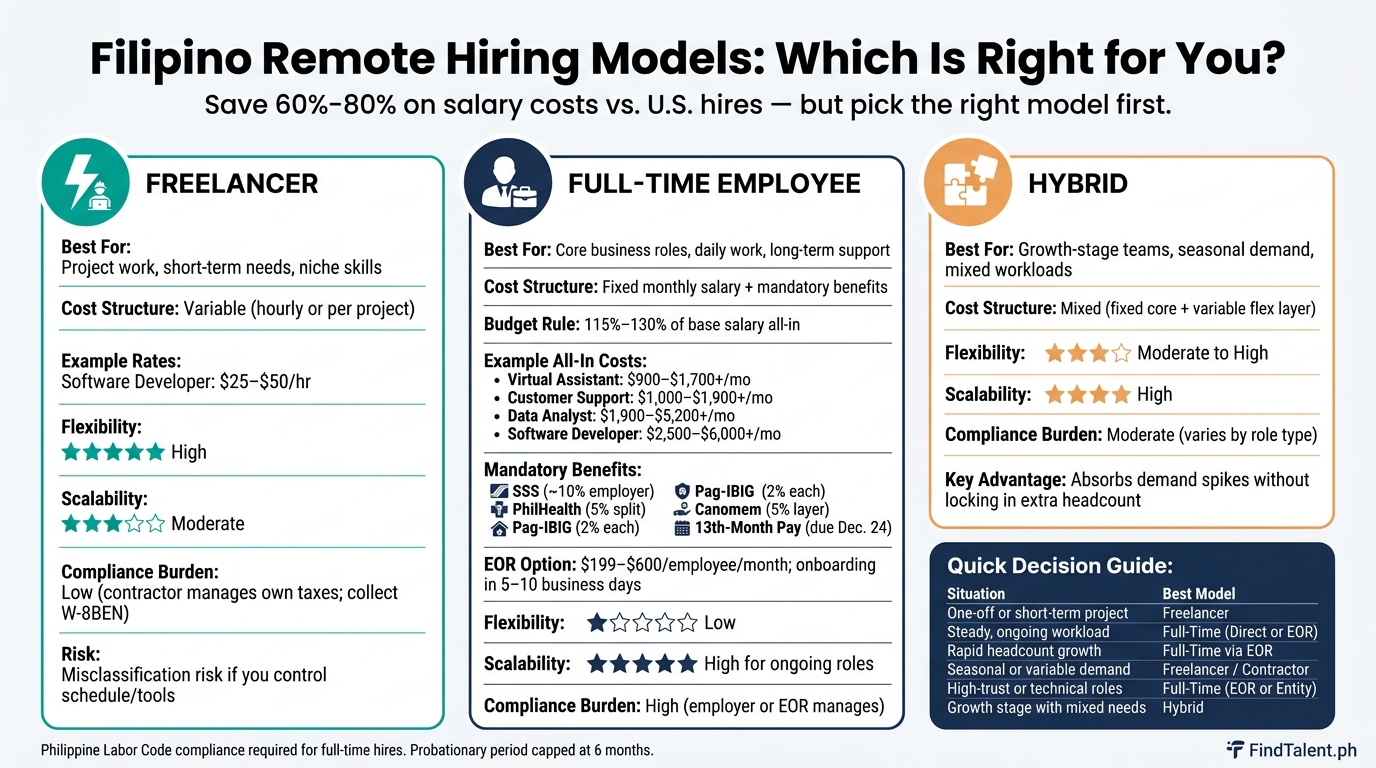
Filipino Remote Hiring Models: Freelancer vs Full-Time vs Hybrid Cost & Fit Guide
What Everyone Gets Wrong About Filipino Remote Workers
sbb-itb-3690fed
Quick Comparison
| Model | Best For | Cost Style | Flexibility | Team Growth | Compliance |
|---|---|---|---|---|---|
| Freelancer | Project work, short-term needs, niche skills | Variable | High | Medium | Lower employer burden, but classification risk |
| Full-Time | Core business roles, daily work, long-term support | Fixed + benefits | Lower | High | Employer or EOR handles benefits and local rules |
| Hybrid | Growth-stage teams, seasonal demand, mixed workloads | Mixed | Medium to High | High | Depends on role type |
Bottom line: I’d pick the model based on workload first, then cost, then legal setup. That keeps hiring simple, lowers risk, and makes team growth easier to plan.
Choose the Right Hiring Model: Freelancer, Full-Time, or Hybrid
Once you know if you need flexibility, scale, or a mix of both, the next step is simple: pick the setup that fits that need. In most cases, it comes down to three options: freelancer, full-time, or hybrid.
Filipino Freelancers and Independent Contractors
Freelancers usually work on a project, hourly, or retainer basis, and they often support more than one client at the same time. This setup makes the most sense when the work is short-term, tied to a specific project, or calls for a specialized skill set. For example, software developers often charge $25–$50 per hour.
There’s one big thing to watch: misclassification risk. If you control a contractor’s schedule too closely or treat them like an employee, you can run into compliance issues under Philippine law.
Full-Time Filipino Remote Employees
If the work is steady and tied closely to your day-to-day business, a full-time hire usually makes more sense than contractor support. Full-time roles fit work that needs clear ownership, consistency, and long-term follow-through.
Under the Philippine Labor Code, full-time employees must receive statutory benefits, including SSS, PhilHealth, and Pag-IBIG contributions, plus 13th-month pay equal to one-twelfth of their basic annual salary, due by December 24. In practice, you should budget 115%–130% of base salary to cover salary, benefits, and statutory pay.
If you don’t want to set all of this up on your own, an Employer of Record (EOR) can manage payroll, compliance, and benefits for you. EOR fees usually range from $199 to $600 per employee per month, and onboarding can take as little as 5–10 business days.
One more point matters here: under Philippine law, the probationary period is capped at six months. After that, the employee automatically becomes a regular employee with security of tenure.
Hybrid Team Structures for Growth
For growing teams, the answer often isn’t one model or the other. It’s both. Use full-time team members for core operations, then bring in freelancers for overflow work, seasonal spikes, or niche tasks.
Here’s how the three models stack up:
| Factor | Freelancer | Full-Time Employee | Hybrid |
|---|---|---|---|
| Best For | Short-term or specialized work | Long-term, core operations | Scalable growth, seasonal overflow |
| Cost Structure | Variable (hourly or project) | Fixed (monthly + benefits) | Mixed |
| Flexibility | High | Low | Moderate to High |
| Scalability | Moderate | Strong for ongoing roles | High |
| Management Complexity | Low | High | Moderate |
| Compliance | Contractor manages own taxes | Employer/EOR handles compliance and benefits | Varies by role type |
Compare Flexibility, Scalability, and Total Cost
How Each Model Handles Changing Workloads and Schedules
Once you pick a hiring model, the real test starts when work shifts.
That’s where the gap shows up fast. Contractors usually flex the fastest, full-time staff give you steadier day-to-day coverage, and hybrid teams help absorb spikes without locking you into extra headcount. Full-time roles are also tougher to unwind than contractor agreements.
| Factor | Freelancer | Full-Time | Hybrid |
|---|---|---|---|
| Scheduling Flexibility | High; pay only for hours worked | Fixed; aligned to your schedule | Moderate; core team + flex layer |
| Scope Changes | Easy to pivot or end | Requires training and onboarding | Scalable via flex roles |
| Responsiveness | Variable; may serve other clients | High; dedicated to your business | High for core; variable for flex |
There’s also a practical point here: many Filipino remote professionals already work U.S. hours, so live overlap is usually manageable.
Cost Breakdown in USD: Pay, Benefits, Tools, and Management Time
After you know which setup matches the workload, it’s time to look at cost.
Base pay is only one piece of the bill. Benefits, tools, and the time it takes to manage people all add up.
For full-time hires, compliant employment usually adds about 14% to 22% on top of gross salary once you include SSS, PhilHealth, Pag-IBIG, and mandatory 13th-month pay. So a $1,500/month salary can land at about $2,075/month all-in after statutory contributions, 13th-month accrual, EOR admin, and HMO are added.
Freelancers can seem cheaper at first glance. But that doesn’t mean the total spend stays low. You still need to factor in sourcing, vetting, onboarding, and re-briefing across separate engagements. That time costs money, even if it never shows up as a payroll item.
| Role | Base Monthly Salary | All-In EOR Planning Range |
|---|---|---|
| Virtual Assistant | $700–$1,400 | $900–$1,700+ |
| Customer Support | $800–$1,500 | $1,000–$1,900+ |
| Data Analyst | $1,500–$4,500 | $1,900–$5,200+ |
| Software Developer | $2,000–$5,000+ | $2,500–$6,000+ |
Cost matters, but only after the structure matches the workload.
Which Hiring Model Fits Your Business Situation
The best model comes down to what your business needs right now. You can find verified Filipino professionals to match any of these structures. A product launch with a hard deadline is one kind of problem. A year-round support queue is another.
| Business Situation | Best Model | Why |
|---|---|---|
| Short-term or one-off project | Freelancer | Lowest commitment; easy exit when work ends |
| Steady, ongoing workload | Full-Time (Direct or EOR) | Predictability and long-term task ownership |
| Rapid headcount growth | Full-time via EOR | Handles compliance and payroll without entity setup |
| Seasonal or variable demand | Freelancer / Contractor | Ramp up and down without long-term liability |
| High-trust or technical roles | Full-Time (EOR or Entity) | Better IP protection and retention of top talent |
Once the model is set, the next move is to handle classification, onboarding, and communication the right way.
Handle Legal, Compliance, and Team Operations Correctly
This hiring model only works if classification, compliance, and day-to-day management match the level of control you want.
Worker Classification, Labor Rules, and Mandatory Benefits
Once you pick the hiring model, the legal setup needs to match it.
The Philippine Department of Labor and Employment (DOLE) uses a "four-fold test" to decide whether someone is an employee or an independent contractor. The four checks are: how the worker was selected and engaged, whether wages are paid, whether the company has the power to dismiss, and - most of all - whether the company controls how the work is done, not just the final result.
If you control hours, tools, or daily tasks, Philippine law may treat that worker as an employee.
And getting this wrong can get expensive fast. Back pay for unpaid 13th-month pay, SSS, PhilHealth, and Pag-IBIG contributions can pile up. If a remote worker negotiates contracts or closes sales for you, the Philippines may also treat part of your business as locally taxable.
| Obligation | Details |
|---|---|
| SSS | Social Security System; employer contributes about 10% of monthly salary credit. |
| PhilHealth | Health insurance; 5% total premium, split evenly between employer and employee. |
| Pag-IBIG | Housing fund; both employer and employee contribute 2%, capped at PHP 200 each. |
| 13th-Month Pay | Mandatory; equals 1/12 of annual basic salary, paid by Dec. 24. |
| Service Incentive Leave | 5 paid days per year after one year of service, convertible to cash if unused. |
For contractors, those items don't apply. But the contractor setup has to be real, not just a label on paper. U.S. companies should also collect a W-8BEN from Filipino contractors to document foreign status and avoid U.S. backup withholding.
There’s another thing to watch: if you miss the evaluation window, regular-status rules apply. And unlike U.S. at-will employment, ending a Philippine employee relationship requires either "Just Cause" or "Authorized Cause", plus a strict two-notice rule.
Once classification is settled, the next step is simple: set up the work before the person starts.
Onboarding, SOPs, and Communication Systems for Remote Teams
After compliance is sorted out, turn the role into a repeatable process.
Get the role, process, and access ready before day one. That means a written job scorecard with measurable outcomes, documented SOPs for recurring tasks, and tool access and permissions already set up. Week one should focus on training, not output. A 30/60/90-day onboarding plan helps a lot here and can prevent early disengagement.
A simple tool stack usually does the job:
- Slack or Teams for chat
- Zoom for calls
- Asana, ClickUp, or Jira for task tracking
- Google Drive or Notion for SOPs
Once SOPs are in place, set overlap hours and response-time rules so nobody has to guess.
Managing Performance Across Time Zones
The Philippines is about 12 hours ahead of U.S. time zones. That can actually work in your favor because it makes a handoff workflow possible.
The main shift is this: manage by output, not screen time. Be clear about what "done" means for each task, set deadlines, and use your project management tool as the single source of truth.
Use overlap hours for live decisions, then let the work move forward async. Record key meetings and put response-time rules in writing. When giving feedback, keep it direct and respectful: one positive note, the correction, then the next steps. Also ask for questions on purpose. That small step often clears up expectations before problems start.
That kind of structure makes remote work far more predictable across time zones.
Build a Scalable Hiring Process and Next Steps
Once your team structure is set, lock in a hiring process that you can use again and again. Every new role should follow the same playbook. That means using a standard role brief, a clear hiring model, and a consistent screening flow.
Start with a precise role brief. Spell out the core deliverables, the tools the person needs to know, and the exact working hours. When those details are clear from the start, you cut down on misalignment on day one. The brief should also guide the hiring model.
How FindTalent.ph Supports Faster and More Reliable Hiring
Screening is often the slowest part of hiring. So one of the biggest wins is cutting down the time spent filtering candidates.
FindTalent.ph helps speed that up with AI-powered matching and verified Filipino specialists across:
- admin
- support
- tech
- content
- finance
- design
- sales
- data roles
The recruiter-assisted plan also includes sourcing and screening support, with 1–3 pre-vetted candidates and a free replacement guarantee. In plain English, that means less time sorting through applications and more time talking to strong candidates.
Final Takeaway: Choose the Model That Matches Your Workload and Growth Stage
Once the hiring system is in place, the next step is simple: pick the model that fits your workload and growth stage.
Use freelancers for variable tasks, full-time staff for core functions, and hybrid teams when you're in growth mode. Then back that up with clear classification, SOPs, onboarding milestones, and performance expectations.
FAQs
How do I choose between a freelancer and a full-time hire?
It comes down to your budget, your goals, and how closely you want this person tied into your day-to-day work.
Freelancers make the most sense for project-based tasks. They’re a good fit when you need short-term help, specialized skills, or more flexibility.
A full-time hire works better when the role includes steady, long-term responsibilities and a set schedule on your team. If you're hiring full-time, an Employer of Record can help U.S. startups manage payroll and benefits in line with local rules without opening a local entity in the Philippines.
What is the real monthly cost of hiring in the Philippines?
The real monthly cost of hiring a Filipino remote professional comes down to three main things: the role, the person’s experience level, and how technical the job is.
Base pay usually falls between $700 and $5,500+ per month.
For example:
- Entry-level admin or support roles often start at $500 to $1,500 per month
- More specialized roles, like software developers or project managers, can cost $2,000 to $6,000+ per month
On top of base salary, plan to add about 14% for employer costs like social security, health insurance, and 13th-month pay.
How can I avoid contractor misclassification risk?
Simply calling someone an independent contractor does not override Philippine labor laws. The Department of Labor and Employment (DOLE) looks at a four-factor test, with special focus on who controls how the work is done.
That point matters a lot. If you set fixed hours, assign day-to-day tasks, or keep a close watch on performance, the worker may be treated as an employee instead. And that can lead to benefit and tax liability.
To lower the risk, use clear, compliant agreements. If you want more protection, consider an EOR.