Business Operations
Filipino Virtual Assistant Salary Guide 2026: Real Rates by Role (Data From 1,000+ Hires)
2026 pay ranges for Filipino virtual assistants: $800–$3,000+ monthly by role, adjusted for experience, skills, US hours, and hiring model.
17 min read

If you’re hiring a Filipino VA in 2026, most direct-hire budgets fall between $800 and $3,000+ per month depending on the role. From data across 1,000+ hires, general admin and support sit at the low end, while project management, SEO, bookkeeping, and technical roles cost more.
Here’s the short version:
- General admin: about $800–$1,200/month for entry-level full-time help
- Customer support: about $600–$2,000+/month, based on channel, shift, and experience
- Executive assistant: about $640–$2,400+/month, with more pay for trust-heavy work
- Bookkeeping: about $1,000–$3,200+/month, since finance work carries more risk
- Social media: about $640–$2,880+/month, with higher pay for content ownership and ads
- SEO / digital marketing: about $640–$3,200+/month, driven by tools and results
- Project management: about $1,200–$3,200/month, based on delivery ownership
- Technical / web support: about $640–$3,200+/month, with coding and systems work at the top
What changes the price most?
- Experience
- Skill depth
- U.S. hours overlap
- How you hire: direct hire is usually lower, while agencies and EOR setups often add 15%–60%
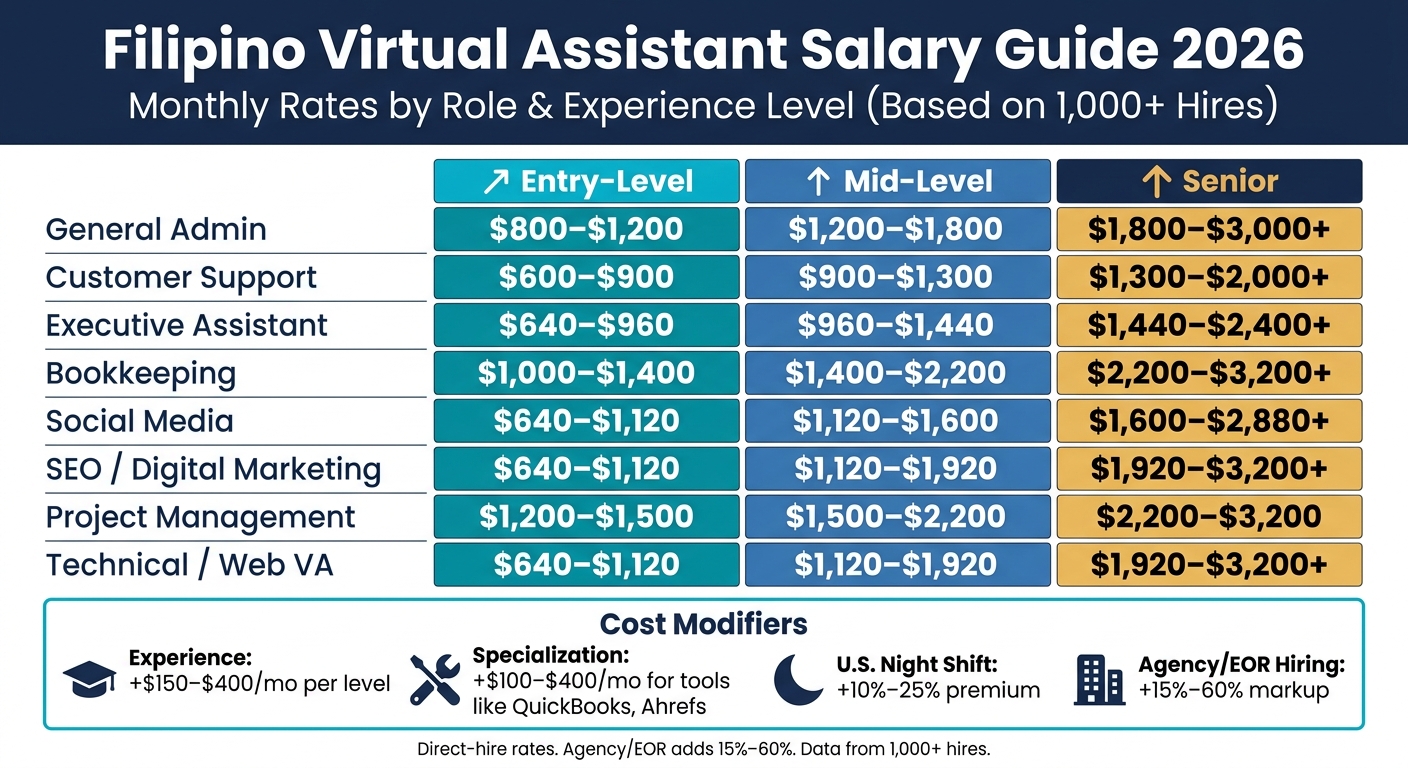
Filipino Virtual Assistant Salary Guide 2026: Rates by Role & Experience Level
Hiring Virtual Assistants in the Philippines (With Rates & Salaries!)
sbb-itb-3690fed
Quick comparison
| Role | Entry-Level Monthly | Mid-Level Monthly | Senior Monthly |
|---|---|---|---|
| General Admin | $800–$1,200 | $1,200–$1,800 | $1,800–$3,000+ |
| Customer Support | $600–$900 | $900–$1,300 | $1,300–$2,000+ |
| Executive Assistant | $640–$960 | $960–$1,440 | $1,440–$2,400+ |
| Bookkeeping | $1,000–$1,400 | $1,400–$2,200 | $2,200–$3,200+ |
| Social Media | $640–$1,120 | $1,120–$1,600 | $1,600–$2,880+ |
| SEO / Digital Marketing | $640–$1,120 | $1,120–$1,920 | $1,920–$3,200+ |
| Project Management | $1,200–$1,500 | $1,500–$2,200 | $2,200–$3,200 |
| Technical / Web VA | $640–$1,120 | $1,120–$1,920 | $1,920–$3,200+ |
Bottom line: I’d budget by role first, then adjust for experience, shift needs, and hiring model. That gets you much closer to the true monthly cost before you post the job.
1. General Admin Virtual Assistant
General admin VAs usually take care of inboxes, calendars, data entry, basic research, and routine documentation. For many teams, this role sets the baseline for Filipino VA budgets.
| Experience Level | Hourly Rate (USD) | Monthly Rate (Full-Time, ~160 hrs/mo) | Typical Work |
|---|---|---|---|
| Entry-level (0–2 years) | $5–$8 | $800–$1,200 | Data entry, basic inbox sorting, calendar updates, task execution under supervision |
| Mid-level (2–4 years) | $8–$12 | $1,200–$1,800 | CRM updates, independent inbox management, research, meeting coordination |
| Senior (4+ years) | $12–$18+ | $1,800–$3,000+ | SOP ownership, complex scheduling, cross-functional coordination, light team oversight |
The jump in pay usually happens when the role moves beyond simple task handling. Once a VA starts managing moving parts, keeping things on track, and taking ownership without much hand-holding, rates tend to climb fast.
For U.S. companies, business-hour overlap is often baked into the base rate instead of charged as a separate add-on. If you hire through an agency or EOR, expect extra overhead and service fees on top. So a $6.00/hour base rate can end up closer to $7.50–$9.00/hour all-in.
2. Customer Support Virtual Assistant
Once a VA shifts from behind-the-scenes task work to live customer support, pay starts to depend a lot more on speed, tone, and product knowledge. This role usually sits in the middle of the market: it often pays more than general admin work, but less than executive assistance and most technical jobs. There’s also a healthy supply of support VAs, which keeps pricing competitive. Even so, live support still tends to pay more than admin tasks.
| Experience Level | Hourly Rate (USD) | Monthly Rate (Full-Time, ~160 hrs/mo) | Typical Work |
|---|---|---|---|
| Entry-level (0–1 year) | $3.50–$5.00 | $600–$900 | Basic email/chat support, templated replies, FAQ tickets, simple refunds |
| Mid-level (1–3 years) | $5.00–$7.50 | $900–$1,300 | Multi-channel support, CRM/help desk tools, light escalations, knowledge base updates |
| Senior / Lead (3+ years) | $7.50–$12.00 | $1,300–$2,000+ | Escalation handling, QA, team coordination, SOPs, SLA ownership |
Inside each tier, a few things push pay toward the top of the range:
- stronger written English
- clear spoken English and solid phone skills
- deeper product knowledge
Shift coverage is the next big cost driver. Evening and weekend shifts usually add $0.50–$1.00 per hour, while fixed U.S. overnight coverage often adds 10%–25%. If night work is priced too low, churn tends to go up and performance can slip.
Hiring model matters too. Direct hires and freelance VAs usually land at the lower end. Managed providers and EOR setups add 15%–30% because that fee covers vetting, quality checks, backup coverage, and overhead.
If your support queue includes phone calls, do a live screening call before making an offer. Written English can look strong even at lower experience levels. But when a VA is speaking with U.S. customers by phone, clear spoken communication is often what earns a spot at the top end of the pay band.
3. Executive Assistant
An executive assistant is not the same as a general admin hire or a customer support rep.
This role comes with more trust. EAs deal with confidential information, make judgment calls for the executive, and often speak for that person in email and internal communication. That extra trust is a big reason EA pay sits above general admin and customer support.
For 2026, Filipino executive assistant pay usually falls into three bands.
| Experience Level | Hourly Rate (USD) | Monthly Rate (Full-Time, ~160 hrs/mo) | Typical Work |
|---|---|---|---|
| Entry-level (0–2 years) | $4–$6 | $640–$960 | Calendar management, inbox triage, travel research and booking, basic document prep |
| Mid-level (2–4 years) | $6–$9 | $960–$1,440 | Complex scheduling, proactive inbox management, meeting prep, vendor coordination, deeper tool proficiency |
| Senior / Strategic (4+ years) | $9–$15+ | $1,440–$2,400+ | Executive gatekeeping, board/investor prep, confidential HR/finance coordination, light project management, process design |
Pay can move toward the top of each band when the assistant has prior U.S. client experience. In many cases, senior EAs with that background can command a 10%–20% premium.
Tool fluency also has a direct effect on rate. The usual stack includes Google Workspace, Microsoft 365, Slack, Zoom, and common expense or project tools. After experience and tool skill, the next big driver is hours coverage.
A lot of Filipino EAs work U.S. business hours, and many employers see that as part of the job. If you need steady, real-time support during meetings or fast decision windows, it makes sense to budget near the upper end of the range.
Hiring through an agency or BPO changes the math. You should expect about a 15%–40% markup over direct-hire pricing because the client rate also covers recruitment, training, supervision, and overhead.
For a simple example, a mid-level EA at $7/hour on a direct-hire basis may cost about $9–$12/hour through an agency.
4. Bookkeeping Virtual Assistant
Bookkeeping VAs usually earn more than general admin VAs because they work with financial data, not everyday admin tasks. That difference matters. Admin mistakes can be annoying. Bookkeeping mistakes can throw off cash flow, delay tax prep, or create a mess at month-end.
Here’s what 2026 direct-hire pricing looks like:
| Experience Level | Hourly Rate (USD) | Monthly Rate (Full-Time, ~160 hrs/mo) | Typical Work |
|---|---|---|---|
| Entry-level (0–2 years) | $6–$9 | $1,000–$1,400 | Supervised data entry, basic invoicing, receipt organization, expense categorization |
| Mid-level (2–5 years) | $9–$14 | $1,400–$2,200 | Independent bank reconciliation, accounts payable/receivable, QuickBooks or Xero management, payroll support |
| Senior / Certified (5+ years) | $14–$20+ | $2,200–$3,200+ | Month-end close, multi-entity books, financial reporting for CPA review, process design |
The gap between these pay bands isn’t just about time on the job. It comes down to how much financial ownership the VA handles. Receipt sorting sits at the entry level. Running the ledger and handing off clean books for review lands much higher.
Certifications in Xero or QuickBooks can push a VA into mid- or senior-level pricing faster because they cut down ramp-up time. That matters when someone needs to jump in without much hand-holding. And in many cases, bookkeeping VAs don’t just live inside one accounting platform. They often move between finance and commerce tools like Bill.com, Ramp, Brex, Amazon Seller Central, and Shopify.
If full-time help feels like too much, part-time retainers are often easier on the budget and simpler to plan around. Common pricing for part-time bookkeeping lands around $300–$600 for 10–15 hours, or $500–$900 for 20–30 hours, based on the level of work involved. Agency hires usually cost more, with a 30%–50% markup to cover vetting, admin, and backup support.
5. Social Media Virtual Assistant
Social media VA pay works a bit differently from plain admin work. It starts on the low end for execution tasks like posting, scheduling, and making simple Canva graphics. Then it moves up as the role shifts into content calendar ownership, caption writing, community management, and reporting. If the job also includes KPI ownership, paid social, or campaign results reporting, it belongs in the senior band.
Here’s what 2026 direct-hire pricing usually looks like:
| Experience Level | Hourly Rate (USD) | Monthly Rate (Full-Time, ~160 hrs/mo) | Typical Work |
|---|---|---|---|
| Entry-level (0–2 years) | $4–$7 | $640–$1,120 | Basic scheduling, Canva visuals, caption posting, hashtag research, comment replies from scripts |
| Mid-level (2–4 years) | $7–$10 | $1,120–$1,600 | Content calendar ownership, caption writing, community management, short-form video editing, basic analytics reporting |
| Senior / Strategist (4+ years) | $10–$18+ | $1,600–$2,880+ | Multi-platform strategy, Meta/TikTok ad campaigns, KPI tracking, team coordination, performance dashboards |
The move from mid-level to senior comes down to ownership. A senior VA doesn’t just post what they’re given. They build the plan, track performance, and report on results.
Scheduling needs can push pricing up too, especially if you need weekend coverage or real-time community management. Weekend coverage usually adds $50–$150 per month, or $1–$2 per hour. Managed-service hires often come with a 30%–60% markup.
At the top of the range, pay should line up with proof of campaign ownership. If a candidate knows Meta Ads Manager, TikTok Ads, Google Analytics, and CRM tools, they should sit near the high end. For senior roles, ask for a portfolio or a campaign walkthrough before you agree to the higher rate.
6. SEO / Digital Marketing Virtual Assistant
SEO and digital marketing is the next step up from social media work because pay goes up when the role helps drive traffic, leads, and revenue. These VAs often earn more than general admin support because the work is more technical and closely tied to business results. Keyword research, audits, tracking, and ad management all call for stronger tool skills, and that mix usually pushes rates higher.
Here’s what direct-hire rates usually look like in 2026.
| Experience Level | Hourly Rate (USD) | Monthly Rate (Full-Time, 160 hrs/mo) | Typical Work |
|---|---|---|---|
| Entry-level (0–2 years) | $4–$7 | $640–$1,120 | On-page SEO updates, meta tag edits, basic keyword tagging, blog post formatting in WordPress, simple reporting |
| Mid-level (2–4 years) | $7–$12 | $1,120–$1,920 | Keyword research in Ahrefs or SEMrush, content briefs, internal linking, basic Google Ads setup, monthly performance reports |
| Senior / Strategist (5+ years) | $12–$20+ | $1,920–$3,200+ | Full SEO and paid media strategy, multi-channel campaign management, GA4 dashboards, landing page optimization, reporting to founders or marketing leaders |
That move from execution to performance ownership is what pushes pay into the senior band.
The jump from mid-level to senior usually comes down to ownership of results, not just knowing how to click around in tools. A senior SEO VA helps shape strategy, tracks performance against KPIs, and explains why traffic moved instead of only saying that it did.
Tools and proof matter a lot here. VAs with hands-on experience in Ahrefs, SEMrush, Google Tag Manager, GA4, Search Console, or Looker Studio usually land near the top of their tier. And if a candidate can show traffic growth, lead growth, or ROAS results, they should be priced at the top of the range. Before you agree to senior-level pay, ask for campaign screenshots, audit samples, or dashboard exports.
Scheduling also affects cost. If you need U.S. daytime coverage, expect to pay about 10%–25% more than you would for a similar VA working a Philippine daytime schedule. Split shifts tend to add a smaller 5%–10% premium. Fully async work can often stay at the base rate. If you hire through an agency, the client rate may run 30%–60% above base pay.
7. Project Management Virtual Assistant
When a VA starts owning timelines and cross-team delivery, pricing moves past basic admin work. Project management VAs handle timelines, deliverables, and stakeholder alignment across teams. That level of ownership is why PM VAs sit in a higher pay band.
Here’s what direct-hire rates usually look like in 2026.
| Experience Level | Hourly Rate (USD) | Monthly Rate (Full-Time, ~160 hrs/mo) | Typical Work |
|---|---|---|---|
| Entry-level (Project Coordinator) | $8–$10 | $1,200–$1,500 | Single-project coordination and status tracking, basic timeline updates, meeting notes, supporting a senior PM |
| Mid-level (Project Manager) | $10–$14 | $1,500–$2,200 | Owning 1–2 projects end to end, stakeholder updates, deliverable QA, timeline management |
| Senior / Lead (Senior PM) | $14–$20 | $2,200–$3,200 | 3–5 concurrent projects and cross-functional delivery, budget ownership, reporting to founders or executives |
PM pay goes up with cross-team ownership, not just task tracking.
The biggest jumps in price come from ownership, not just keeping a schedule updated. If a candidate can build workflows in Asana, ClickUp, Monday.com, Notion, or Jira, they’ll often land at the middle or top of the range. In many cases, hands-on agency or SaaS work matters more than certifications.
If you need U.S. business-hour coverage, plan for a 10%–25% premium over Philippine daytime rates for live coordination across time zones. For example, a mid-level PM VA charging $11/hour may quote $12–$14/hour for a fixed overnight shift. Managed agencies and BPOs usually add about 18%–22% in benefits and margin.
Before you commit to a long-term contract, run a paid one-week trial on an active project. It’s one of the fastest ways to see how someone communicates, when they escalate issues, and how well they handle stakeholders. That makes it a solid way to test whether the rate fits the hire before you lock anything in.
Next, rates climb again when the role turns technical.
8. Web Development / Technical Virtual Assistant
After project management, pay climbs again when a VA can handle systems, integrations, and tech fixes. That’s why technical VAs sit near the top of the Filipino VA pay scale. They’re not just handling admin work. They’re keeping tools connected, automations running, and workflows from breaking.
| Experience Level | Hourly Rate (USD) | Monthly Rate (Full-Time, ~160 hrs/mo) | Typical Work |
|---|---|---|---|
| Entry-level (0–2 years) | $4–$7 | $640–$1,120 | WordPress updates, basic plugin management, simple Zapier flows, site backups |
| Mid-level (2–5 years) | $7–$12 | $1,120–$1,920 | Shopify customization, CRM workflow ownership, multi-tool integrations, light scripting |
| Senior / Lead (5+ years) | $12–$20+ | $1,920–$3,200+ | Full-stack development, automation design, ownership of the software stack, mentoring junior VAs |
Here’s the line that matters: a technical VA sets up and maintains tools, while a developer writes custom code. If you need help with setup, upkeep, and fixing tool-to-tool issues, a technical VA is often the right fit. If you need software built from scratch, you’re in developer territory.
Pay also shifts based on schedule and risk. If someone needs to overlap with U.S. business hours, that’s often baked into base pay. But if the role includes on-call production support or 24/7 coverage, rates tend to go up. And once lead duties enter the picture, it’s not unusual to see rates move past $20 per hour.
Before you commit, run a paid 2–4 hour trial using a real build task or bug fix. That gives you a much clearer read than a polished resume ever will.
Those details set up the pay gaps in the next section.
Key Factors That Affect Filipino VA Pay Rates
No two VA roles cost the same. Most of the gap comes down to four things.
Experience level is the biggest factor. Moving from entry-level to mid-level usually adds $150-$300 per month. Moving from mid-level to senior often adds another $200-$400 per month. Executive assistants tend to have the biggest range because pay climbs not just with workload, but with trust, judgment, and decision-making.
Specialization and tool proficiency add the next layer of cost. A bookkeeping VA with hands-on experience in QuickBooks Online or Xero will often earn $100-$250 more per month than a general admin VA. An SEO or digital marketing VA who can manage Google Ads budgets and pull useful reports from Ahrefs or SEMrush can often command $200-$400 more per month than a social media VA who only handles basic posting. The pattern is pretty simple: the closer the skill is to money, reporting, or sales, the more employers tend to pay.
Schedule alignment also has a bigger effect than many employers expect. If you need someone on a U.S.-aligned graveyard shift, pay often goes up by 10%-25%. If you also need weekend coverage, that can add another 5%-10%.
After role, skill, and schedule, the hiring model is the last big cost driver. Managed hiring usually adds about 15%-35% to cover vetting, payroll, backup coverage, and HR support. Fully managed agency or BPO setups sit at the top end of the cost range.
| Factor | Lower band | Higher band | Typical impact on monthly cost |
|---|---|---|---|
| Experience: Entry → Mid-level | +$150 | +$300 | More reliability, less oversight needed |
| Experience: Mid-level → Senior | +$200 | +$400 | Process ownership, can train others |
| Specialization: Bookkeeping tools | +$100 | +$250 | Reduces errors, supports U.S. accounting |
| Specialization: SEO/ads tools | +$200 | +$400 | Direct impact on traffic and revenue |
| U.S. night-shift differential | +10% | +25% | Better alignment with U.S. business hours |
| Weekend coverage | +5% | +10% | Real-time responsiveness, 7-day ops |
Those variables set the starting point. The next section looks at how the hiring model changes the total cost.
Hiring Options Compared: Pros, Cons, and Budget Impact
Once you’ve set role-based salary ranges, the hiring model becomes the next big factor in your budget.
A direct freelance hire usually gives you the most control and the lowest upfront cost. You negotiate rates yourself, set the terms, and pay the VA directly with no middleman markup. That sounds great on paper. But there’s a catch: you do all the screening. If a candidate says they can handle a task, you have to figure out whether that’s true. And if expectations aren’t clear from day one, turnover risk tends to go up.
A direct-hire platform gives you more structure while still letting you work directly with the person you hire. You usually get pre-vetted profiles, clearer rate benchmarks, and easier billing. It’s a nice middle ground for teams that want some guardrails without paying agency fees.
Recruiter-assisted hiring makes more sense for senior or specialized roles, where a bad hire can get expensive fast. These providers take care of screening, payroll, and backup support. The trade-off is cost: expect roughly 18%–22% in benefits and provider markup on top of base pay.
Then there’s the question of time commitment. Full-time hires tend to give you steadier availability and cleaner workflow ownership. Part-time hires can cut your monthly spend, but they may not be around when work piles up during peak hours.
The table below lays out the main trade-offs around control, screening load, and monthly spend.
| Option | Pros | Cons | Best for |
|---|---|---|---|
| Direct-hire platform | Pre-vetted talent; clear rate benchmarks; direct candidate access; time tracking and billing tools | You still manage day-to-day work and onboarding | Teams that want structure without agency overhead |
| Direct freelance hire | Lowest upfront cost; full flexibility on rates and terms | High screening burden; no external skill validation; higher turnover risk | Cost-sensitive employers with time and expertise to run their own hiring |
| Recruiter-assisted / agency | Strong candidate quality; multi-stage screening; better fit for senior or specialized roles | Higher upfront or ongoing costs; less flexibility on fixed terms or minimum commitments | Senior, specialized, or leadership-support roles |
| Full-time engagement | Stable availability; better commitment and loyalty; predictable monthly labor costs | Requires enough workload and budget to justify a dedicated hire | Core business functions that need consistent coverage |
| Part-time engagement | Lower monthly spend; flexible way to test a role | Limited availability during peak hours; higher turnover risk | Early-stage businesses or limited, recurring workloads |
These trade-offs shape the final budget range covered in the conclusion.
Conclusion
After 1,000+ hires, the clearest takeaway is simple: set your budget by role, not by "VA." Start with the role benchmark, then adjust for experience, schedule, and hiring model.
General admin and customer support usually land on the lower end of the market. Executive assistants, bookkeepers, and SEO, project management, or technical VAs tend to cost more, especially when the role grows in scope and the person owns more of the work.
Inside each role, ownership matters more than raw task volume. Two people can hold the same title, but the one making more decisions, handling more moving parts, and needing less oversight will usually earn more. In many cases, senior specialists make 2x to 3x what entry-level hires earn in that same role.
For live roles like customer support and personal assistants and executive assistance, it makes sense to price near the top of the range when you need overlap with U.S. business hours.
Once the schedule is clear, the last step is turning base pay into the true monthly cost. Set the base rate by role, adjust for experience and shift coverage, then add hiring-model costs to get the all-in monthly total.
FAQs
How much should I budget all-in per month?
For a full-time Filipino virtual assistant, plan to spend about $800 to $3,000+ per month, based on the role and level of skill.
Entry-level generalist roles usually begin around $800 per month. Senior roles with more specialized work can go up to $3,000+ per month.
Specialized positions, like project managers or technical assistants, often start in the $1,200 to $1,500 per month range. One more thing to budget for: the standard 13th-month bonus, which is usually paid in December.
When should I hire full-time vs. part-time?
It depends on your workflow and the kind of tasks you need help with. Many engagements start at 20 hours per week and then grow into full-time support as trust builds and day-to-day processes get smoother.
Part-time is often the better fit for deliverable-based or rhythm-based roles. That includes work like personal assistance, research, and data entry, where 15–25 hours per week can make more sense than a full 40-hour schedule.
How do I price a VA with mixed responsibilities?
Price the role based on its most specialized or complex responsibility. So if the job leans into project management, technical operations, or senior executive support, a rate of $10–$18+ per hour is common. More general admin work usually falls in the $5–$10 per hour range.
Experience matters too. Senior hires who manage complex workflows or juggle multiple systems should sit at the upper end of the pay range.
Also make sure annual compensation includes the required 13th-month bonus.