Business Operations
Best Practices for Interviewing Filipino Remote Talent
Structure interviews for Filipino remote talent with scorecards, STAR questions, time-zone clarity, tech backups, and paid trials.
12 min read

If you want better interview results, keep the process structured, judge work examples instead of style, and plan for time-zone and internet issues from the start.
I’d boil the article down to this: Filipino remote candidates often speak English well, may answer in a more modest or team-focused way, and should be reviewed with the same scorecard at each stage. The article also stresses clear scheduling in ET and PHT, role-based skills checks, STAR questions, and written notes right after the interview.
Here’s the short version:
- I should define the role, success targets, and a 1–5 scorecard before interviews start.
- I should check for English level, remote work history, pay expectations in U.S. dollars, and required U.S. time overlap early.
- I should use a set process: pre-screen, skills check, behavioral interview, then references and offer review.
- I should not mistake a quiet, careful, or team-first answer for weak job performance.
- I should ask follow-up questions that pull out the candidate’s exact actions and results.
- I should send interview times in both Eastern Time and Philippine Time, plus a tech checklist and backup plan.
- I should review candidates right after each interview while details are still clear.
- I can use pre-vetted sourcing tools to cut manual screening time.
A few details stand out. The article notes the Philippines ranks #2 in Asia and #28 globally in the 2025 EF English Proficiency Index. It also points out that 9:00 AM ET is often 9:00 PM PHT, which is an easy place for scheduling mistakes.
| Area | What I should do |
|---|---|
| Interview structure | Use one scorecard and the same questions for each candidate |
| Communication style | Listen for actions, choices, and outcomes, not self-promotion |
| Scheduling | Show both time zones in every invite and reminder |
| Tech issues | Allow backup audio, hotspot use, or a reschedule if needed |
| Hiring decision | Compare notes fast, check references, and use a short paid trial for some roles |
The main point is simple: keep interviews clear, consistent, and aware of communication differences so I can judge the candidate’s work, not just their delivery.
What Everyone Gets Wrong About Filipino Remote Workers
Build a Structured Virtual Interview Process Before Meeting Candidates
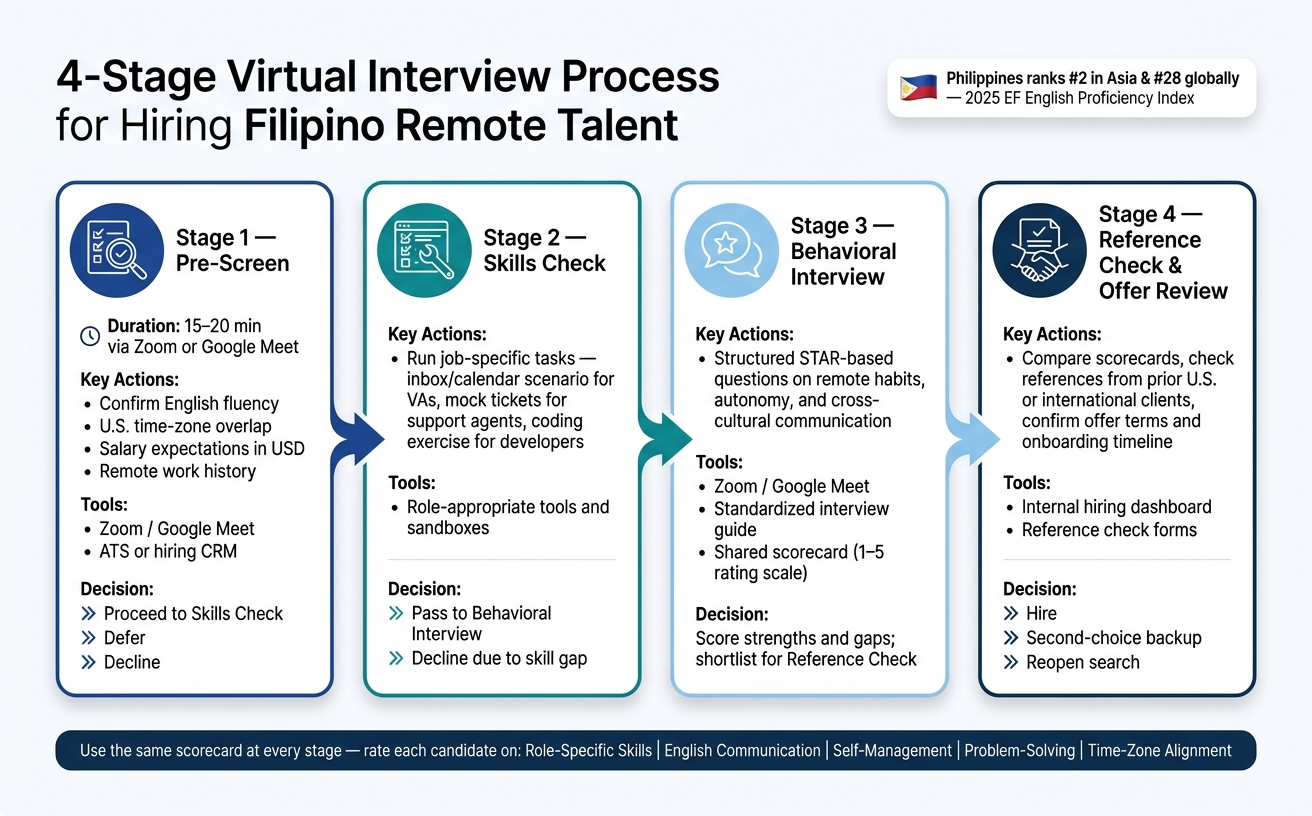
4-Stage Virtual Interview Process for Hiring Filipino Remote Talent
Once you understand the main cross-border communication gaps, put a structured interview process in place. That means every candidate gets measured the same way, against the same standards. That matters a lot in remote hiring, where some candidates may speak modestly or answer in a more indirect way instead of spotlighting their own wins. Structured interviews tend to predict job performance better than casual, free-form conversations.
Define the Role, Outcomes, and Scorecard Before You Start
Before you book a single interview, set your scorecard criteria. Be specific about:
- must-have skills
- minimum remote experience
- English level
- U.S. time-zone overlap
- collaboration expectations, like regular video check-ins, async updates, and documented work
Spell out the exact overlap you need. For example, require at least 4 hours during 9:00 a.m.–5:00 p.m. Eastern Time. When you set measurable standards at the start, you give each candidate a fair read. That helps you judge indirect or modest communication in context instead of treating it like a flaw.
Next, define success at 30, 60, and 90 days.
For a Filipino virtual assistant, a 30-day goal could be 95%+ task completion in a delegation tool, along with replies inside agreed response windows. By 60 days, that person should fully own recurring work like inbox triage and calendar management. By 90 days, you’re looking for proactive suggestions and steady, error-free execution.
For a customer support specialist, those same checkpoints may focus on average handle time, CSAT scores, and ticket backlog management.
Put all of that into a scorecard with a 1–5 rating scale and clear behavioral anchors for each area: role-specific skills, English communication, self-management, problem-solving, and time-zone alignment. Use the same scorecard for every candidate. That’s how you keep the process clean and consistent.
Use a Four-Stage Process: Pre-Screen, Skills Check, Behavioral Interview, Reference Check and Offer Review
Use the scorecard through every stage so each round tests a different signal, not the same thing over and over.
| Stage | Key Actions | Tools Used | Decision Outcome |
|---|---|---|---|
| Pre-Screen | Confirm English fluency, schedule overlap with U.S. time zones, salary expectations in USD, and remote work history | Zoom or Google Meet (15–20 min), ATS or hiring CRM | Proceed to Skills Check, defer, or decline |
| Skills Check | Run job-specific tasks: inbox/calendar scenario for VAs, mock tickets for support agents, coding exercise for developers | Role-appropriate tools and sandboxes | Pass to Behavioral Interview or decline due to skill gap |
| Behavioral Interview | Structured STAR-based questions on remote habits, autonomy, and cross-cultural communication | Zoom or Google Meet, standardized interview guide, shared scorecard | Score strengths and gaps; shortlist for Reference Check and Offer Review |
| Reference Check and Offer Review | Use the last stage to confirm references and compare notes, not to re-open earlier judgments. Compare scorecards, check references from prior U.S. or international clients, confirm offer terms and onboarding timeline | Internal hiring dashboard, reference check forms | Hire, second-choice backup, or reopen search |
Ask Behavioral Questions Using the STAR Method
The STAR method - Situation, Task, Action, Result - gives you a steady way to compare answers across candidates. It helps you test how someone works when things get messy, which is pretty much the reality of remote work.
Use behavioral questions to check independence, communication, and follow-through in situations that feel close to the job itself.
Here are strong STAR prompts to use:
-
Unclear instructions: "Describe a situation where your U.S. client gave vague or incomplete instructions. What did you do to clarify, and what was the result?"
Look for proactive follow-up. A strong answer might include summarizing assumptions in writing instead of sitting back and waiting. -
Time-zone deadlines: "Tell me about a time you had to deliver work on a tight deadline while collaborating with a team in a different time zone."
Look for specific tools, a clear process, and a concrete result such as faster turnaround or fewer miscommunications. -
Limited supervision: "Share a time when your manager was unavailable and you had to resolve a client issue on your own."
Look for references to escalation protocols and an outcome like keeping customer satisfaction intact.
As candidates answer, take notes under each STAR heading. It makes scoring much faster and helps you compare people based on what they actually did, not just how polished they sound.
Set Up the Virtual Interview to Avoid Scheduling and Technical Problems
Once the scorecard is set, take logistics off the table. Good scheduling and a clear plan for tech issues help you judge the interview itself, not the chaos around it.
Schedule Interviews with Time-Zone Clarity and Clear Expectations
Philippine Standard Time (PHT) is usually 12 to 13 hours ahead of U.S. Eastern Time. So a 9:00 AM ET interview lands at 9:00 PM PHT for the candidate. That gap is easy to misread, especially when someone is moving fast, so show both times in every message. A format like Wednesday, 08/12/2026, 9:00 AM ET / 9:00 PM PHT works well because it also includes the day of the week, which helps cut down on conversion mistakes.
Your calendar invite should spell out the basics in one place:
- Date and time in both time zones
- Meeting link and passcode
- Short agenda
- Attendee names and roles
- Prep requirements
- When the candidate can expect to hear back
Use calendar tools that show both time zones on their own. Then send a reminder 24 hours before the interview, again with both time zones listed, so any mix-up gets fixed before it turns into a no-show.
Send Candidates a Pre-Interview Technical Checklist
Filipino remote professionals may be dealing with unstable internet, short power outages, or normal household noise. That’s why it helps to send a short checklist 24 to 48 hours before the interview. The goal is simple: let preparation shape the interview, not luck.
Ask candidates to do a few basic checks ahead of time:
- Test the internet connection, webcam, and microphone
- Charge the device
- Keep a hotspot ready
- Pick a quiet, well-lit space
- Let people at home know the interview time
Be direct about your policy too. If there’s a brief connection problem, the candidate should switch to the backup channel. On your side, pause or reschedule if needed instead of knocking someone out over a short tech issue.
Handle Technical Glitches Consistently So Strong Candidates Are Not Screened Out
Set the glitch protocol before interviews start so everyone handles problems the same way. You want to score the candidate, not the Wi-Fi. If video drops but audio still works, keep going on audio. If both fail, try reconnecting once or twice. If the issue keeps going, reschedule within two to three business days with no penalty.
Write down any technical issue in your notes. For example:
the candidate switched to a mobile hotspot and completed the interview on audio-only.
That kind of note gives context. It also helps you look at problem-solving and communication instead of treating the outage like an automatic warning sign.
After logistics are stable, shift to communication style so you can hear the candidate's actual thinking.
sbb-itb-3690fed
Adjust Your Communication Style to Get Better Answers from Candidates
Once the logistics are set, the way you sound in the interview starts to matter just as much as the questions you ask. A structured interview does its job only when candidates feel at ease enough to answer fully. When that happens, the behavioral examples you get are much more useful.
Open with Rapport Before Moving to Direct Questions
Filipino communication can be more indirect and harmony-oriented. If an interviewer jumps in with a blunt or confrontational tone, candidates may spend more energy trying to stay polite and composed than giving clear, detailed answers.
A short, structured warm-up at the start can help a lot. Spend 3–5 minutes to:
- introduce yourself and the team
- explain what the interview will cover and about how long it will take
- ask one or two light, non-invasive questions
- say that you want to understand how they think and learn, not just hear “perfect” answers
This is not about small talk for the sake of small talk. It helps you collect better evidence. These steps lower pressure and improve candor. After that, you can move into deeper questions without making the conversation feel combative.
Phrase Questions to Encourage Honest, Detailed Responses
Skip adversarial wording. Ask about challenges, what happened, what the candidate did, and what changed afterward.
A couple of simple swaps work well:
- Replace “What’s your biggest weakness?” with “What skill have you improved most this year, and how did you improve it?”
- Replace “Why did that project go wrong?” with “Walk me through a time when a project did not go as planned. What was your role, and what changed?”
It also helps to say out loud that clarifying questions are welcome. Many candidates wait for direct permission before interrupting or asking what you mean.
"If anything I ask isn't clear, please pause me and ask - that actually helps us both"
A line like that can lead to more accurate, complete answers. The standard is not lower. The signal is just cleaner.
Do Not Confuse Communication Style with Job Readiness
A modest delivery style does not mean weak ability. Filipino candidates may say “we” instead of “I” when talking about wins, soften claims of expertise, or give context before the main point. That often reflects humility and harmony, not weak skills or a lack of ownership.
The better move is to listen for the candidate’s actions, decisions, and results inside the story instead of judging how forcefully they present themselves. Then use follow-ups that bring out accountability without making the person shut down. For example, ask, “What specifically was your role in that?” or “What would you change next time?” Score the actions, decisions, and outcomes, not the presentation style.
Use this quick adjustment rule to avoid mixing up communication style with capability.
| Common U.S. Interview Habit | Possible Candidate Reaction | Recommended Adjustment |
|---|---|---|
| Expecting candidates to “sell themselves” aggressively | Highlights team effort over individual contributions. | Ask targeted follow-ups about the candidate's specific role and listen for concrete actions |
| Using direct, critical questions about failure or weakness | Heightened hiya (fear of shame) leads to vague or overly positive answers. | Frame questions around challenges, learning, and improvements; probe gently for the candidate's role and decisions |
| Equating fast, assertive responses with confidence | Pauses to choose respectful wording or provide context. | Allow brief thinking time; evaluate substance and clarity of examples rather than speed. |
| Treating a quick “yes” as firm agreement | Candidate may be acknowledging receipt, not agreement. | Confirm understanding with a follow-up: “Does that make sense, or should I rephrase?” |
Use FindTalent.ph and a Clear Post-Interview Review to Make Faster Hiring Decisions
How FindTalent.ph Simplifies Candidate Sourcing Before Interviews Begin
Once you've sorted out interview logistics and question format, the next place hiring tends to slow down is candidate sourcing. Even with a smooth interview process, things can drag if your team is still trying to narrow a large pool by hand.
FindTalent.ph helps cut that down with AI matching across 14 categories and 130+ roles. That includes virtual assistance, customer support, web development, bookkeeping, digital marketing, and data analytics. Every visible profile goes through identity verification, skills assessment, and portfolio review.
If your team wants more hands-on help, the recruiter-assisted option takes care of sourcing, screening, and interviewing. Then it sends 1–3 pre-vetted candidates straight to your inbox.
Use Pre-Vetted Profiles and Structured Notes to Compare Candidates Faster
After the interview ends, compare candidates right away while the details are still clear in your mind. Start with the platform's Talent Match Score as a first filter, then layer in your own scorecard notes from the interview.
A few platform signals can also help speed up the review:
- ID Proof verification for identity checks
- Top Rated and Rising Talent badges for a quick read on track record and potential
- Recorded voice introductions to gauge verbal communication and English fluency before the live meeting
For technical roles, it also helps to end the process with a short paid trial task, like a bug fix or a component build, before you send an offer.
Conclusion: Keep Interviews Structured, Fair, and Culturally Informed
Verified sourcing, steady scorecards, and a final paid trial task can help you move faster without lowering your standards.
FAQs
How many interview rounds should I use?
Aim for one to three interview rounds with pre-vetted candidates. That keeps things moving while giving you enough time to spot the right fit.
With FindTalent.ph, candidates are already sourced, screened, and skills-tested. So you can skip the long, old-school interview cycle. If you're handling hiring on your own, stick to only the interviews you need.
What if a candidate has strong skills but weak internet?
If a candidate has strong skills but mentions internet problems, check their setup before you move ahead. For roles that depend on steady communication - like outbound calling or customer support - a stable, wired internet connection is a must.
During screening, confirm they also have the right hardware in place, including a good headset and dependable hardwired internet. Many qualified professionals in the Philippines already have the setup needed to support business needs day to day.
Should I include a paid trial before hiring?
Yes. A paid trial is a smart way to see how someone actually works before you make a long-term hire.
It can be something small and focused, like a bug fix, a component build, or a research brief. That gives you a clearer picture of how the candidate handles the job, communicates, and follows through.
People who trust their skills will often be open to a paid trial. FindTalent.ph can help by connecting you with verified Filipino specialists for these first-round evaluations.