Business Operations
OnlineJobs.ph Alternatives: 8 Ways to Hire Filipino Talent in 2026 (Honest Comparison)
Compare 8 ways to hire Filipino talent — costs, speed, screening, and compliance across marketplaces, agencies, EORs, and job boards.
15 min read

If I want Filipino talent fast, OnlineJobs.ph is only one path. The main trade-off is simple: lower monthly cost often means more work on my side.
Here’s the short version:
- OnlineJobs.ph is low-cost at $69/month, but I still have to source, screen, interview, and sort out payroll and classification.
- FindTalent.ph is close in entry price at $69 to $99/month, but it adds pre-screened profiles, AI matching, and an optional $600 recruiter service.
- Upwork and Fiverr work best for freelance or one-off jobs, not core hires.
- Remote staffing agencies and specialist recruiters cut down hiring work, but I pay more.
- EOR platforms cost the most, but they handle contracts, payroll, taxes, and local benefits.
- LinkedIn, job boards, and Facebook groups can work, but I should expect more manual screening.
If I strip this down to one question, it’s this: Do I want lower cost, less hiring work, or built-in compliance help? Most teams can only get one or two of those at once.
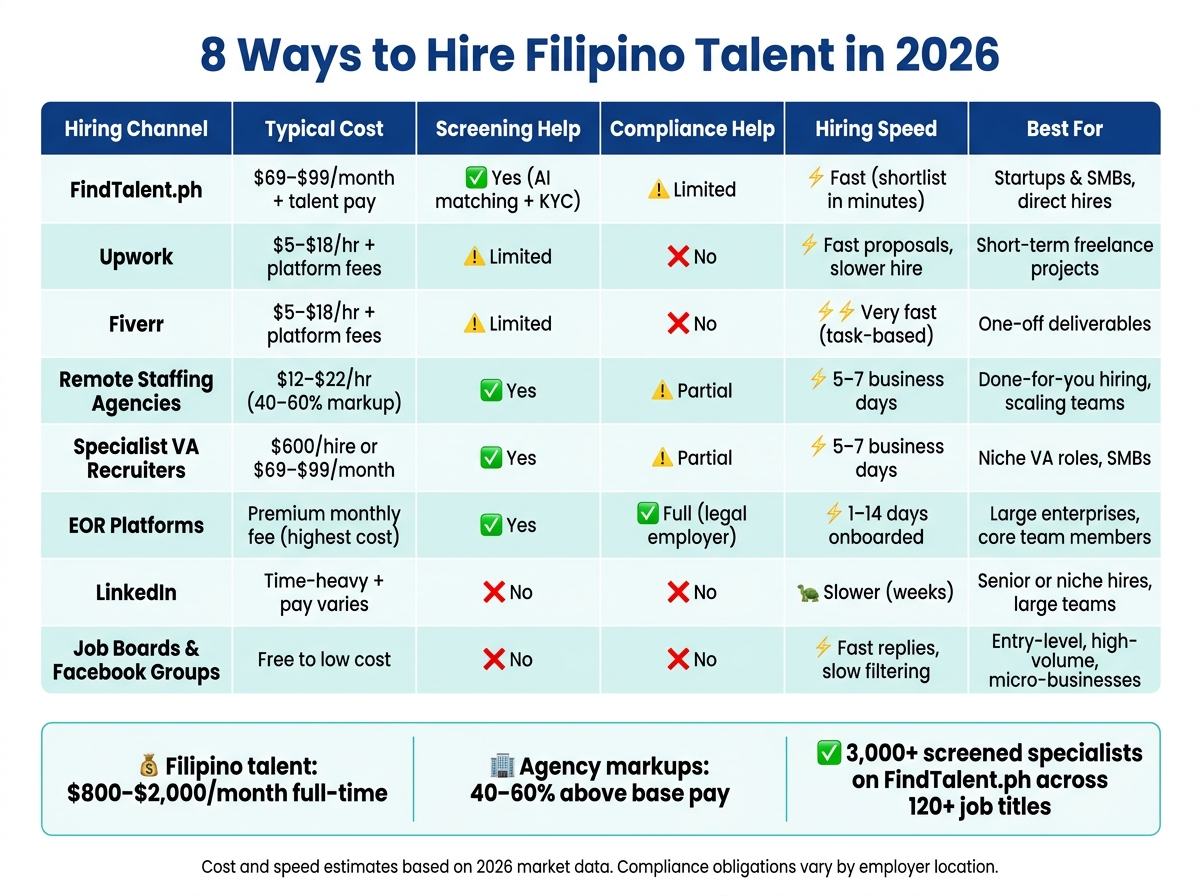
8 Ways to Hire Filipino Talent: Cost, Speed & Compliance Compared (2026)
Where to Find Your Philippines Virtual Assistants
sbb-itb-3690fed
Quick Comparison
| Option | Best for | Typical cost | Screening help | Compliance help | Hiring speed |
|---|---|---|---|---|---|
| FindTalent.ph | Direct hires with some vetting | $69 to $99/month + pay | Yes | Limited | Fast |
| Upwork | Freelance projects | $5 to $18/hour + fees | Limited | No | Fast to get proposals |
| Fiverr | One-off tasks | $5 to $18/hour + fees | Limited | No | Very fast for fixed tasks |
| Remote staffing agencies | Done-for-you hiring | $12 to $22/hour | Yes | Partial | Fast |
| Specialist VA recruiters | Niche VA roles | $600 per hire or $69 to $99/month | Yes | Partial | Fast |
| EOR platforms | Full legal employment support | Premium monthly fee | Yes | Yes | 1 to 14 days in many cases |
| Senior or niche hires | Pay varies + time cost | No | No | Slower | |
| Job boards / Facebook groups | Low-cost volume hiring | Free to low cost | No | No | Fast replies, slower filtering |
A few numbers stand out. Direct full-time Filipino hires often land around $800 to $2,000 per month. Agencies may add 40% to 60% markups. And some platforms can send 1 to 3 vetted candidates in 5 to 7 business days.
My takeaway: if I want control, I should use a direct-hire platform. If I want less hiring work, I should use an agency or recruiter. If I want payroll, tax, and legal setup handled for me, I should use an EOR.
That’s the frame I’d use before picking any platform on this list.
1. FindTalent.ph
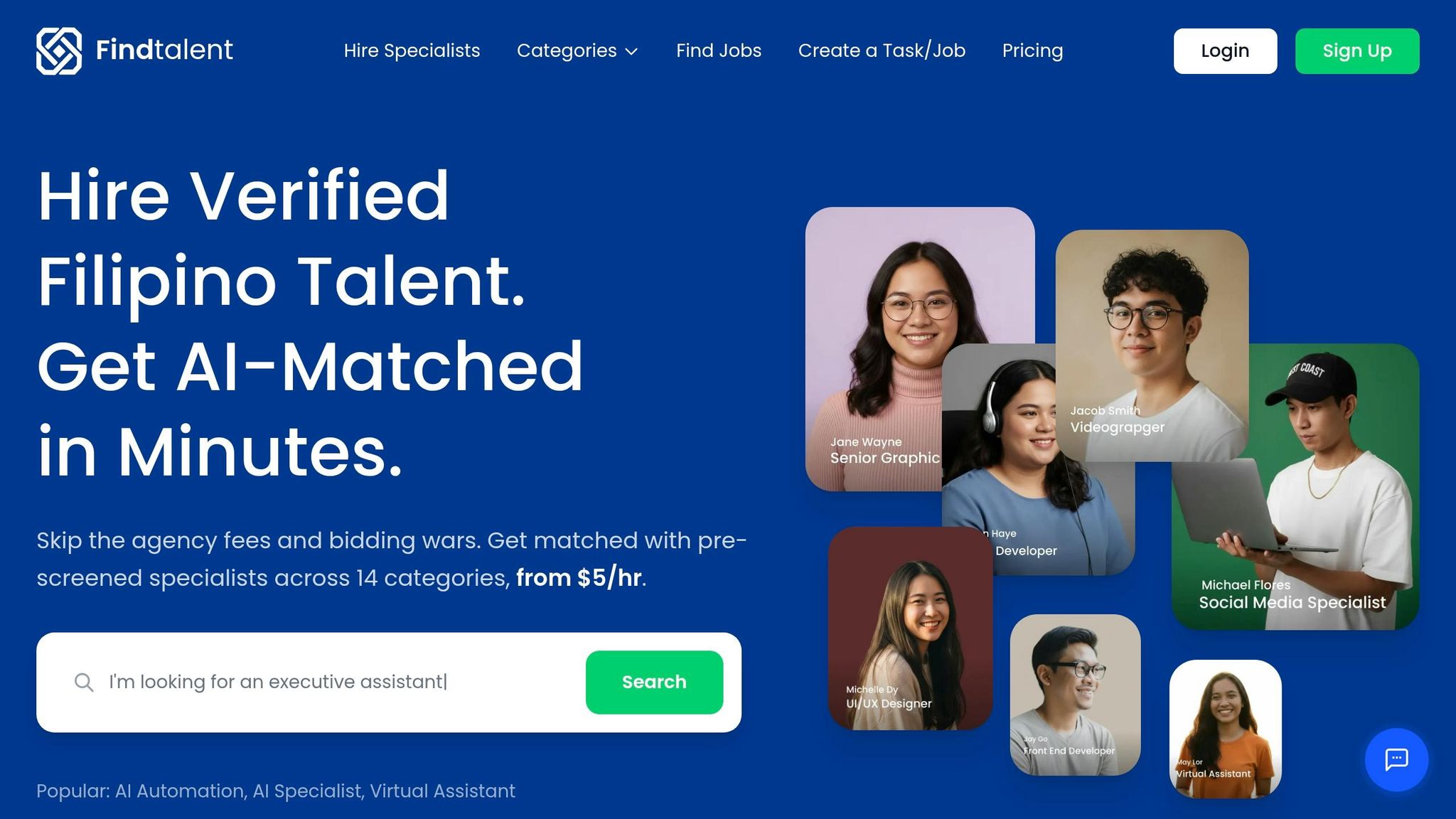
FindTalent.ph is a direct-hire marketplace for verified Filipino specialists. If you want a bit more hand-holding, it also offers optional recruiter support to guide the hiring process.
Cost
Paid plans start at $69/month for Plus and $99/month for Pro. There’s also a free tier that lets you browse specialists and view AI recommendations before paying.
You pay specialists directly based on their listed rates. For full-time Filipino talent, that usually lands around $800 to $2,000 per month, depending on experience. If you’d rather get help with sourcing and screening, FindTalent.ph offers a one-time Recruitment Service for $600, and that comes with a replacement guarantee.
Speed to Hire
One of the main draws here is speed. AI matching can produce a ranked shortlist within minutes after you submit your job brief. If you’re on the Plus or Pro plan, you can start reaching out to specialists right away.
If you use the managed Recruitment Service, the platform usually delivers 1–3 vetted candidates within 5–7 business days.
Talent Quality
FindTalent.ph screens specialists before they appear on the marketplace. That process includes identity checks, skills assessments, and portfolio reviews. Profiles also include voice introductions and talent badges, which can make screening feel less like guesswork and more like a quick skim through the people who fit.
The platform has more than 3,000 screened specialists across 120+ job titles. That range includes virtual assistants, customer support staff, developers, marketers, and analytics talent.
Compliance Support
FindTalent.ph is a direct-hire marketplace, not an Employer of Record (EOR). It helps with identity verification and onboarding support for first-time international employers, but payroll tax compliance and remittance are still on you. If you're a U.S. employer, you’ll still need a separate payroll provider.
There’s one nice detail here: once you hire someone, you can cancel your subscription and continue working with the specialist directly.
This setup makes sense if you want direct control over hiring and don’t mind handling payroll on a separate system. If you want more help with screening or compliance, the next options hand off more of that work.
2. Upwork
Upwork gives you access to a big pool of Filipino freelancers. That sounds great on paper. But in practice, you still do most of the screening work yourself.
Cost
Filipino specialists on Upwork usually charge $5–$15/hr for general roles. For more specialized work, like HR or recruitment, rates often land around $7–$18/hr. On top of that, platform fees and bid competition can push your total cost higher.
Speed to Hire
You can post a job and start getting proposals fast. That's the easy part.
The slower part comes next: reviewing profiles, comparing applicants, and screening people one by one. So while proposals may come in quickly, the actual hire can still take time.
Talent Quality
Upwork does have a profile approval process. Even so, employers can still run into unverified profiles, overstated skills, and weak follow-through.
In other words, the talent pool is large, but the quality check mostly sits with you.
Compliance Support
Upwork uses escrow to hold funds until milestones are completed. That helps with payment flow, but it doesn't cover payroll tax compliance or worker classification.
You still need to handle those pieces on your own, usually through your CPA or a payroll provider.
Upwork works best for project-based hiring when you're comfortable screening candidates yourself and handling compliance separately.
If you want a more packaged, task-based hiring model, the next option may be a better fit.
3. Fiverr
Fiverr is a task-first marketplace. You’re buying a defined service, not posting a role and waiting for a stack of applications.
Cost
Filipino talent on Fiverr often falls between $5 and $10/hour for general VA work and $10 to $18/hour for more specialized roles, before platform fees. Those fees can push your total spend above the listed gig price.
Speed to Hire
Fiverr is built for speed. Because the service is already packaged, you can go from browsing to purchase in a short amount of time. That makes it a good fit for one-off work like graphic design, video editing, or a clearly defined technical task.
Talent Quality
Fiverr gives you access to a large pool of Filipino freelancers across many service categories.
Compliance Support
Fiverr handles payment, but not payroll or compliance. It does not take care of payroll, tax withholding, or contractor classification for you.
Use Fiverr when you need a deliverable, not a team member. It works best for clearly scoped projects instead of long-term roles. If you want help with sourcing and screening, the next option shifts from self-serve gigs to a managed hiring process.
4. Remote Staffing Agencies
Remote staffing agencies sit in the middle ground between self-serve marketplaces and full hiring support. They take care of sourcing and screening for you, which saves time, but you pay more for that help.
Cost
Most agencies charge $12 to $22 per hour for Filipino talent, and that price usually includes wages, infrastructure, and the agency's margin. Those markups often fall in the 40% to 60% range, and in some cases reach 50% to 80%.
Speed to Hire
Agencies usually send over one to three vetted candidates within 5 to 7 business days. So instead of digging through a huge pile of applications, you get a short list that has already been filtered.
Talent Quality
Candidates from agencies are often pre-screened for English fluency, reliability, and domain competence. They also tend to be used to SOPs, KPI tracking, and common collaboration tools. That can make onboarding a lot smoother, especially when you need someone who can get up to speed fast.
Compliance Support
Agencies generally manage Philippine-side contracts and payments, but U.S. payroll tax compliance is still on you. In plain English, you'll still need a U.S. payroll provider like Gusto or ADP, or a CPA, to handle remittance and legal payroll duties.
Remote staffing agencies are a good fit when you want a done-for-you hiring process and don't have the time to screen people yourself. If you'd rather get that kind of hiring help with a tighter role focus, the next option is more specialized.
5. Specialist VA Recruitment Services
When a role is narrow and skill-specific, a general staffing firm can be too broad. Specialist VA recruitment services focus on specific job types - AI automators, medical VAs, bookkeepers, and support specialists - instead of trying to cover everything.
That narrower focus usually means less screening time and a better match for repeat niche hires. If broad marketplaces would flood you with weak applicants, this is often the better route.
Cost
Specialist services usually charge either:
- A flat one-time fee of about $600 per hire
- A monthly subscription of $69 to $99 for direct access to a vetted talent pool
Filipino specialists generally bill $5 to $15 per hour, depending on the role and the person’s experience.
Speed to Hire
Because these firms stay focused on one role type, they can usually build shorter, more relevant shortlists faster. Most send one to three vetted candidates within 5 to 7 business days by pulling from existing candidate pipelines.
Talent Quality
By the time you see a candidate, a lot of the early filtering is often already done. Screening usually includes identity checks, skills tests, portfolio reviews, and live interviews.
Many services also offer a replacement guarantee if the hire doesn’t work out during the agreed timeframe.
Compliance Support
These services can coordinate with Gusto, ADP, or Xero, but local tax and worker-classification compliance still sits with the employer.
If you need an employer-of-record layer after this, the next section covers that option.
6. EOR Platforms
An Employer of Record (EOR) platform legally employs your Filipino worker on your behalf. You still manage the day-to-day work, but the EOR takes care of contracts, payroll, taxes, and benefits. That setup is simple on your side, but it comes at a higher price.
EORs are a fit for companies that want to hire talent in the Philippines without becoming the legal employer.
Cost
EOR platforms charge a bundled monthly fee for employment administration. That’s much higher than direct hiring at $5 to $15 per hour or agency hiring at $12 to $22 per hour per seat. The upside is plain: your team spends less time dealing with admin work.
Speed to Hire
The big speed advantage is access to pre-vetted candidates. In many cases, an EOR platform can move someone from shortlist to fully onboarded in 1 to 14 days. If you’ve got an open technical role sitting there and burning time, that kind of speed can make a big difference.
Talent Quality
Most EOR platforms screen candidates through several checks before you even meet them. That often includes:
- Technical skills assessments
- English proficiency checks
- Identity verification
- Behavior checks
Compliance Support
This is where EOR platforms justify the premium. They serve as the legal employer in the Philippines and handle contracts, payroll, taxes, and mandatory benefits for you.
If you only need help finding candidates, and not legal employment, the next option is lighter and costs less.
7. LinkedIn
LinkedIn works best when you’re trying to find experienced Filipino professionals for senior, niche, or passive-candidate roles.
Cost
Direct-hire Filipino talent often costs $5 to $15 per hour. But on LinkedIn, the bigger cost usually isn’t pay.
It’s the time your team spends on manual outreach, screening, follow-ups, and interview coordination. That work adds up fast, especially if your hiring team is already stretched.
Speed to Hire
Expect a longer hiring cycle, often taking weeks for screening and reference checks. That gets even slower when you’re sorting through unverified profiles.
So while LinkedIn can be a good fit for targeted sourcing, it’s usually not the best choice for fast, high-volume hiring.
Talent Quality
LinkedIn Recruiter is a strong sourcing tool for senior Filipino specialists, especially in HR and other niche roles.
That said, profiles are self-reported. A polished page can look great on the surface, but you still need to check skills, references, and tool experience. For example, if a role calls for Greenhouse, Workday, or Rippling, make sure the candidate has hands-on experience with those platforms - not just a mention in their profile.
Compliance Support
LinkedIn does not provide local compliance support. Your team has to manage payroll, tax remittance, and legal compliance through internal staff, a payroll provider, and local employment counsel.
If you want broader local reach without so much manual outreach, the next option moves into Philippine job boards and Facebook groups.
8. Philippine Job Boards and Facebook Groups
Philippine job boards and Facebook groups are the least structured option on this list. That’s exactly why they can work well when cost matters more than speed or vetting. Compared with curated marketplaces and agencies, these channels give you more reach at a lower cash cost, but you do more of the work yourself.
Cost
General job boards like Indeed are often free to use, niche boards may charge a one-off fee, and Facebook groups are usually free to post in. So the cash outlay is low.
The trade-off is time. You handle screening, follow-up, and early filtering on your own, which can eat up hours fast.
Speed to Hire
Applications can show up fast, especially in active Facebook groups and large job boards. But the hiring process often slows down once you begin sorting through candidates by hand.
Ghosting can also be a problem, which makes these channels less predictable than curated hiring platforms. You may get a big batch of replies, but that doesn’t always turn into a smooth hiring process.
Talent Quality
These channels tend to work best for high-volume, entry-level roles like VAs, support, admin, and basic bookkeeping and payroll specialists. That’s where broad reach helps most.
The candidate pool can be large, but profiles are often unverified. In plain English, you need to screen carefully to sort qualified applicants from unreliable ones.
Compliance Support
There is no built-in verification, testing, or compliance support. If you go this route, you get access to more candidates, but you also take on the full screening and compliance workload.
That means you manage contracts and worker classification yourself. U.S. employers still need a payroll provider and local counsel for classification questions.
Use these channels when reach matters most. The next section matches each option to the right hiring situation.
Pros, Cons, and Best-Fit Use Cases by Hiring Situation
Once you’ve looked at each hiring channel on its own, this matrix makes the next step simpler: pick the option that fits your team size, hiring style, and role type.
| Channel | Pros | Cons | Ideal Role Types | Best Company Size |
|---|---|---|---|---|
| FindTalent.ph | AI matching, KYC-verified profiles, no commission | Paid subscription for full contact access | VAs, tech, marketing, HR, AI and automation | Startups and SMBs |
| Upwork | Large freelancer pool, milestone payments | Bidding wars, platform fees | Short-term projects, development gigs | Startups and small teams |
| Fiverr | Fast, affordable, project-based | Quality varies; weak fit for long-term roles | Graphic design, voiceovers, one-off content | Small businesses |
| Remote Staffing Agencies | Fully managed, low internal effort | 40–60% salary markups, less direct control | Customer support, BPO, scaling team builds | Growing companies |
| Specialist VA Recruitment Services | Pre-vetted shortlists, replacement guarantees | About $600 per hire | Executive assistants, specialized VAs | SMBs |
| EOR Platforms | Legal employer; payroll and taxes handled | Most expensive option | Long-term core team members | Large enterprises |
| High-quality candidates, direct outreach | Manual sourcing, no remote-specific vetting | Senior tech roles, management | Large teams | |
| Philippine Job Boards and Facebook Groups | Free or low cost, high applicant volume | No verification, time-intensive screening | Data entry, simple admin tasks | Micro-businesses |
Here’s the simple way to think about it: direct-hire tools work well for lean teams that want more control. Managed services make sense when you want less screening and less admin. And EOR platforms are built for companies that need the legal employer side handled for them.
Company size gets you close. Role type usually makes the final call.
The table below pairs each channel with the kinds of roles it tends to fit best.
| Role Category | Most Suitable Channels | Why |
|---|---|---|
| Admin and general VA | FindTalent.ph | Large supply of generalists at competitive rates |
| AI and automation | FindTalent.ph | Automation specialists |
| Creative and design | Fiverr, FindTalent.ph | Fiverr works well for one-off gigs; FindTalent.ph is better for ongoing creative support |
| Accounting and finance | FindTalent.ph, Specialist Agencies | High-trust work benefits from verified profiles and niche experience |
| Customer support | Remote Staffing Agencies, FindTalent.ph | Agencies help you scale larger teams; FindTalent.ph fits boutique support roles |
| Software development and tech | FindTalent.ph, LinkedIn | Verified technical skills and portfolios matter most here |
Conclusion
No hiring channel works for every role. Once you compare cost, speed, screening, and compliance, the choice usually comes down to four things: budget, speed, role complexity, and support.
For direct-hire roles, the main call is how much screening you want to keep in-house. A lower-cost, self-serve option like FindTalent.ph gives you access to 3,000+ screened Filipino specialists across 120+ job titles. If speed matters more, the recruitment service can deliver a pre-vetted shortlist within days for a flat fee. Marketplaces make more sense for short-term work with a clear scope.
For most employers, role risk matters more than platform convenience. That’s usually the clearest signal. General VA work is often simple to manage directly, while more specialized roles like AI automation or medical billing tend to need pre-vetted shortlists and skills testing. As role risk goes up, the need for screening and managed support goes up too.
Filipino talent is still far more affordable than similar U.S. or European rates across every channel on this list. Start with your limits first, not platform features, and the right hiring path gets a lot easier to spot.
FAQs
Which hiring option is best for my budget?
It comes down to the level of help you want.
You can browse the talent pool for free. If you're making your first hires, the $69/month plan may be enough. For teams that are hiring more often and need extra job posts plus unlimited specialist contacts, there's the $99/month option.
If you'd rather have someone handle the heavy lifting, the $600 one-time recruitment service covers sourcing, screening, and 1 to 3 vetted candidates. It also includes a replacement guarantee.
When do I need an EOR in the Philippines?
You need an Employer of Record (EOR) in the Philippines when you need a legal entity to take care of local labor law compliance, tax withholding, and statutory benefits on your behalf.
This usually makes sense if you want to lower legal risk when hiring in a foreign country, or if your company doesn’t have a local legal presence. An EOR acts as the legal employer and handles payroll, benefits, and contracts under Philippine employment rules.
Should I hire direct or use an agency?
It comes down to a simple tradeoff: how much help you want vs. how much control you want.
Hiring direct gives you a straight line to the person doing the work. You also avoid agency markups, which can run 40% to 60%.
If you want more hands-on support, an agency can take care of sourcing, screening, and skills testing. Some also include a replacement guarantee.
FindTalent.ph sits somewhere in the middle. It offers AI matching, pre-vetted talent, and direct pay at the listed rates.