Business Operations
Checklist for Managing Filipino Teams
Checklist for US managers of Filipino remote teams: set overlap windows, write clear task briefs, run daily check-ins, and audit team health.
12 min read

If you lead a Filipino remote team from the U.S., your results usually come down to three things: clear instructions, steady check-ins, and smart scheduling across a 12–16 hour time gap. This article shows you how to run that system day by day, week by week, and month by month.
Here’s the short version:
- Set a fixed overlap window and always list the full date plus both time zones in invites.
- Write every task clearly: what to do, what “done” means, deadline, resources, and who to contact.
- Use daily check-ins to confirm priorities and blockers before they turn into rework.
- Hold weekly 1:1s to review workload, KPIs, and support needs.
- Review docs, overtime, and team health monthly to cut burnout and turnover risk.
- Ask open-ended questions because some team members may avoid direct disagreement.
- Give praise in public and corrective feedback in private to protect trust.
- Document decisions after calls so people are not left guessing.
- Use shared tools and SOPs so work does not depend on memory or scattered chat messages. This is how you collaborate with specialists effectively at scale.
A few facts shape the whole approach: the Philippines is on UTC+8 year-round, the U.S.-Philippines gap is often 12 to 16 hours, and 68% of remote team communication problems come from misunderstandings tied to work style rather than language. The article also explains why phrases like “I’ll try my best” or “I can manage” may signal risk, delay, or overload instead of clear agreement.
| Area | What to do |
|---|---|
| Scheduling | Keep a small overlap window and rotate hard meeting times |
| Task management | Put tasks, deadlines, and success checks in one shared tool |
| Communication | Ask people to walk through next steps instead of asking “Does that make sense?” |
| Feedback | Keep corrections private and specific |
| Team health | Check overtime, night shifts, pay, growth, and role fit each month |
If you want a simple way to manage Filipino teams well, this is it: be clear, be consistent, and make it easy for people to speak honestly.
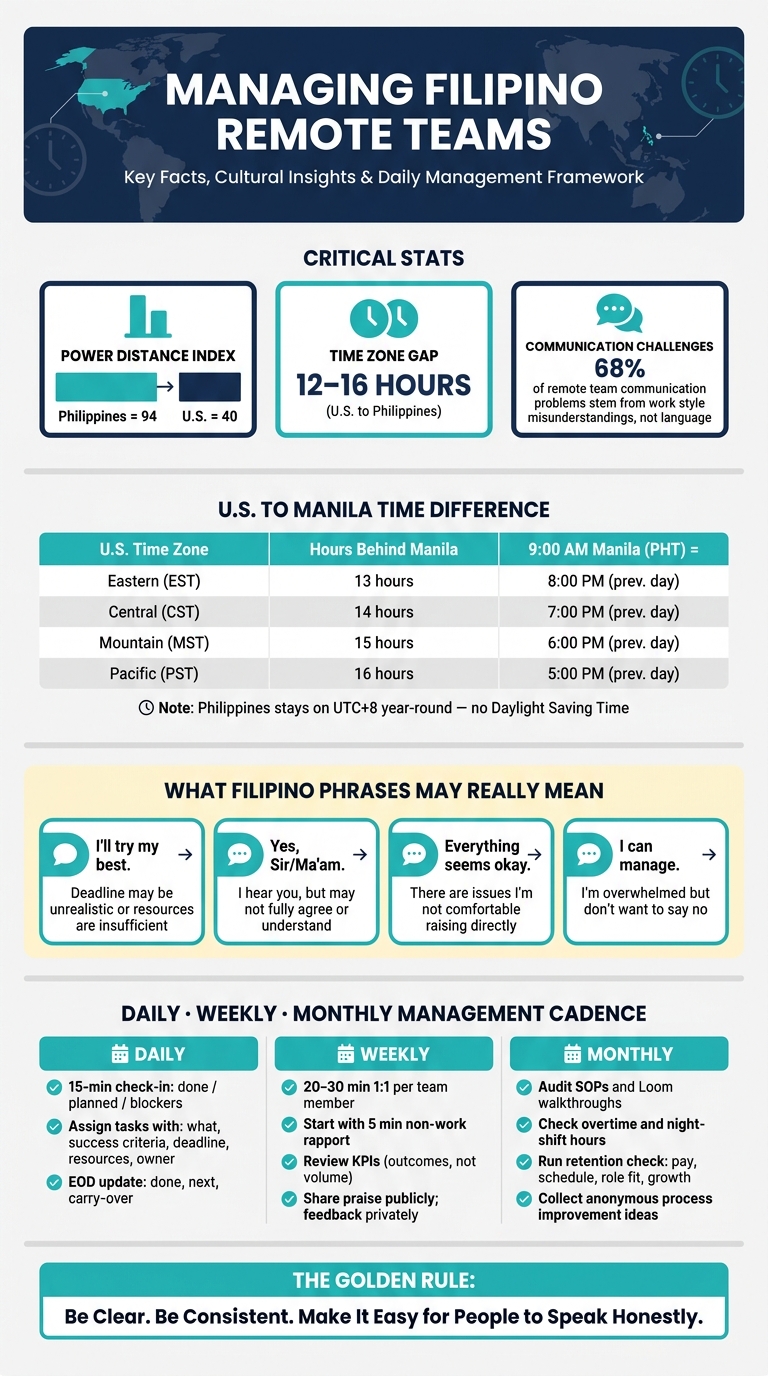
U.S. vs. Filipino Remote Team Management: Key Cultural & Scheduling Differences
How to Manage Filipino Virtual Assistants (Culture Guide)
sbb-itb-3690fed
1. Understand the work culture before managing the workflow
Start with the habits that shape day-to-day management. Use that lens first, because it affects how people take tasks, deadlines, and feedback.
The Philippines scores 94 on the Power Distance Index, compared to 40 for the U.S. That gap helps explain why Filipino virtual assistants may wait for direction instead of moving on their own. It also helps explain why they may not push back on deadlines, even when those deadlines don't look workable.
Respect, harmony, and why team members may avoid open disagreement
Two ideas sit near the center of Filipino workplace culture: pakikisama (group harmony) and hiya (face-saving). Put them together, and you get a strong pull to avoid conflict. Many Filipino professionals use indirect language to show respect and keep things smooth. So if someone has concerns about your plan, they're often more likely to say "Yes, Sir/Ma'am" or "I'll do my best" than to tell you flat out that it won't work.
A small shift in how you ask questions can help a lot. Instead of asking, "Does everyone agree?" ask, "What might be challenging about this approach?" or "What concerns should we consider?" That gives people room to speak up without feeling like they're creating friction.
| Phrase | Likely meaning |
|---|---|
| "I'll try my best." | The deadline may be unrealistic or the team may need more resources. |
| "Yes, Sir/Ma'am." | I hear you, but I may not fully agree or understand. |
| "Everything seems okay." | There are issues I'm not comfortable raising directly. |
| "I can manage." | I'm overwhelmed but don't want to say no. |
Once you're clear on communication style, the next step is simple: line up meetings around the overlap window.
How to plan around U.S. and Philippine time zone overlap
The Philippines uses PHT (UTC+8) all year and does not observe Daylight Saving Time, so the gap changes by one hour when the U.S. moves into or out of Daylight Saving Time.
| U.S. Time Zone | Offset from Manila (Standard Time) | 9:00 AM Manila (PHT) = U.S. Time |
|---|---|---|
| Eastern (EST) | 13 hours behind | 8:00 PM (previous day) |
| Central (CST) | 14 hours behind | 7:00 PM (previous day) |
| Mountain (MST) | 15 hours behind | 6:00 PM (previous day) |
| Pacific (PST) | 16 hours behind | 5:00 PM (previous day) |
Try to set up a 2- to 3-hour overlap for live work. And on every meeting invite, include both time zones and the full date. For example: "July 15, 2026, 3:00 PM ET / July 16, 2026, 3:00 AM PHT."
With culture and timing clear, day-to-day management is much easier to standardize. If you are still building your team, you can find verified Filipino talent to fill these roles.
2. Core checklist: Daily, weekly, and monthly management habits
Once your communication norms and overlap windows are in place, the next step is simple: turn them into a steady management rhythm. That rhythm keeps work lined up across time zones and different communication styles.
Daily checklist: Set rhythm, clarify priorities, and confirm understanding
Daily habits help stop small mix-ups before they turn into rework.
Start your overlap window with a 15-minute daily check-in. Focus on three things: what got finished, what’s planned for today, and any blockers.
For each task, spell out the basics:
- what needs to be done
- what success looks like
- the deadline
- available resources
- who to ask for help
Put all of that in a shared tool like Asana, ClickUp, or Trello so ownership and priority are clear.
It also helps to ask for a walkthrough of next steps. That gives people room to surface confusion without having to directly disagree. Instead of asking, "What are your next steps?" or "Walk me through your understanding of this task" - use open-ended prompts that make it easier to bring up issues without feeling like they’re pushing back.
Close the day with a short EOD update: what’s done, what’s next, and what’s carrying over.
Weekly checklist: Hold 1:1s, review KPIs, and remove blockers
Weekly check-ins catch the issues daily standups often miss.
Schedule a 20- to 30-minute 1:1 with each team member every week. Use the first five minutes for non-work conversation. That small buffer helps build rapport and makes it easier for people to speak up.
Be specific when you check in. Ask, "What support do you need?" or "Is there anything slowing your progress?" A vague question like "Everything okay?" usually gets a polite yes. You can also ask them to rate their workload from 1 to 10.
When you review KPIs, focus on outcomes instead of raw volume. A customer support rep whose resolution time dropped from 8 hours to 2.5 hours tells you more than someone who closed 40 tickets. Share praise in team channels, but handle performance concerns in private so you don’t damage rapport.
Monthly checklist: Audit systems, workload, and team health
Monthly reviews help you spot process drift, burnout, and retention risk early.
Once a month, review your SOPs and workflow docs. If the process changed, update the SOP. For steps that are harder to explain in writing, add short Loom walkthroughs. Video can cut down on back-and-forth when written instructions leave too much room for guesswork.
Check overtime patterns and night-shift hours too. Permanent graveyard shifts often don’t hold up past 6 to 12 months. If someone has been on a fixed overnight schedule that long, talk about a rotation or partial overlap.
Run a short retention check each month. Review pay, schedule fairness, role fit, and growth opportunities. If you need to scale, you can hire verified Filipino talent to fill new roles. Ask directly for process improvement ideas, and give people a low-pressure way to surface concerns. Because pakikisama can suppress honest feedback, anonymous input or a standing improvement item can help the team flag issues without feeling like they’re creating conflict.
| Audit Category | Monthly Action | Goal |
|---|---|---|
| Systems | Review SOPs and Loom walkthroughs | Keep documentation current |
| Capacity | Check overtime and night-shift hours | Prevent burnout |
| Team Health | Run a retention check | Reduce turnover |
| Growth | Review training and certification progress | Increase retention through development |
These checks help keep the team steady as workloads and schedules shift.
3. Communication, feedback, and scheduling rules that prevent avoidable problems
Once tasks and meeting rhythm are set, these rules help keep communication on track instead of letting it drift.
Write clearly, document decisions, and ask for confirmation
Most remote problems come from unclear instructions, not from language. That’s why every task should be written down.
For each task you assign, include:
- Task: what needs to be done
- Success criteria: what “done” looks like
- Due date/time zone: the exact deadline and time zone
- Resources: where the person can find what they need
- Owner/contact: who to reach if something gets blocked (an operations virtual assistant is often the best point of contact for this)
After every call, send a short recap with decisions, owners, and deadlines.
And when you want to check understanding, skip vague lines like “Does that make sense?” Instead, ask: “Can you walk me through your first two steps?” That small shift tells you far more. It also helps to use the same format every time, so people aren’t left guessing what changed.
Give feedback privately and make praise specific
Corrective feedback belongs in a private 1:1. Keep the focus on the behavior, the result, or the process gap, not the person. Say what happened, explain the impact, and work with them on the fix.
Praise should be specific too. Don’t just say “great job.” Point to the exact contribution and the business impact. That shows the team what good work looks like in practice.
Keep schedules consistent and protect night-shift workers' time
Set one overlap window and protect it.
The Philippines stays on UTC+8 all year, so U.S. meeting times move by one hour when daylight saving time starts or ends. That means a 9:00 AM ET meeting lands late in the evening in Manila.
| U.S. Time Zone | Manila Time Difference | 9:00 AM U.S. = Manila |
|---|---|---|
| Eastern | 12–13 hours behind | 9:00 PM – 10:00 PM PHT |
| Central | 13–14 hours behind | 10:00 PM – 11:00 PM PHT |
| Mountain | 14–15 hours behind | 11:00 PM – 12:00 AM PHT |
| Pacific | 15–16 hours behind | 12:00 AM – 1:00 AM PHT |
When you need live meetings, aim for just 2 to 3 hours of overlap per week. Rotate the inconvenient slot so the burden doesn’t keep landing on the same person. And if people are working nights, protect their time with flexible shifts, partial overlap schedules, or connectivity stipends when needed.
4. Build the systems behind the checklist
Once the checklist is set, build it into your tools and onboarding so it keeps working without constant follow-ups.
Good management runs on documented systems, not memory or random Slack messages. If those systems aren’t in place, even a solid checklist can fall apart.
Use shared tools for tasks, meetings, and SOPs
Every repeat task your Filipino team handles should live in a system, not in someone’s head. Use one task tracker, one chat channel, and one video tool so ownership, updates, and meetings stay in one place.
For repeated or more involved tasks, record a short Loom walkthrough and save it in a shared knowledge base like Notion or Google Docs. That way, workers can follow the process without waiting for a meeting.
Each SOP should include:
- The purpose
- Step-by-step instructions
- Screenshots
- A clear definition of done
It should also show the escalation path: what they can fix on their own and what needs approval. Example: resolve internal issues under 30 minutes; escalate client-facing issues first. That documentation is what makes daily, weekly, and monthly management repeatable across time zones.
Use FindTalent.ph to source verified Filipino specialists who fit the role
Hiring needs to follow the same system too. If it doesn’t, the workflow can break on day one.
Use FindTalent.ph to source verified Filipino specialists matched to the role, budget, and skill requirements.
Comparison tables for quick manager decisions
Use the tables below when you need to make a fast call.
U.S. vs. Filipino communication adjustments
| U.S. Management Style | Filipino Communication Style | What to Adjust |
|---|---|---|
| Direct and low-context | Indirect; relationship-oriented (Pakikisama) | Provide context behind direct feedback |
| Public critique is common | Public criticism can cause shame (Hiya) | Always give corrective feedback privately |
| No is a standard answer | Yes may mean I hear you, not I agree | Ask workers to walk you through their approach |
| Disagreement is expected | Hesitant to push back on authority | Explicitly invite concerns and questions |
Keep meeting times in both U.S. time and PHT.
Tie each cadence to one owner and one outcome.
Role-to-KPI alignment
| Role | Primary KPI | Secondary KPI |
|---|---|---|
| Virtual Assistant | Task completion rate | Accuracy and response time |
| Developer | Sprint velocity | Code quality and bug resolution time |
| Customer Support | Resolution rate | CSAT score |
| Content Writer | Articles delivered | SEO rankings and engagement metrics |
Conclusion: Keep using the checklist
Managing Filipino remote teams takes steady attention. The checklist matters because it turns cultural awareness into repeatable habits. Culture and process need to work side by side.
The main point is simple: consistency makes the system work. Document expectations. Check for understanding with open-ended questions. Give corrective feedback in private. Share the time-zone burden in a fair way. Use FindTalent.ph to source verified Filipino specialists who fit the role.
Then come back to the checklist every week and adjust it as the team’s workload, schedule, and communication needs shift.
FAQs
How do I know if a team member is overloaded?
Some Filipino team members may not say, “I’m overwhelmed,” because they want to keep the peace. So don’t wait for them to bring it up first.
Instead, look for indirect signals. You might hear vague answers about workload, or notice hesitation when deadlines come up. That can be a sign that something’s off.
Regular one-on-one check-ins help a lot. Use specific prompts like “Is anything getting in the way?” or “Can you walk me through your next steps?” Those questions make it easier for them to talk about bandwidth without feeling like they’re causing friction.
What should I include in every task brief?
Include five basics in every handoff: what needs to get done, what a good outcome looks like, the deadline, where to find resources or examples, and who to contact if something gets stuck.
Don’t assume people will ask questions. Before work starts, ask the team member to explain their understanding or share their planned approach. That quick check can save a lot of back-and-forth later.
It also helps to put instructions in writing. For repeat tasks, use SOPs or recorded video walkthroughs so the person isn’t starting from scratch each time.
How can I make feedback easier to accept?
Give feedback in private. That simple choice shows respect and helps the other person stay open instead of feeling put on the spot.
A good way to handle it is the sandwich method:
- Start with something the person did well
- Talk about the part that needs work
- End with support and encouragement
Keep the feedback tied to specific actions, not who the person is. For example, talk about missed deadlines, unclear handoffs, or tone in a meeting, rather than calling someone careless or difficult. That keeps the conversation fair and easier to act on.
Skip blame. Be direct, calm, and clear about what should happen next. If possible, offer one or two simple next steps so the person knows how to improve.
Regular informal check-ins also help a lot. A quick chat here and there builds trust, so feedback feels supportive instead of confrontational.